


Blog
Xcent.ai: Google Gemini
Real Estate CRM
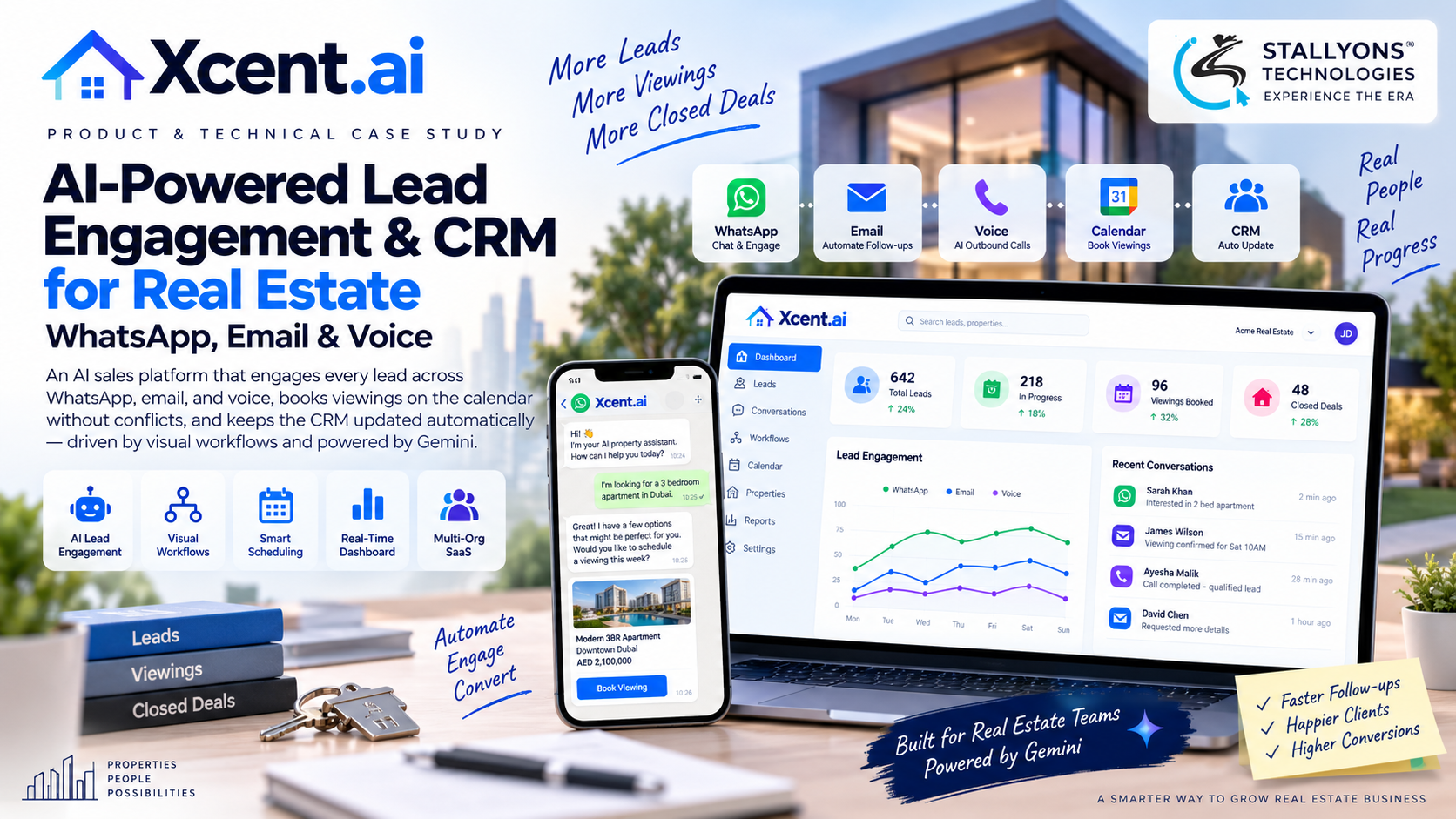
A real estate ad pulls in a lead at nine in the evening. By the time an agent sees it the next morning, that person has already messaged two other agencies. In most teams the lead is gone, not because nobody wanted it, but because nobody answered in time. The question this project set out to solve is blunt: what if every new lead got a personal reply within about a minute, on whatever channel they used, and then kept getting followed up until they booked, replied, or clearly went cold?
That is what Xcent.ai does. It is an AI-powered lead-engagement and CRM platform for real estate teams that works every lead across three channels, a WhatsApp chatbot, an email assistant, and an outbound voice assistant, following visual workflows the agency designs itself. The AI answers property questions from the team’s own knowledge base, books viewings on Google Calendar without double-booking, and updates the CRM as it goes. The moment a human agent replies, the AI steps back on that lead.
Put simply, a lead arrives, gets engaged across WhatsApp, email and voice on the agency’s own sequence, and ends up booked on the calendar and moved through the funnel without anyone doing it by hand. Behind the conversations sits Google’s Gemini, and the agency stays in control of the workflow, the knowledge base, the funnel stages, and who on the team owns each lead.
The Starting Point: Replacing Manual Follow-Up, Across Every Channel
Real estate runs on speed and persistence, and both slip first when a campaign produces more inquiries than agents can work by hand. For a platform to replace that follow-up, answering once is not enough; it has to carry the lead through days of touches on the right channel and keep the record honest. That set a clear list of requirements.
- Engage every lead fast. Meta, Google and TikTok campaigns produce leads faster than a person can reply, so each new lead had to be engaged within seconds of arriving, not the next morning.
- Follow up until the lead acts. Most leads need several touches over days or weeks. The platform had to keep following up on inactivity rather than dropping the lead after one message.
- Work all three channels as one sequence. Some leads reply on WhatsApp, some to email, some only answer a call. Those channels had to run from a single workflow, not three bots talking past each other.
- Keep the CRM true on its own. Status, scores and tags had to update as the conversation happened, so managers could trust the funnel without an agent maintaining it by hand.
- Book without double-booking. Offering a viewing slot is worthless if it is already taken, so any time offered had to be checked against the live calendar first.
- Give every agent the same process. Instead of each agent following up differently, the whole team had to run one consistent, measurable sequence.
The Build: One Workflow, Three Channels, Handled End to End
A manager sets the platform up once and it runs at scale. A visual workflow builder wires conditional sequences across WhatsApp, email and voice, and the Gemini-powered assistant handles the conversations inside them. Making those replies sound human, stay grounded in the agency’s own property data, and turn into a booked, logged appointment is the substance of the Google Gemini app development behind the platform. A lead runs through a set path:
- The lead is imported from Meta, Google, TikTok or a CSV, and the workflow engages it within seconds.
- The first step fires on the agency’s sequence, for example a WhatsApp message on day zero.
- Gemini answers the lead’s property questions from the organisation’s knowledge base, holds context across the conversation, and detects sentiment to flag hot leads.
- If there is no appointment within two days, the sequence sends an email follow-up.
- If there is still nothing, it places an outbound AI voice call.
- When the lead is ready to view, the assistant checks Google Calendar for conflicts, books the viewing, and confirms it.
- Throughout, the CRM moves the lead through New, Contacted, Interested and Closed, scoring and tagging it, and the AI hands off the instant a human agent replies.
The sequence also copes with the messy parts of follow-up. A “text me next week” becomes a scheduled reminder rather than a lost thread. Bulk WhatsApp messages go out on intervals, AI voice calls disclose that they are automated, and every sequence honours replies and opt-outs, so the team gets reach and persistence without tripping spam flags or breaking platform rules. Leads also sync out to Google Sheets for external tracking, and a real-time dashboard shows every active chat, call and email as it happens.
Technical Architecture
Xcent.ai is a multi-organisation SaaS that runs AI conversations across three channels on top of a shared CRM. The hard part is not any single bot; it is orchestrating WhatsApp, email and voice from one workflow engine, grounding the AI in each agency’s property data, and keeping the CRM and calendar in sync. Each layer does one job.
- Channels. A WhatsApp Business API layer handles 24/7 chat with interval-based sending, an email assistant sends behaviour-triggered follow-ups, and a voice assistant places outbound AI calls with speech-to-text and text-to-speech behind it.
- Application backend. A Laravel (PHP) backend holds the multi-organisation CRM, the workflow engine, channel orchestration, and role-based access. Wiring those sequences to run per lead and fire the right step at the right time is the heart of the AI automation in this build.
- AI layer. Gemini generates the human, on-brand replies, grounded in each organisation’s knowledge base of property data and FAQs, and detects sentiment to route hot leads.
- Data and queues. MySQL holds leads, organisations, workflows and conversation history, and Redis runs the sequenced follow-ups, scheduling and job queues.
- Integrations. Google Calendar and Sheets handle conflict-free booking and lead sync, Stripe handles subscriptions and billing, and Meta, Google and TikTok feed leads in through their capture APIs.
- Interfaces and access. A web dashboard, the visual workflow builder, and an admin panel sit in front, with Super Admin, Admin, Manager, Sales Agent and AI Agent roles, and every organisation’s data isolated behind its own subdomain.
The part worth engineering carefully was the join between the workflow engine and the live channels and calendar, because that is where a sequence contradicts itself or an appointment gets double-booked. Running one coordinated timeline per lead, checking real availability before any slot is offered, and stopping the automation the moment a person steps in is what makes the platform safe to point at a live sales pipeline.
Challenges Solved
The hardest problems were the ones that break a naive set of bots. Three disconnected channels were solved with a single workflow engine driving all three on one shared lead timeline, branching on replies, bookings and inactivity. Generic, sometimes wrong answers were solved by grounding Gemini in each agency’s own knowledge base, so replies are accurate for that agency and sound like their team. Double-booking was solved by checking Google Calendar for conflicts before any slot is offered or confirmed. Automation talking over a human was solved by handing control to the agent the instant they reply. And reach that risks a ban was solved by sending on intervals, disclosing automated calls, and honouring replies and opt-outs.
The through-line was building one coordinated process rather than a pile of separate tools, which is exactly what real estate teams need when every unanswered lead is a viewing that goes to a faster agency.
The Result
The outcome is a platform that engages every lead across WhatsApp, email and voice on the agency’s own workflow, answers property questions from the team’s knowledge base, books viewings without double-booking, and keeps the CRM current on its own. The design target is a first personalised AI reply within a minute of a lead arriving, on the right channel; the follow-up continues on inactivity until the lead books, replies or goes cold; and the moment an agent joins a conversation, the AI steps aside. Work that used to be dropped between busy agents is carried by the sequence, day and night.
The build works because it was designed around one coordinated workflow, grounded answers and a real calendar check, rather than a stack of bots working past each other. If you are planning a lead-engagement platform like this, you can hire agentic AI developers who have built this multi-channel workflow-and-CRM engine, or tell us about your sales process and we will map your channels, calendar and funnel to a system that follows up for you.
Frequently Asked Questions
What does the Xcent.ai platform do?
It is an AI lead-engagement and CRM platform for real estate teams. It works every lead across WhatsApp, email and voice on a workflow the agency designs, answers property questions from the team’s knowledge base, books viewings on Google Calendar without double-booking, and moves leads through the funnel while scoring and tagging them automatically.
How does Xcent.ai avoid double-booking viewings?
Before it offers or confirms any time, the assistant checks Google Calendar for conflicts. It only ever offers slots that are genuinely open, so every appointment it books is a free slot rather than a clash an agent has to untangle later.
What keeps the AI’s answers accurate and on-brand?
Gemini is grounded in each organisation’s own knowledge base of property data and FAQs. Because it answers from that agency’s information rather than from a generic template, replies are accurate for that team and sound like their own staff, and it holds context across the whole conversation.
What happens when a human agent takes over a lead?
The platform is human-first. The moment a human agent replies on a conversation, the AI stops on that lead and hands control to the person, so automation carries the busywork and people close the deal. Leads are never stuck talking to a machine that will not let go.
What technology runs behind the platform?
A Laravel (PHP) backend holds the multi-organisation CRM, workflow engine and role-based access; Gemini powers the conversations; speech-to-text and text-to-speech drive the voice calls; and the WhatsApp Business API handles chat. MySQL and Redis store data and run the queued follow-ups, while Google Calendar and Sheets, Stripe, and the Meta, Google and TikTok APIs handle booking, billing and lead capture.