


Blog
Consulting Site Rebrand
on HubSpot CMS
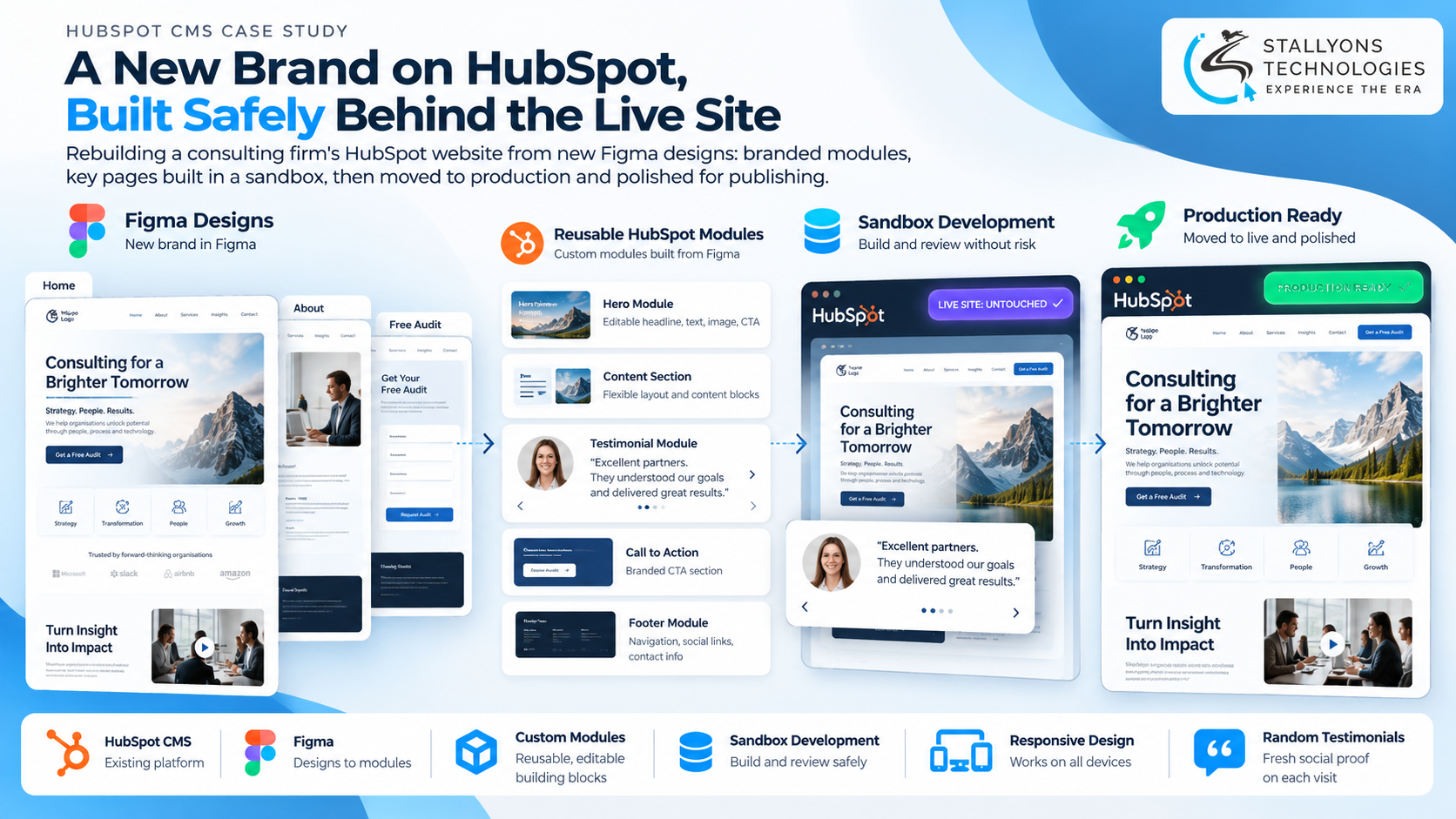
A US consulting firm had just finished a rebrand. The new look existed as Figma designs, but the firm’s website, already live on HubSpot CMS and sending prospects to a free audit offer, still wore the old brand. The pages could not go dark for a redesign, and they could not show half-finished work to a visitor mid-rebuild. The new brand had to appear on the live site in one clean switch.
Consulting Site Rebrand is how we handled that. We turned the Figma designs into custom, editable HubSpot modules, built the firm’s key pages from them in a HubSpot sandbox where the live site could not be touched, then moved the finished pages to the production account and polished them for publishing. The marketing team ended up with a rebranded site and a kit of branded blocks it could reuse to build new landing pages on its own. The pages reached production in August 2024 with no downtime, and the client left a review thanking us for being diligent and making it polished.
Put simply, the new brand was built quietly behind the live site, then switched on in one move, and the team can now change and extend pages without calling a developer.
The Starting Point: A New Brand on a Site That Cannot Go Offline
The firm needed its core pages rebuilt to match the new brand quickly, and it wanted to stay in control afterwards. That shaped a short, firm list of requirements.
- New brand, live site. The current site could not go offline or show unfinished work while the rebuild happened.
- Figma into HubSpot. The designs had to become real, editable HubSpot modules, not a flat copy of the screens.
- Every device. Each page had to read and work on mobile, tablet, and desktop.
- Self-service afterwards. The marketing team needed to edit content and build new landing pages from the same branded blocks without a developer for every change.
- A safe path to production. The new pages had to be built and reviewed somewhere the live account would not be affected, then moved across cleanly.
The Build: Figma to Branded Modules, Sandbox to Production
The firm’s site already ran on HubSpot, so this was a rebuild in place rather than a migration, the kind of work our HubSpot CMS development team does inside the client’s own account. The job moved in a deliberate order:
- We turned the Figma designs into custom HubSpot modules: branded hero banners, content sections, testimonial blocks, calls to action, and footer elements, each with editable fields.
- In the client’s HubSpot sandbox, we built the Home page, the About page, and both variations of the free audit landing page, all responsive.
- We added the second Home version and the blog listing page, so the team could compare layouts and keep a home for future articles.
- We applied the marketing team’s feedback over two rounds, with larger changes agreed and quoted as a separate round of enhancements.
- Those enhancements included testimonials that change at random on each page load, so returning visitors see fresh social proof.
- We moved the pages to the production account and polished them there, fixing headers, footers, sections, and mobile layouts, then applied the final feedback so the team could publish.
The first three pages were ready for review within about a week, and the client’s early note back was that the pages looked really good. Everything was assembled from the same branded blocks, which is what lets the team build a new landing page later without starting from scratch, and building the Home and audit pages in two versions each gave the firm something concrete to compare rather than a single take to accept or reject. Carrying the Figma brand across every module accurately is a piece of UI and UX design as much as a build, because a hero or a testimonial block has to match the designs across every screen size, not just the one it was drawn for.
Technical Architecture
The deliverable is a set of branded HubSpot pages assembled from reusable modules, built in a sandbox and migrated to production. The hard part was not drawing the pages. It was turning one source of design truth into blocks the team could reuse and edit, keeping the live site untouched during the work, and repairing what a cross-account move broke. Each part has one job.
- Platform. HubSpot CMS, the firm’s existing site and CRM, so the rebrand lands where the audience and the audit offer already are.
- Building blocks. Custom HubSpot modules, branded, reusable, and editable, so new pages reuse the same parts.
- Design source. Figma as one source of truth for the brand, translated field by field into the modules.
- Environment. A HubSpot sandbox for building and review, which keeps the live account out of harm’s way.
- Layout. Responsive sections that hold up on mobile, tablet, and desktop.
- Dynamic content. Randomised testimonials that show fresh social proof on each visit.
The part that took the most care was the move from sandbox to production. HubSpot does not copy pages between accounts, so the step that should have been simple was the one that could undo the whole build if it was rushed.
Challenges Solved
The biggest problem was that HubSpot does not move pages between accounts. The client’s migration tool brought the pages across, but it broke headers, footers, sections, and mobile layouts in the process. We repaired every page directly in production and kept the sandbox copies as a reference to check each one against, so the live pages matched what had been approved. Building in the sandbox in the first place is what kept the live site, and its audit offer, running the whole time.
Two smaller problems shaped the work as well. A static CMS does not rotate testimonials on its own, so we built them to change at random on each page load, which gives returning visitors fresh social proof without the team touching anything. Scope also grew during review, as it tends to, so small fixes were folded into the job while larger changes were quoted and agreed as a separate round, which kept the project moving and the budget clear. That split mattered because the feedback came over two rounds, with an extra round of enhancements on top, and an open-ended rebuild can drift if every new idea is treated as part of the original quote.
The Result
The firm got its full core site rebranded, six pages counting the variations, with the new brand live and no downtime for the site or its audit offer. The marketing team can now edit content itself and build new landing pages from the branded blocks, so a fresh campaign page no longer waits on a developer. The pages reached production in August 2024, every milestone was paid, and the client left a review calling the work diligent and polished.
If your brand has changed and your site cannot go offline for the switch, you can hire CMS developers who build in a sandbox and migrate cleanly, or tell us what your rebrand needs to look like live and we will turn your designs into reusable branded modules. It fits any B2B services firm that runs lead generation from its own site.
Frequently Asked Questions
What was the Consulting Site Rebrand project?
It was a rebuild of a US consulting firm’s HubSpot CMS website to match a new brand. We turned the firm’s Figma designs into custom, editable HubSpot modules, built the key pages in a sandbox, then moved them to production and polished them for the team to publish.
How did you rebrand the site without downtime?
The new pages were built and reviewed in a HubSpot sandbox, so the live site stayed untouched and kept running its free audit offer. Only when the pages were approved were they moved to the production account and switched on, which is what kept downtime at none.
Can the marketing team build new pages on its own?
Yes. Every page is assembled from branded, reusable HubSpot modules with editable fields. The team changes content and builds new landing pages from the same blocks in the HubSpot editor, without calling a developer for each change.
What broke during the move to production?
HubSpot does not copy pages between accounts, so the migration tool brought the pages across with broken headers, footers, sections, and mobile layouts. We repaired every page in production and checked each against the sandbox copies, so the live pages matched what had been approved.
How do the testimonials stay fresh on a static site?
A static CMS does not rotate content on its own, so the testimonials were built to change at random on each page load. A returning visitor sees different social proof each time, without the team having to update the page by hand.