


Blog
SawaTalk Case Study:
Building a Flutter Real-Time Voice Translation App for African Languages
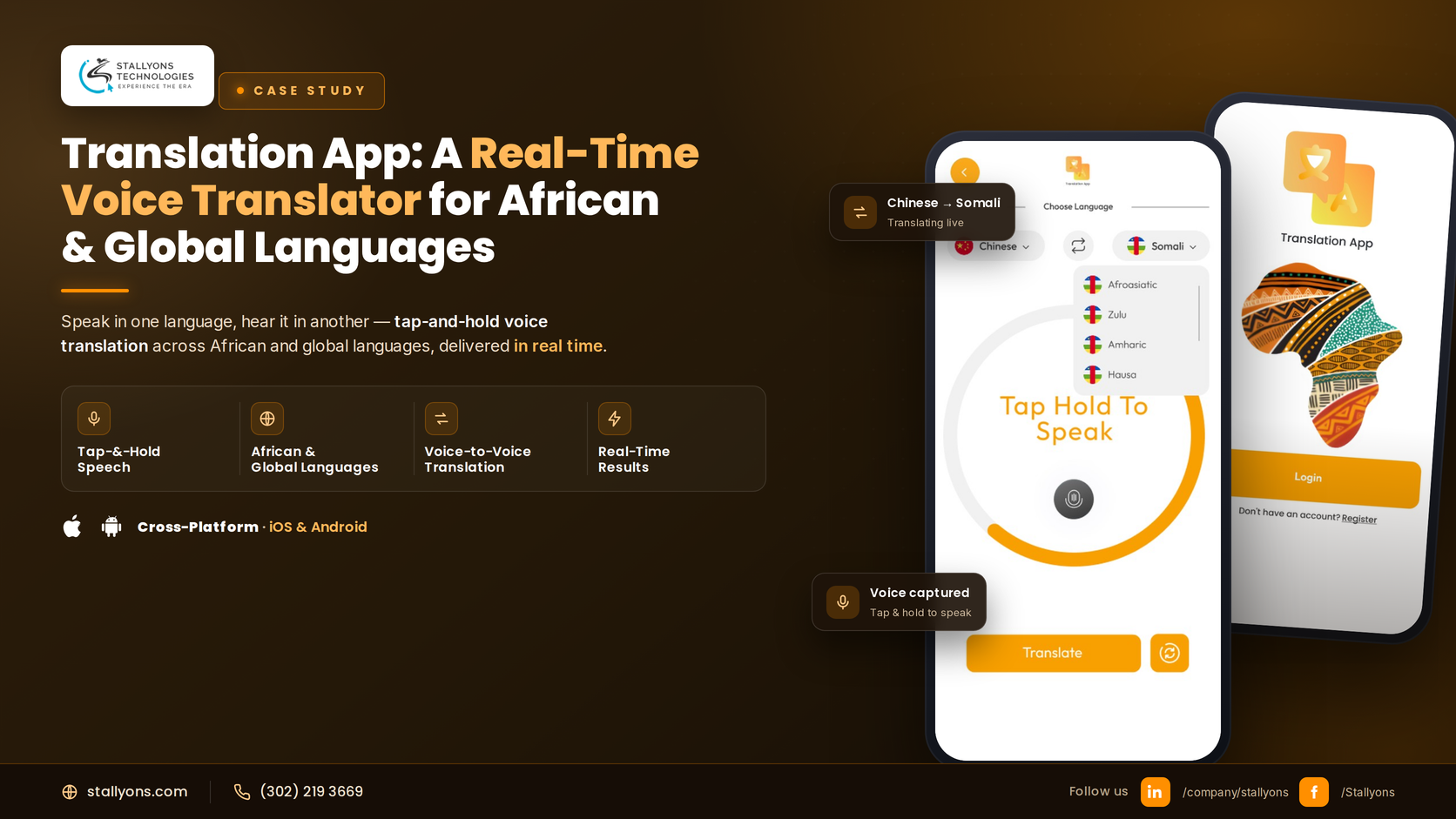
Africa is home to many languages, and people constantly need to talk across them. A trader, a nurse, a teacher, or a traveler may meet someone whose language they do not speak, yet most translation tools leave those languages out. SawaTalk fixes that. Two people each speak their own language, and the app says the translation out loud, in real time, across eight African languages. The promise is simple: pick two languages and just speak, and the app does the rest.
This case study covers the problem, the build, and two things that make it a strong proof point: a real-time voice translation experience, and a clean split of work delivered alongside the client’s own backend team. SawaTalk is a focused product, so simplicity, voice quality, and clean integration are treated here as the whole point.
The Problem: Africa’s Languages Are Left Out of Translation Tools
People across the continent often need to speak across a language barrier, and the usual translation tools do not serve them well. SawaTalk was created to close a clear set of gaps.
- Many African languages are left out. Popular apps focus on a few world languages, so speakers of languages like Chichewa, Hausa, or Xhosa find little or no support.
- Typing is slow and gets in the way. In a real conversation, typing is too slow, and people want to just speak and be understood.
- Most apps are too busy. Crowded screens and long menus confuse users who simply want to talk.
- Switching between two speakers is clumsy. Real talk goes back and forth, and many apps are not built for two people trading turns in two languages during one session.
- Signing up is often a barrier. Long forms and email checks slow people down, when a phone number is the simplest way to identify someone in many markets.
The problem was never translation technology in general. It was building it around the languages, the voices, and the simplicity that these users actually need.
The Solution: Pick Two Languages, Then Speak
SawaTalk keeps the whole experience down to one idea. A user signs up and logs in with their phone number and a password, with no long form and no email step. They land on the Translation screen, choose an input and an output language, and start talking. The app listens, translates with the Google Cloud Translation API, and says the result out loud in the other language. The other person answers, and the app translates back the same way, so the two keep trading turns for as long as they like. When the conversation is finished, the user closes the session and can start a fresh one with two new languages.
| Step | What happens |
|---|---|
| 1 | The user logs in with their phone number and password |
| 2 | On the Translation screen, they pick an input and an output language |
| 3 | Output defaults to English until they choose another language |
| 4 | The user speaks, and the app translates and says it out loud in the other language |
| 5 | The other person replies, and the app translates back the same way |
| 6 | The two keep trading turns until the conversation is done |
| 7 | The user closes the session, then can start a new one with two new languages |
| 8 | Session data is sent to the client’s backend for statistics |
Voice First, Not Typing
Real conversation is spoken, so the app is built for speaking and listening rather than typing and reading. A user talks, and the app talks back in the other language, which keeps the conversation moving at a natural pace. That focus is reinforced by a deliberately minimal design of just four screens, Login, Signup, Privacy Policy, and Translation, so the app is easy to learn even for someone who is not comfortable with technology. Phone-number login rounds it out, because in many African markets a phone number is the simplest and most common way to identify someone. This is the promise kept in practice: the user was told they could just pick two languages and speak, and the whole design protects exactly that.
What Makes SawaTalk Defensible
Four choices make SawaTalk a strong fit for its users. It puts African languages first, covering eight of them in the first version where bigger apps treat them as an afterthought. It is voice-first, so people speak and listen instead of typing. It is stripped down to four screens, with everything that does not help two people talk left out. And it uses phone-number login that fits the market, so getting started is quick. Each choice serves the same user and leaves room to add more languages later.
How the Work Was Split: Delivering Cleanly Alongside the Client’s Backend Team
SawaTalk is a good example of Stallyons delivering one part of a larger system flawlessly while another team owns the rest. The split of work was clear and agreed up front. Our team built the native app and the translation experience, and the client built and ran the backend APIs on Oracle. The app was designed to call the client’s APIs for login and statistics, with clean points to plug in new APIs as the client provided them, so both teams kept moving without stepping on each other.
| Owned by our team (the app) | Owned by the client (the backend) |
|---|---|
| Flutter app for iOS and Android | Phone-number authentication API |
| The four screens and the session flow | Oracle backend and database |
| Voice capture and speaking the result | Statistics tracking API |
| Google Cloud Translation integration | Storage of users and session records |
| Sending session data to the backend | Any other APIs the app needs |
For a company that already has a backend team and simply needs a great app partner, this is the model that matters. A capable app partner should own its scope, integrate cleanly with your systems, and ask for what it needs without friction, which is exactly what teams look for when they hire Flutter developers to work next to their own engineers.
The Technical Architecture Behind SawaTalk
SawaTalk is a Flutter app for iOS and Android. The app handles the experience, the voice, and the translation, while the client’s backend team handles authentication and statistics through APIs they provide.
The stack stays deliberately small. The app itself is built in Flutter, so a single codebase covers both phones with a smooth, simple design and faster delivery, the kind of cross-platform app development that suits a focused product like this. Translation runs on the Google Cloud Translation API, which already supports the eight target languages, and a speech-to-text and text-to-speech layer lets the user speak and hear the result instead of typing and reading. Authentication and statistics both sit on the client’s side: a phone-auth API and a statistics API, each running on the client-managed Oracle backend that owns all data storage. The app calls those APIs; the client runs the server.
A few subsystems carry the product. The translation pipeline captures speech, turns it into text, sends it to the Google Cloud Translation API, then speaks the translated text out loud in the other language, and getting that speech and translation AI integration to feel instant is the real craft here. Two-way session handling holds the two chosen languages and lets the speakers trade turns, with the option to end a session and start a new one at any time. Session data capture records the phone number, date, start and end times, and the two languages in the background, then sends them to the client’s backend. Client API integration keeps the calls for login and statistics clean, so new APIs slot in as the client provides them.
It is worth being honest about where the ceiling sits. Because the translation itself runs on Google Cloud Translation, the app is only as strong as that model is for each language, and the eight African languages SawaTalk leads with are exactly the ones large tools have historically supported least well. That is why the language set and real-world testing matter as much as the code: the engineering makes the conversation feel instant, but the quality of any given translation depends on the model underneath it.
The Result
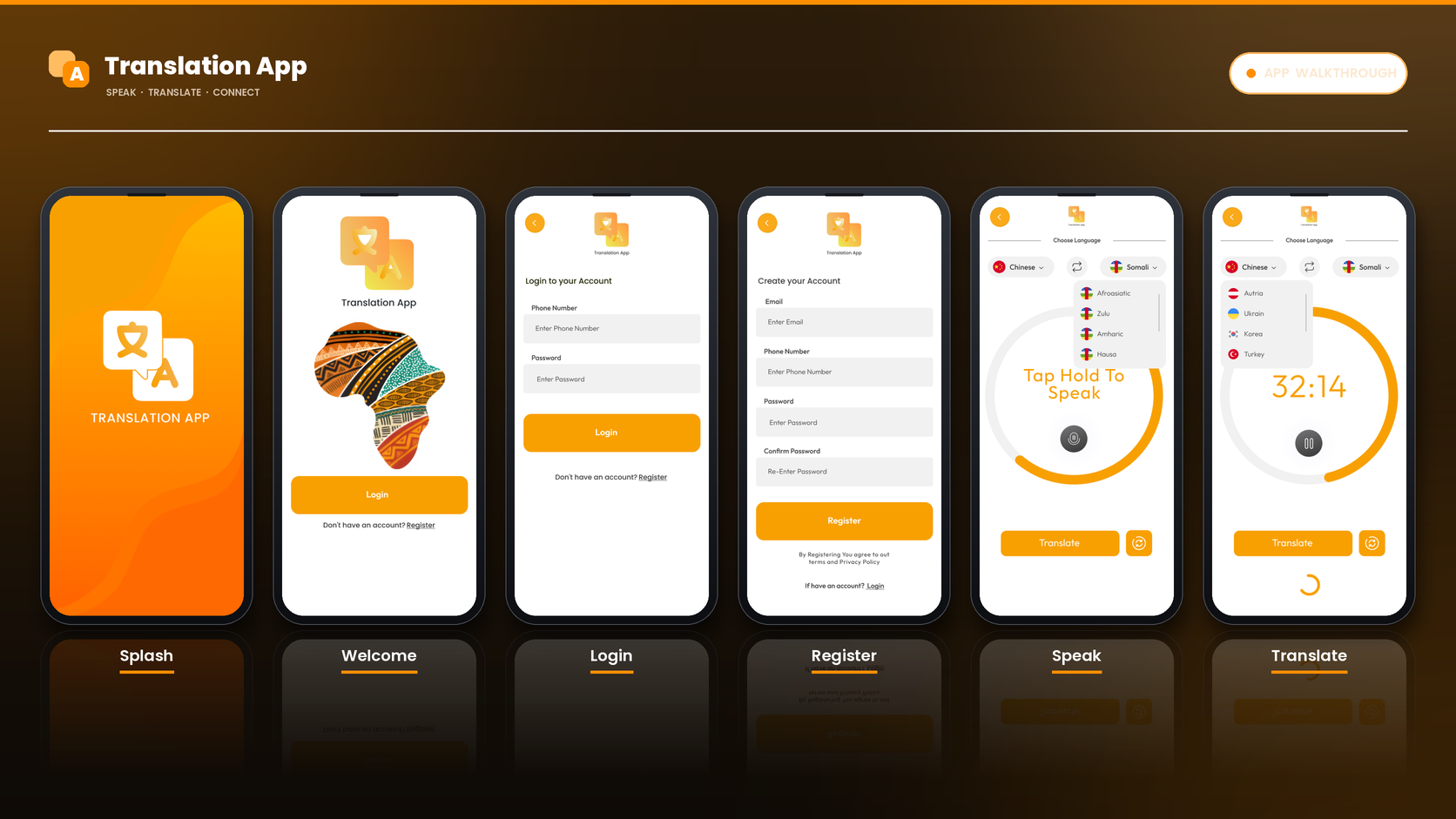
The finished product is a working two-way voice translation app, built in Flutter for both iOS and Android. A user logs in with their phone number, picks two languages, and has a spoken conversation that the app translates out loud in real time, then closes the session and starts again with two new languages whenever they like. The first version delivers all eight target African languages through the Google Cloud Translation API inside a clean four-screen design, and it captures each session’s data for the client’s Oracle backend, which gives the client the usage statistics they wanted. The split of work stayed clear from start to finish, with our team delivering the app, the voice, and the translation, and the client delivering the backend.
What This Means When You Want to Hire a Flutter Team
SawaTalk shows two things a strong Flutter partner brings. First, the skill to build a real-time voice product, with speech capture, live translation, and spoken output that keeps up with a natural conversation. Second, the discipline to own a clear scope and integrate cleanly with a client’s existing backend team, delivering exactly what was agreed without friction. Both are harder than they look, and both are what you should look for when choosing a partner.
If you are planning a voice, AI, or real-time product, or you need an app team that can slot in beside your own engineers, one of the more capable Flutter app development teams to consider is Stallyons. You can see the range across our Flutter work, from a real-time translation app like SawaTalk to our ALLMarket vehicle marketplace and our InsuraNest insurance platform, each built end to end on Flutter.
Frequently Asked Questions
Can Flutter handle real-time voice translation?
Yes. SawaTalk captures speech, translates it through the Google Cloud Translation API, and speaks the result out loud in the other language, all in real time inside a Flutter app.
Can you build the app while our own team runs the backend?
Yes. On SawaTalk, our team built the Flutter app and the translation experience while the client ran the Oracle backend, with the app calling the client’s APIs for login and statistics. Clean ownership was agreed up front.
Can Flutter integrate Google Cloud Translation and text-to-speech?
It can. SawaTalk combines speech-to-text, the Google Cloud Translation API, and text-to-speech in one Flutter app to power a spoken, two-way conversation.
How many languages can an app like SawaTalk support?
The first version supports eight African languages, and because it uses the Google Cloud Translation API, more languages can be added as the project grows without rebuilding the app.
Can Stallyons build a voice or AI-powered app for us?
Yes. Stallyons delivers full Flutter app development, including voice capture, real-time translation, and clean integration with your existing backend or a new one we build for you.
Start Your Flutter App With Stallyons
SawaTalk proves a simple point. When you build around one clear idea, keep the design out of the way, and integrate cleanly with the rest of the system, you get a product that just works for the people who use it. If you are planning a voice, AI, or real-time app, or you need a partner who can deliver a precise scope beside your own team, our custom Flutter app development can turn the idea into a fast, dependable app on both iOS and Android. The best place to start is a conversation, so book a discovery call and let us build your part flawlessly.