


Blog
Keyboard-First Bookkeeping Web
App: Laravel
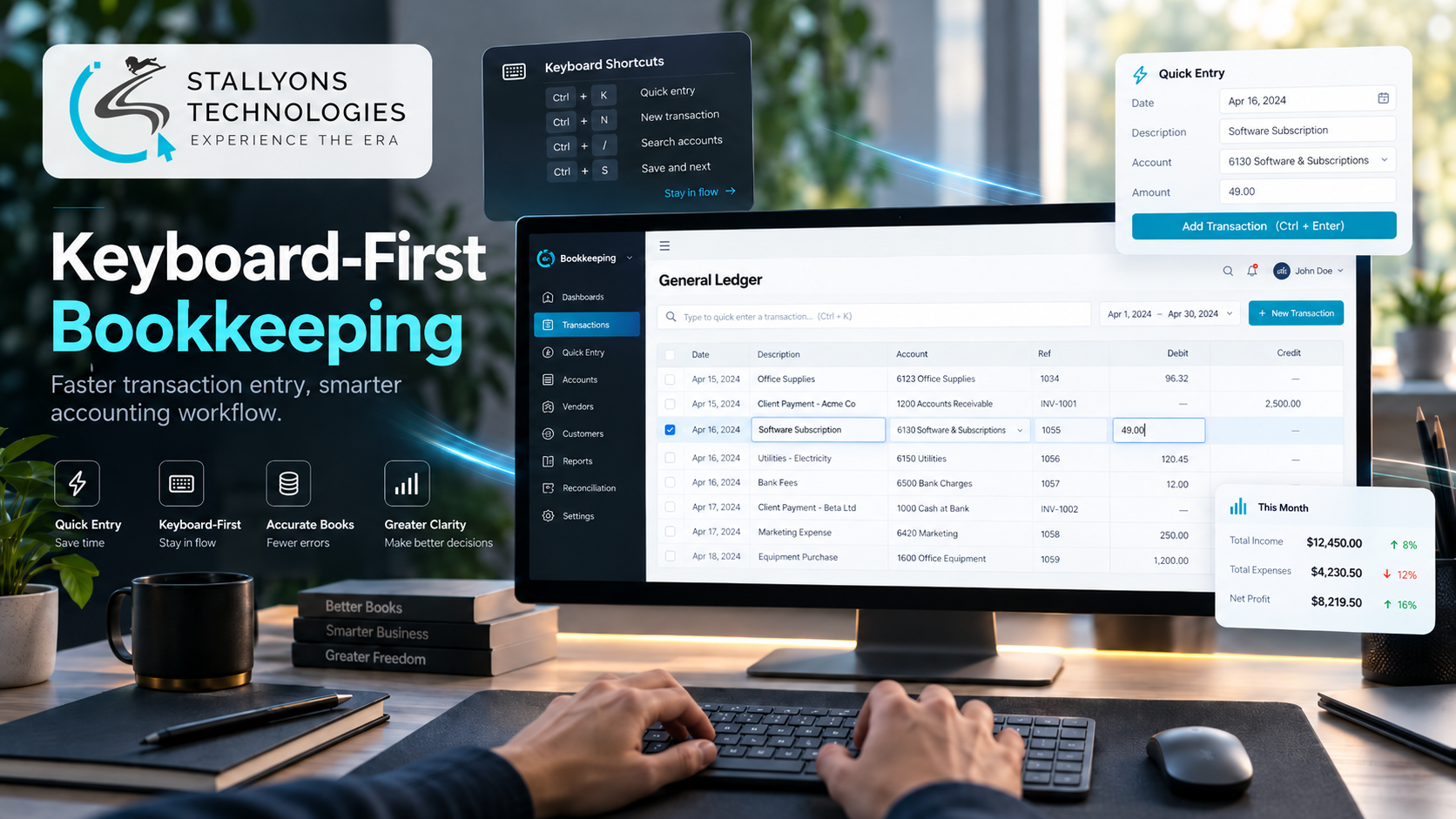
A bookkeeper opens his laptop, pulls up a client’s set of books, and starts typing. Line after line of journal entries, hundreds on a single page, each one a debit and a credit that has to balance. Reach for the mouse on every field and the afternoon disappears. The work is not difficult so much as relentless, and the general-purpose database he had made him click far more than he typed.
Our client is a bookkeeper in the Netherlands who keeps his financial records in a double-entry structure he designed himself in MySQL. The volume is the whole problem: many journal lines per page, many pages per database, and a fresh database for each new set of books through the year. At that scale a saved keystroke is the difference between a manageable day and a long one, so he asked us for a focused web app that does one job, fast and correct data entry on top of his own schema.
Put simply, he types a line, presses Enter, and lands on the next one, and the books stay in balance the whole way down the page. No mouse, no SQL, no entry that quietly breaks a rule he set for himself.
The Starting Point: Fast Entry on an Existing Set of Books
A data-entry tool only earns its place if it is quicker than the thing it replaces and never lets a wrong entry through. For a bookkeeper working at this volume, that set a short but strict list of requirements, and each one had to hold up across many separate databases that all share the same rules.
- Keyboard before mouse. The whole flow, field to field and line to line, had to run from the keyboard so he never has to stop typing to point and click.
- Books that always balance. Entries had to respect double-entry, and where several lines belong together they have to add up to zero before anything is saved.
- His own schema, untouched. The tool had to sit on top of the carefully designed MySQL database he already uses, with every relation kept exactly as he built it.
- Many databases, one tool. He opens a new database for each client’s books, so picking, creating, copying or deleting one had to be as easy as opening a file.
- Entry in his own formats. Amounts had to read in Dutch format, such as 9.000,00, with negative values accepted and VAT handled the way his accounting expects.
- Rules that match his accounting. A document number and its contact always fill in together, page numbers stay unique within each journal, and VAT codes live inside their categories.
The Build: Type, Enter, Next Line
A single journal page can hold a few hundred lines, so the entry screen is a scrollable, spreadsheet-like table rather than a stack of paged forms, which keeps the lines he is working on in view. Designing an interface this fast, where correctness is checked as he types rather than after he saves, is the kind of focused tool a web app development company is built to put on top of a client’s existing database. Entering a line runs in a set order:
- He opens the database manager and picks, creates or copies the database he needs, without ever seeing a line of SQL.
- Inside it he opens a journal and a page, the two containers every journal item belongs to.
- He types an account, found by its number or by its description, then the amount in Dutch format, with negative values accepted.
- A default VAT code fills in automatically, and he can overwrite the VAT amount on the line when a case calls for it.
- Pressing Enter moves him through the fields and, on the last line, starts a fresh one, while he can still step back to correct an earlier line at any point.
- In the memo view, where several lines must balance to zero, he saves them together with a Save button, and the total is checked before the save goes through.
Behind the screens, validation follows his rules rather than a generic template: a document number such as a supplier’s invoice number is always paired with its contact, page numbers are unique inside each journal, and optional details like a VAT number or bank account are never forced on a new contact. Building the entry surface and that rule set as proper web application development, instead of bending a spreadsheet to the task, is what lets him work at speed without the books drifting out of balance.
Technical Architecture
The app is a password-protected Laravel application with a Tailwind interface, running on the client’s own self-hosted Linux and Apache setup, sitting directly on top of the MySQL schema he designed. The hard part was never the storage. It was making entry feel instant from the keyboard while checking every rule as the data goes in, across many databases with the same structure. Each layer has one job.
- Entry front end. HTML, Tailwind CSS and JavaScript render the keyboard-driven tables and forms where journals, pages and journal items are typed in.
- Laravel application. The PHP back end handles database switching, the validation rules, and the Dutch number formatting the client works in.
- Database manager. A screen for picking, creating, copying and deleting databases, so he manages a year’s worth of client books without touching SQL.
- The client’s MySQL schema. His own double-entry design, with every relation and constraint kept exactly as he built it, holds journals, contacts, accounts and VAT.
- Validation layer. Paired document number and contact, the zero-sum check on memo entries, unique page numbers per journal, and VAT codes kept inside their categories.
- Hosting and access. Self-hosted Linux and Apache under his control, with password protection for a single operator, so the tool is simple and secure for one person.
The part worth engineering with real care is the Enter-driven flow. Pressing Enter has to carry him forward through every field and open a new line at the bottom, yet still let him walk back and fix a mistake without losing his place, and the balance check on save has to catch an unbalanced memo entry before it reaches the schema. We reworked that behaviour from his feedback on how he actually types.
Challenges Solved
The first tension was live saving against balanced totals. The original spec asked for live updates, but a memo entry only balances once several lines are in, so a running save would reject half-finished work on every keystroke. We agreed a Save button for that view, with the zero check run first, which keeps the books correct without fighting the way he enters them. The second was endless entry: the last line had to spawn the next automatically while the user could still move backward, a small behaviour that took a round of refinement to get right.
The third challenge was fitting an existing schema rather than imposing one. Rules such as per-journal page numbers and the paired document number and contact came straight from his design, and they are respected in every screen rather than worked around. Because we designed the screens in Figma and agreed them before building, and because no SQL is ever shown to the user, the finished app reads as his own system made faster, not a new one he has to learn.
The Result
What he has now is mouse-free entry where the books stay in balance, running on his own server, across every database he opens through the year. He owns the codebase outright rather than renting a plug-in, the screens match the formats and rules he already uses, and the pace of entry is set by how fast he can type. After the core build he asked us about a follow-up module for reporting on the same data, which is usually a good sign the first job landed.
If you run a data-heavy operation and want a tool shaped around how your team actually works, you can hire Laravel developers who have built this kind of keyboard-first entry surface, or tell us how you keep your books and our US-registered web development company will map your rules and formats into a focused app. It suits any finance and accounting business that lives in structured records all day.
Frequently Asked Questions
What is the Keyboard-First Bookkeeping Entry app?
It is a custom web app, built in Laravel with a Tailwind interface, that lets a bookkeeper enter double-entry financial records at speed from the keyboard. It runs on top of the client’s own MySQL schema and checks every entry against his accounting rules as he types.
How does keyboard-only entry actually work?
Journal items are typed into a scrollable, spreadsheet-like table. Pressing Enter moves through the fields and starts a new line at the bottom, while the user can still step back to fix an earlier line. Accounts are found by number or description and default VAT codes fill in automatically, so the hands rarely leave the keyboard.
How does it keep the books in balance?
Entries follow double-entry rules, and in the memo view, where several lines must add up to zero, they are saved together with a Save button that checks the total first. Paired document numbers and contacts, unique page numbers per journal and VAT codes kept inside their categories all stop a broken entry from being saved.
Did you change the client’s existing database?
No. The app was built on top of the MySQL schema he designed himself, with every relation kept exactly as it was. A database manager lets him pick, create, copy or delete a database for each client’s books without ever seeing or writing any SQL.
Can a tool like this be built for another business?
Yes. The same approach, a focused Laravel web app shaped around your own data structure and entry rules, suits any team entering large volumes of structured records. We design the screens, agree them with you, then build the entry flow and validation around how your people actually work.