


Blog
Reflyca Case Study:
Building an Ionic Referral Networking App Built to Scale
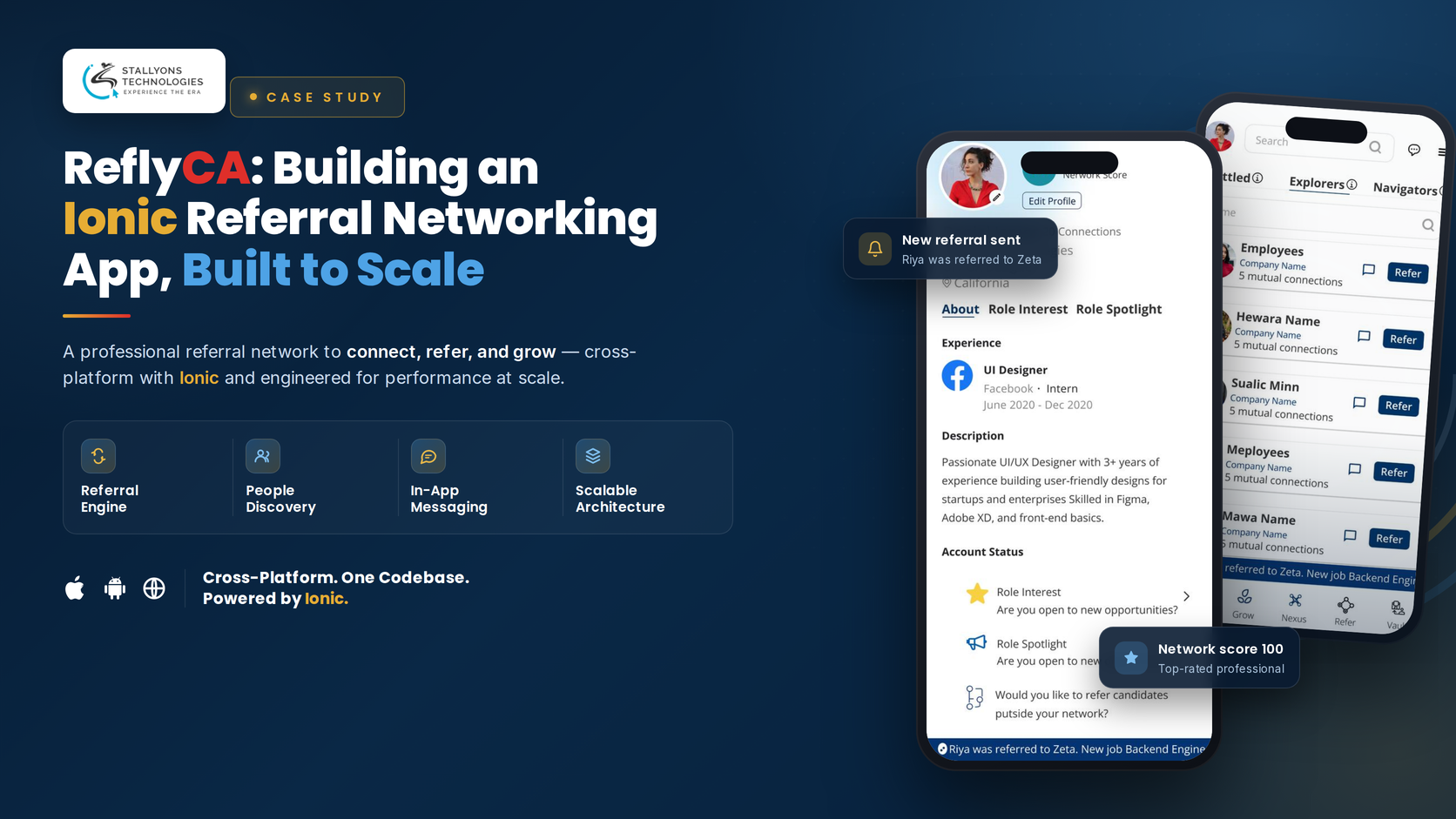
The best jobs rarely come from a job board. They come through people you already know. Reflyca turns that quiet truth into a product, a referral engine where a job seeker, a hiring manager, and a willing referrer can find each other in a few taps. It is built with Ionic for both iOS and Android, a single piece of mobile app development that ships to the whole market at once and stays fast as the network grows.
This case study covers the problem, the build, and the growth mechanics that make a referral network valuable. A referral app only works at scale, so scale, retention, and reach are treated here as first-class goals, not afterthoughts.
The Problem: Referrals Drive Hiring, but the Tools Do Not
Most people land their best roles through a referral, yet referrals are hard to ask for and easy to forget to give. The large networking platforms are crowded and noisy, and none of them is built around the simple act of one person referring another. Reflyca was created to close a clear set of gaps.
- Referrals are hidden and informal. There is no simple tool that surfaces who can refer you, and where.
- Job status is unclear. It is hard to know who in your network is open to a move and who is happy where they are, so people miss chances to help each other.
- Networks are full but underused. People hold hundreds of contacts yet rarely use them for hiring, because the tools make it hard to act.
- Asking for a referral is awkward. Reaching out cold feels uncomfortable, so people need a clean, low-pressure way to ask and to offer.
- Privacy gets in the way. Job seekers do not always want everyone to know they are looking, and without good controls they stay quiet and miss opportunities.
- The big platforms are noisy. News, ads, and posts bury the simple goal of getting a referral.
The Solution: Answer Three Questions, and the App Knows How to Help
Reflyca strips networking down to the part that gets people hired. A new user signs up with email or LinkedIn. With LinkedIn, the app pre-fills their name, company, role, experience, and skills, so setup is quick. Then comes the survey that drives everything: are they open to new opportunities, are they hiring or holding referrals to give, and will they refer people from outside their own network. Those three answers sort every user into a clear role and unlock the right tools.
| Question | The user becomes | What unlocks |
|---|---|---|
| Open to new opportunities? | An Explorer | A job application form and a choice of who can see their status |
| Hiring or have referrals to give? | A Navigator | A job vacancy form that others can find and view |
| Willing to refer outside your network? | A Referral Hub contact | Listed under their company for others to ask for a referral |
Once set up, the user lives in five simple tabs. Profile Hub holds their profile and settings. Grow helps them find people they may know and invite phone contacts. Nexus shows their connections sorted by status. Referral Hub lists companies where people are willing to refer. Vault tracks every referral received and sent. A global search finds people, open candidates, and jobs, and one-to-one chat connects them, with privacy controls over who can message whom.
Built Around the Referral, Not the Feed
Four choices make Reflyca more than another networking app. It is built around the referral rather than a content feed, so every screen exists to give or get one. It sorts people into Explorers, Navigators, and referrers, which makes referring a single tap. It reaches beyond a user’s own circle through the Referral Hub and shadow invitations. And it stays alive with a gentle live ticker instead of an endless feed. That focus is the moat.
Status With Privacy Control: The Feature That Makes the Engine Run
People want referrals but fear their employer seeing that they are looking. Reflyca solves this with one careful control. An Explorer can be visible to everyone, or only to selected connections. That single choice changes behavior, because it lets people signal that they are open without broadcasting it to their boss. More people share their status, and more shared status means more referrals can happen. The whole engine depends on it.
The honest tension in that control is that the same switch which unlocks supply can also throttle it. A cautious user who stays visible only to selected connections is invisible to the very strangers in the Referral Hub who might refer them, and the network only pays off once enough people are present and honest about their status. Early on, a user may open Reflyca to find few referrers under their target company and a quiet Hub, which is the cold start every network has to push through.
Retention by Design: The Live Ticker and Notifications
A referral network is only valuable if people come back, so Reflyca is built to pull users in gently and often. A thin, always-visible banner called Reflyca Live sits at the bottom of the screen, showing one update at a time with a calm scroll. Each update is tappable and leads straight to a profile or an action, such as a new job or a contact who just joined. It keeps the app feeling active without the clutter of a social feed.
Behind the ticker sits a full notification system covering connection requests, referrals, profile and CV views, new jobs, status changes, messages, and contacts joining. Together they create the repeat engagement that any growth-focused consumer product needs, and this kind of engagement layer is exactly where careful engineering earns its value, because the difficulty is delivering it reliably without turning the app into noise.
The Five Tabs
Reflyca runs on a five-tab bottom bar, each tab with a clear job. Profile Hub holds the full profile, survey answers, settings, and a connections counter. Grow surfaces people you may know and lets you invite phone contacts. Nexus sorts your connections into Settled, Explorers, and Navigators, each with the right actions. Referral Hub groups outside referrers by company, with options to view, ask for a referral, or message. Vault logs every referral received and sent, so both sides always have a record.
The Technical Architecture Behind Reflyca
Reflyca is built with Ionic for iOS and Android, backed by Laravel over an indexed relational database. The app handles the five-tab experience, while the backend handles profiles, connections, referrals, real-time chat, and push and in-app notifications. A LinkedIn API integration pre-fills a new user’s profile at signup, contact sync with WhatsApp invitations brings their phone contacts in, and CVs live in private cloud storage that only authorized users can open. The hard parts are matching people by status, keeping personal data private, and staying fast as the network grows, and every part of that stack serves those goals.
Four subsystems carry the product. The status and matching engine turns the three survey answers into roles and, with visibility settings, decides who appears where across Nexus, Referral Hub, and search. Privacy and CV handling keeps documents as private files visible only to authorized users. The referral flow sends an Explorer’s application to chosen contacts, lets a referrer forward the attached CV to a company email in one step, logs it in Vault for both sides, and notifies everyone involved. Shadow invitations let the app invite phone contacts on a user’s behalf. Delivering all of this on a single codebase is what separates real product work from a basic template build.
Built to Scale Past 100,000 Users
A referral network is only useful at scale, but scale is exactly what slows most apps down. Reflyca was engineered for growth from the start. The database is indexed, queries are tuned for a large user base, and heavy work is handled on the server rather than the device. The result is an app built to stay quick even as it grows past one hundred thousand users, which gives the network room to expand without a rebuild.
The Result
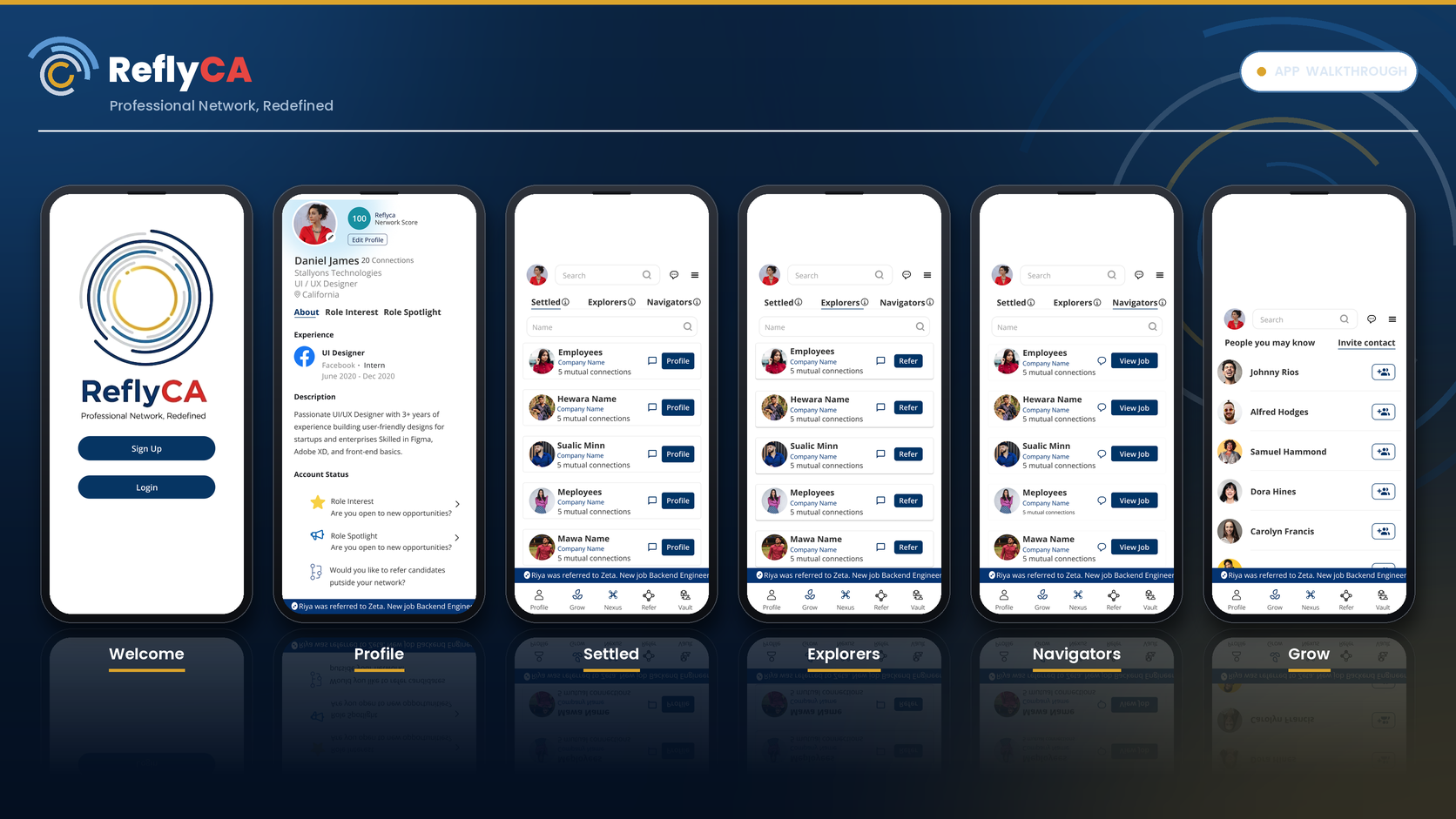
The finished product is a focused professional networking app on Ionic for iOS and Android, backed by Laravel. A user signs up, builds a profile, answers three questions, and is instantly sorted into a network that knows how to help them. From five clean tabs, they grow their network, see who is open or hiring, and give or ask for referrals in a few taps. It delivers the full engine: status with privacy control, a Referral Hub that reaches beyond a user’s own contacts, shadow invitations, global search, private CV handling, one-to-one chat, a live ticker, and a complete notification system, all ready to scale.
What This Means When You Want to Hire an Ionic Team
Reflyca shows the difference between a team that ships screens and a partner that understands network effects, privacy, and scale. A social or referral product lives or dies on retention and performance, so it rewards experience. When you evaluate a build partner for work like this, look for a team that designs the growth loop deliberately, treats privacy as a driver of usage rather than a chore, and engineers for scale before the user base demands it.
If you want a team that has shipped a real, scalable product and can wire in LinkedIn, chat, and contact sync, that track record is what mature Ionic app development brings. We work across Ionic products, from a network-heavy build like Reflyca to on-demand services like our SNKR sneaker-cleaning app, and the goal is always the same: a fast, cross-platform app that is ready to grow.
Frequently Asked Questions
Can Ionic handle a large-scale networking app with 100,000 or more users?
Yes. Reflyca is built on Ionic with an indexed database and tuned queries, with heavy work handled on the server, so it stays fast as the network grows past one hundred thousand users.
Is Ionic a good choice for cross-platform iOS and Android?
It is. Ionic lets you build and maintain one codebase for both platforms, so features ship together and the budget stretches further, which suits lean teams building for a wide audience.
Can Ionic integrate LinkedIn, real-time chat, push, and contact sync?
Yes. Reflyca uses the LinkedIn API for profile pre-fill, real-time one-to-one chat, push and in-app notifications, and contact sync with WhatsApp invitations, all behind an Ionic front end.
How long does an app like Reflyca take to build?
A focused first version usually takes a few months, depending on the feature set. A referral engine with matching, privacy controls, chat, and a notification system needs careful planning, but a single Ionic codebase keeps the timeline efficient.
Can Stallyons build a referral or networking app for us?
Yes. Stallyons delivers full Ionic app development, from product strategy and design to backend, integrations, real-time features, and launch, for networking, marketplace, and other scale-focused products.
Start Your Ionic App With Stallyons
Reflyca proves a simple point. When you build around one clear action, protect people’s privacy, and engineer for scale from day one, you get a network people come back to. If you are planning a social, referral, or marketplace product, our Ionic app engineering can turn the idea into a fast, cross-platform app that is ready to grow. Book a discovery call with the Stallyons team, and let us build a product your users will want to open every day.