


Blog
Pema Property: A
Multi-Currency CS-Cart Real Estate Portal
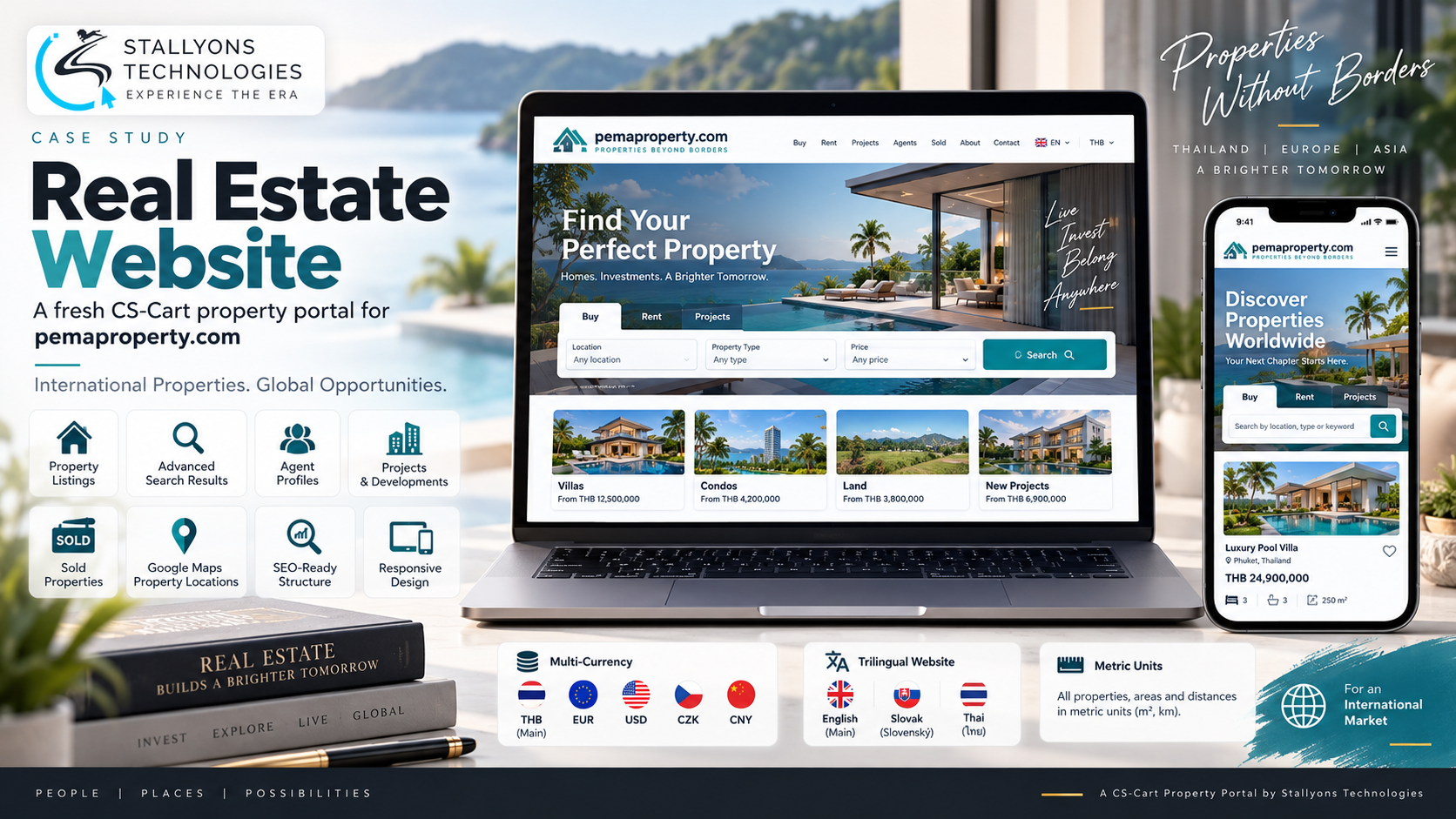
A buyer in Bangkok, an investor in Prague and a family in Munich all open the same property portal in the same hour. One wants to see the price in Thai Baht, one in Czech Koruna, one in Euro. One reads Thai, one Slovak, one English. All three want the size in square metres and the location on a map they trust. One site has to greet all of them correctly, in their own currency and their own language, without three separate builds.
That is the problem this project set out to solve. It is a fresh CS-Cart real estate portal for pemaproperty.com, built for an international property audience, with listings, agent profiles and projects, priced in Thai Baht with a switcher for Euro, US Dollar, Czech Koruna and Chinese Yuan, and served in three languages with metric units throughout.
Put simply, the old site is wiped and replaced with a clean CS-Cart install, the catalog is repurposed for property listings, the checkout is kept out of the way because the goal is enquiries not online sales, and localization sits at the centre of the whole build.
The Starting Point: One Portal, Many Markets
Selling property to buyers from several countries at once means getting currency, language, units and structure right on top of a clean, well-organized site. A generic template does not do that, and the brief was specific about what an international property audience needs. The hard parts were these.
- Buyers from many markets. Prices have to show in the buyer’s own currency, so the site needs Thai Baht as the primary currency plus a switcher for Euro, US Dollar, Czech Koruna and Chinese Yuan.
- Three languages, done properly. The audience spans English, Slovak and Thai speakers, so the site needs real multilingual support with English as the main language, not a single-language site with a translate button.
- Metric units throughout. Property sizes and distances need consistent metric units, kilometre, metre and kilogram, so listings read correctly for the target markets.
- A full agency structure. This is not just listings; it needs agent profiles and an agent list, projects and project detail pages, a sold-properties page and the usual company pages, all consistently laid out.
- A genuinely clean start. The existing site has to be removed completely and replaced with a fresh install, so no leftover data, placeholder content or unwanted statistics carry over.
- Found and mapped. The site has to be SEO-configured, show property locations on Google Maps and work well on every device.
The Build: Localization First, Store Parts Removed
The site is delivered as a fresh CS-Cart development install on pemaproperty.com, configured as a property portal. Listings are managed as catalog items that carry location, price, size and photos, grouped so buyers can search and filter, and the standard agency pages are all built out: homepage, property detail, search results, sold properties, about, agent profile, agent list, projects and project detail. Because the goal is enquiries, the cart and checkout are hidden while the catalog does the real work.
Localization is the heart of it. Thai Baht is set as the primary currency, and a frontend switcher offers Euro, US Dollar, Czech Koruna and Chinese Yuan with rates applied, so every visitor sees prices in a currency they understand. The site runs in three languages, English as the main one plus Slovak and Thai, using CS-Cart’s native multilingual layer with editable translations on every page and listing, and metric units are used across the board so sizes and distances read correctly for the target markets.
The build itself ran as a deliberate sequence, because a clean start was part of the brief:
- Remove the existing site completely, data, databases and files, so nothing old carries over.
- Put down a fresh CS-Cart install and configure it as a property portal with the checkout hidden.
- Set Thai Baht as the primary currency and wire the frontend switcher for the other four currencies.
- Enable the three languages and build out listings, agents, projects and company pages with metric units throughout.
- Add Google Maps, configure SEO, test the base configuration, then hand it over with access for further adjustments.
Technical Architecture
Under the hood this is a fresh CS-Cart build configured as an international property portal, so the architecture centres on localization and structure with the store’s checkout out of the way. Each subsystem maps to a specific part of the brief.
- Fresh install and clean data. The existing site is fully removed, data, databases and files, and replaced with a clean CS-Cart install, so no old content, placeholders or statistics carry over.
- Property listings and search. Listings are catalog items carrying location, price, size and photos, grouped and filterable so buyers find what they want, with metric units throughout.
- Multi-currency. Thai Baht is the primary currency and a frontend switcher offers Euro, US Dollar, Czech Koruna and Chinese Yuan, with rates applied so prices convert consistently.
- Multilingual. English is the main language, with Slovak and Thai served through CS-Cart’s native language layer and editable translations on every page and listing.
- Agents, projects and pages. Agent profile and agent list pages, projects and project detail pages, a sold-properties page and company pages are all built and consistently laid out.
- Maps, SEO and handover. Google Maps shows property locations, SEO is configured for search visibility, and the tested base configuration is handed over with access for further adjustments.
The Google Maps integration deserves a note, because location is half of a property decision. Wiring the map to each listing’s location is the kind of API development work that quietly makes a portal feel trustworthy, since a buyer can place a property before they ever enquire about it.
Challenges Solved
The harder problems all came from serving several markets from one portal without fragmenting it. A primary currency with a live switcher meant every visitor sees prices in their own currency instead of converting in their head, with rates applied so the numbers stay consistent site-wide. Three languages served through CS-Cart’s native layer, with English as the main language, gave all three audiences a properly localized site rather than a machine translation of one. Metric units throughout kept sizes and distances reading correctly, with no mix of metric and imperial across listings.
Structure was the other half. Listings, agent profiles and lists, projects and project details, sold properties and company pages were all built and consistently laid out, so the site works as a complete portal rather than a handful of mismatched pages. Removing the old site entirely before building meant a genuinely clean start with none of the leftover statistics the old one carried, and Google Maps, SEO, the switcher and the multilingual setup were tested before handover. Property that sells across borders like this sits squarely in real estate and proptech, where currency, language and location have to be right before a buyer will trust a listing.
The Result
The outcome is a property portal that is ready for several markets at once. Prices show in the buyer’s currency across five options, pages read in their language across three, and sizes and distances stay metric throughout. Listings, agents, projects and sold properties sit in one consistent, responsive site; Google Maps places every property; SEO is configured for discovery; and the whole thing starts clean, with none of the old site’s data or placeholder content carried over.
It was tested and verified before handover and delivered with access for further adjustments, including submenus and additional features on request, so the portal can grow from a solid, working base. If you are planning an international property site on CS-Cart, you can hire PHP developers who have built exactly this multi-currency, multilingual model, or tell us about your markets and we will map your currencies, languages and page types into one clean portal.
Frequently Asked Questions
Can CS-Cart run a property portal instead of an online store?
Yes. CS-Cart’s catalog is repurposed for property listings that carry location, price, size and photos, while the cart and checkout are hidden because the goal is enquiries rather than online sales. That turns an ecommerce platform into a property portal with search, filters and a full set of agency pages.
How does the multi-currency switcher work?
Thai Baht is set as the primary currency, and a frontend switcher offers Euro, US Dollar, Czech Koruna and Chinese Yuan with rates applied. Every visitor can see prices in a currency they understand, and the rates keep conversions consistent across every listing on the site.
Is the site really trilingual, or just machine-translated?
It is genuinely trilingual. English is the main language, with Slovak and Thai served through CS-Cart’s native multilingual layer and editable translations on every page and listing, so all three audiences get a properly localized site rather than an automatic translation of one.
Why was the old site removed completely before building?
A clean start was part of the brief. The existing data, databases and files were removed entirely before the fresh CS-Cart install went on, so no leftover content, placeholders or unwanted statistics carried over into the new portal, and the site starts consistent and clean.
Can the portal be extended after handover?
Yes. The base configuration, theme, modules, multilingual setup, currency switcher, Google Maps and SEO, is tested and handed over with access, so submenus, extra page types and additional features can be added on request as the portal grows.