


Blog
HeavyParts Market: A
Multi-Vendor Heavy-Parts Marketplace in Laravel
A maintenance manager needs one part: the engine component for a specific excavator, by its exact part number, and nothing close will do. A dealer three states away has that part sitting in a warehouse of thousands of others. The job of a heavy-equipment marketplace is to connect those two people quickly, take payment safely, record the platform’s cut, and pay the seller their share, all without a near-match ever being offered as good enough.
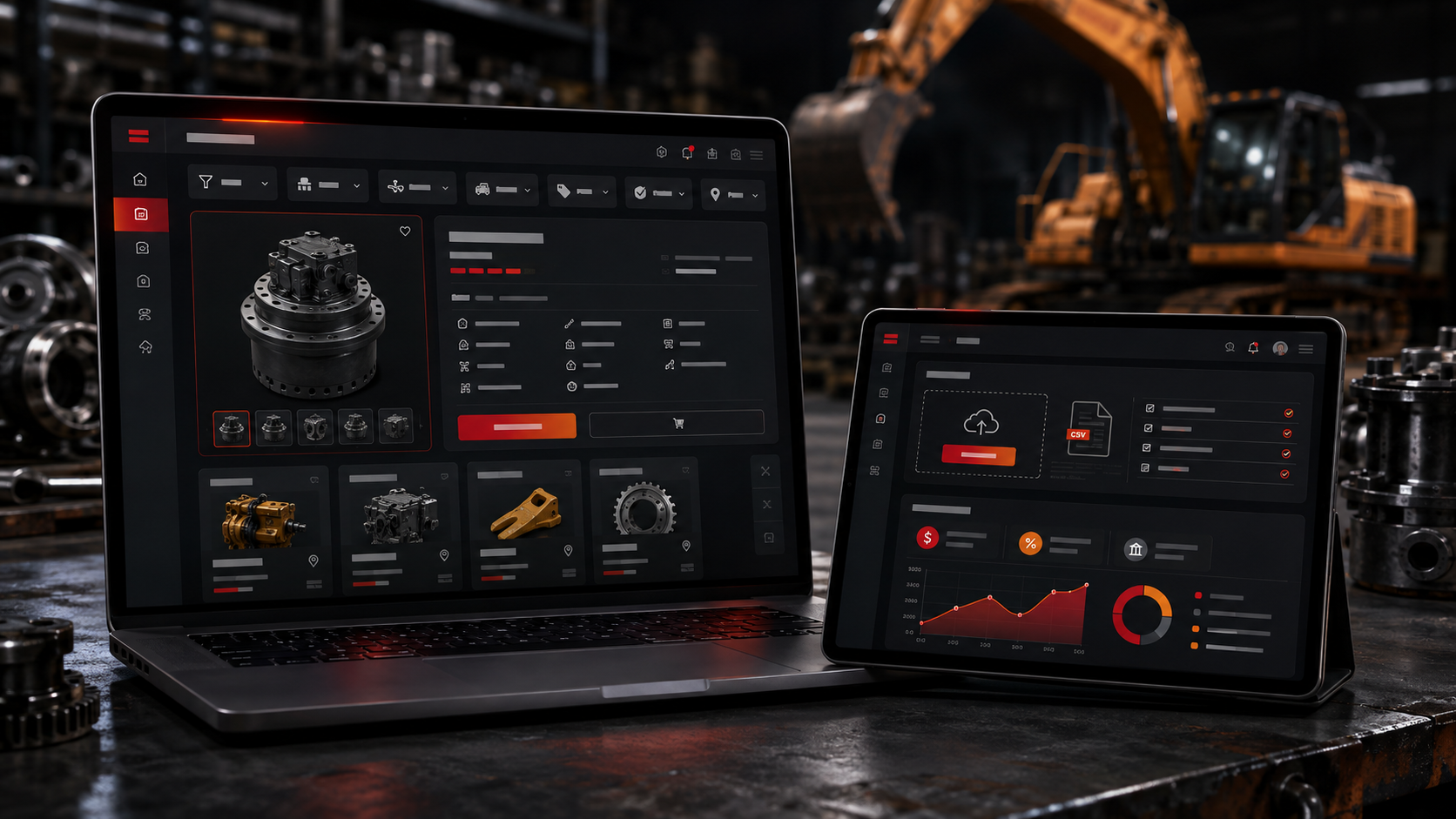
That is what this project delivers. HeavyParts Market is a multi-vendor marketplace for heavy machines, vehicles, and spare parts, built from scratch in Laravel. Sellers list technical items with photos, part numbers, and full specifications; buyers search, filter, and purchase at fixed Buy Now prices; and the platform runs the whole transaction, from cart and checkout with tax and shipping through to payouts.
Put simply, three roles share one system. Buyers shop, sellers list and fulfil, and an admin approves, configures, and controls, with the admin able to list like a seller when needed. Because the buyers are technical and shop by part number, brand, model, and compatibility, discovery is built around exact matches, and because sellers hold large inventories, listings can be uploaded in bulk from CSV or Excel with column mapping.
The Starting Point: A Parts Marketplace Is Harder Than a General Store
Running a marketplace for heavy-equipment parts is harder than a general store, because the buyers are precise, the catalogues are large, and the platform has to move other people’s money and take its cut correctly. Several problems had to be solved at once:
- Technical buyers need the exact part. Someone looking for a specific excavator engine part will not accept a rough match, so search has to work by part number, brand, model, and compatibility, not just loose keywords.
- Large seller catalogues. Sellers can hold hundreds or thousands of parts, so adding them one at a time does not work; they need bulk import with flexible column mapping.
- Rich, structured listings. Each item needs a part number, brand, model, condition, SKU, specifications, stock, location, and shipping, all captured consistently and made searchable.
- Multi-party money. The platform takes a commission on every sale, supports three payment methods, and has to pay sellers their share, all recorded accurately.
- Trust and control. Sellers and listings need verification and approval, and the admin needs reports, refunds, and dispute handling to keep the marketplace healthy.
- Three jobs in one system. Buyers, sellers, and admins each need their own tools and access, cleanly separated from one another.
The Build: Exact-Part Discovery on a Custom Laravel Base
HeavyParts Market is a Laravel application built around exact-part discovery and clean marketplace mechanics. Every listing captures the full technical picture, title, part number, brand, model, condition, SKU, specifications, compatibility, price, stock, location, and shipping, with multiple auto-resized photos, and sits inside categories and subcategories such as Excavator and then Engine Parts. Buyers search by keyword or part number and filter by category, brand, model, price range, condition, and location, then sort by newest, price, or relevance, so a technical buyer reaches the exact part in a few steps.
Buyers check out with tax and shipping shown, pay by bank transfer, PayPal, or credit card, and receive order confirmation, status updates, order history, and downloadable invoices. Sellers register, get verified, manage listings from a dashboard, upload large catalogues in bulk from CSV or Excel with their own columns mapped to the site’s fields, and see their orders. The admin approves sellers and listings, manages categories and attributes, sets the commission, handles refunds and disputes, views reports, and runs payouts. Building this as a custom application rather than a store plugin kept roles, commission, and approvals under full control, which is where bespoke ecommerce development earns its place over an off-the-shelf cart.
For a seller bringing a large inventory onto the platform, the lifecycle runs in a clear sequence:
- Register as a seller and complete verification before any listing goes live.
- Upload the catalogue in bulk from CSV or Excel, mapping spreadsheet columns to the site’s fields during import.
- Submit listings for admin approval, so quality and accuracy are checked before buyers see them.
- Sell at fixed Buy Now prices, with a configurable commission recorded on every sale.
- Accumulate earnings and receive them through the payout system, run manually or on a schedule.
Technical Architecture
HeavyParts Market is a Laravel application over MySQL with S3 image storage, queues, and cron, designed to stay fast at catalogue scale. The design centres on three things: structured, searchable listings for technical parts; a marketplace engine for commission, payouts, approvals, and roles; and dependable handling of payments, images, and background work. Each subsystem maps to a specific requirement.
- Structured listings and catalogue. Every listing captures part number, brand, model, condition, SKU, specs, compatibility, stock, location, and shipping, with multiple auto-resized images in S3 and placement in categories and subcategories.
- Search and filtering. Keyword and part-number search combine with filters for category, brand, model, price, condition, and location, plus sorting, so a large catalogue narrows to the exact part in a few steps.
- Checkout, tax, and payments. Cart and checkout show tax and shipping, payment runs through PayPal and a card gateway online with bank transfer confirmed manually, and buyers get confirmation, status updates, and downloadable invoices.
- Commission and payouts. A configurable commission is calculated and recorded on every sale, seller earnings accumulate, and payouts run manually or on a schedule, all reflected in reports.
- Roles and access. Role-based access separates buyer, seller, and admin, with email verification, hashed passwords, and protected file uploads.
- Background jobs. Queues and cron handle payouts, email notifications, and saved-search alerts, so time-based and heavy work happens on schedule without manual effort.
Choosing a custom Laravel base, rather than bending a store plugin into a marketplace, left commission, payouts, approvals, and bulk import as core features and kept clean room to add compatibility cross-references, saved-search alerts, and seller reviews later. That is the value of custom software development when the business logic, not the storefront, is the hard part.
Challenges Solved
The toughest problems were precision, scale, and money, in that order. Making a catalogue of thousands searchable by exact part meant treating part number, brand, model, and compatibility as first-class fields with dedicated filters, so a technical buyer lands on the precise item instead of a near match. Onboarding large seller inventories meant CSV and Excel import with column mapping, so a seller maps their own spreadsheet to the site’s fields rather than re-entering everything by hand. And handling multi-party money meant three payment methods, tax and shipping at checkout, a configurable commission recorded per sale, and a manual or scheduled payout system, so the platform’s economics stay accurate and auditable across buyers, sellers, and the platform itself.
Trust and separation closed the list. Seller and listing approvals, email verification, and protected uploads keep quality high as the marketplace grows, while role-based access gives buyers, sellers, and admins their own tools and data without responsibilities blurring. A parts marketplace like this fits the needs of heavy-equipment and industrial suppliers who sell technical inventory to precise buyers and need the money side to reconcile cleanly on every sale.
The Result
The outcome is a marketplace that works for precise buyers and busy sellers at the same time. Part-number and compatibility search turn a large catalogue into a precise lookup. Bulk CSV or Excel import with mapping gets big inventories online quickly. Commission and payouts are recorded on every sale and settled cleanly. Cart, tax, shipping, three payment methods, tracking, and invoices meet buyer expectations. Seller and listing approvals, plus reports, refunds, and disputes, keep the marketplace trusted. And a custom Laravel base leaves room for compatibility cross-references, alerts, reviews, and multi-language as the platform grows.
The platform fits the business because discovery, marketplace economics, and operations were built as core features rather than bolted onto a generic catalogue. If you are planning a technical or multi-vendor marketplace, you can hire Laravel developers who have built exactly this kind of roles-commission-payout engine, or tell us about your catalogue and we will map your buyers, sellers, and money flow to a build that stays accurate at scale.
Frequently Asked Questions
Why build a heavy-equipment parts marketplace in Laravel instead of a store plugin?
A marketplace needs roles, a configurable commission, payouts, listing approvals, and bulk import as core features under full control. Building HeavyParts Market from scratch in Laravel kept all of that as first-class functionality and left clean room to add compatibility cross-references, saved-search alerts, and seller reviews later, which a general store plugin makes awkward.
How do technical buyers find the exact part they need?
Part number, brand, model, and compatibility are first-class fields with dedicated filters, and search combines keyword and part-number lookups with sorting. That lets a buyer narrow a catalogue of thousands of parts down to the precise item, rather than settling for a near match that will not fit their machine.
How do sellers add large inventories?
Sellers upload catalogues in bulk from CSV or Excel and map their own spreadsheet columns to the site’s fields during import, so bringing hundreds or thousands of parts online takes minutes rather than weeks and does not force sellers to reshape their spreadsheets first.
How does the platform handle commission and paying sellers?
A configurable commission is calculated and recorded on every sale, seller earnings accumulate, and payouts run manually or on a schedule, with everything reflected in reports. Combined with three payment methods and tax and shipping at checkout, the money side stays accurate and auditable across buyers, sellers, and the platform.
How are buyers, sellers, and admins kept separate?
Role-based access gives each of the three roles its own tools and data, backed by email verification, hashed passwords, and protected file uploads. The admin can also list like a seller when needed, so responsibilities stay clear without a separate account for it.