


Blog
Sak Soti Case
Study: A HarmonyOS App That Turns Dreams Into Lucky Numbers
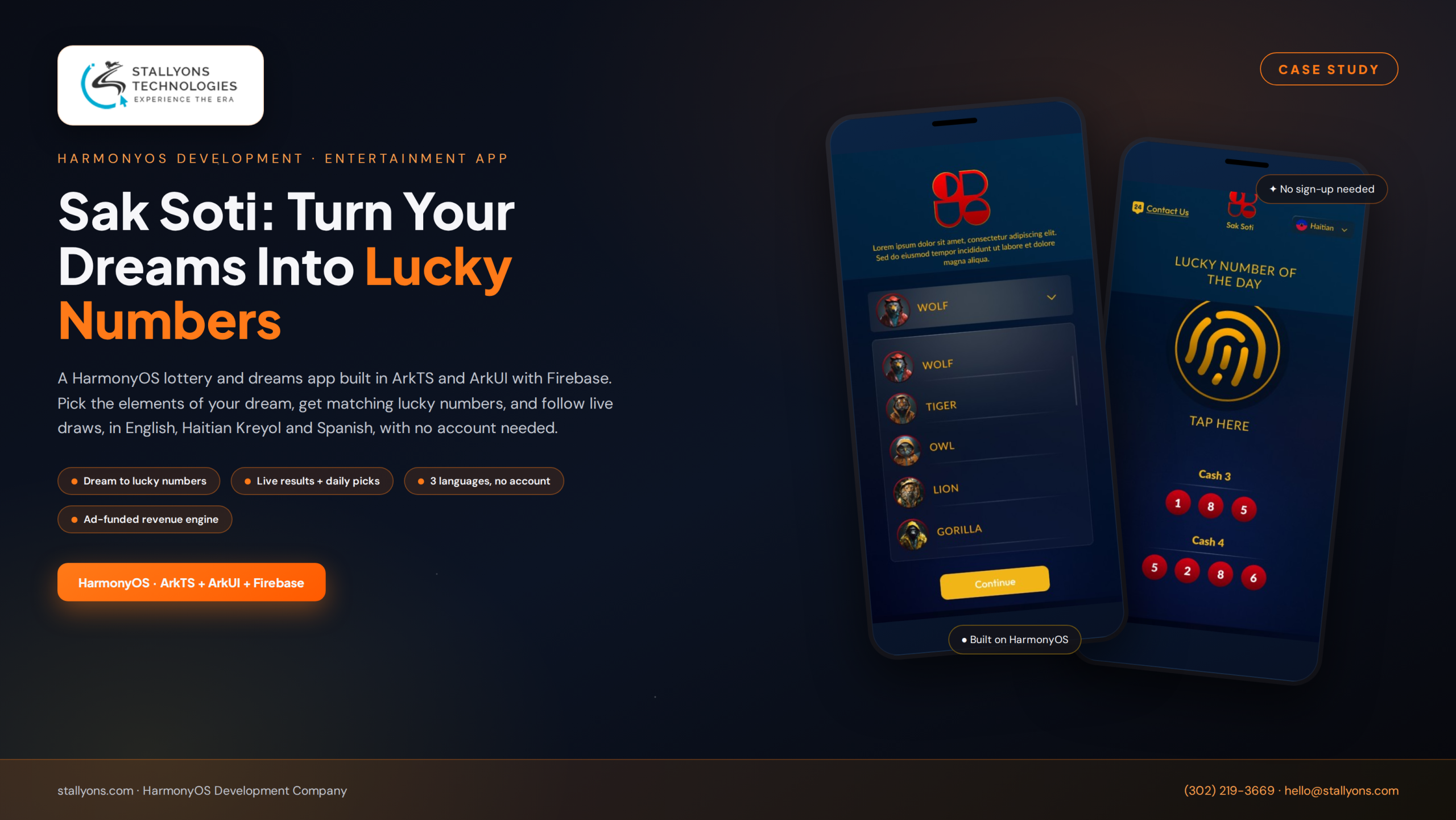
In many communities across the Caribbean and Latin America, a dream is never just a dream. Dream of a snake, a wedding, or a fistful of money, and someone will tell you which numbers to play that day. It is a tradition passed down at kitchen tables and street corners, and for millions of people it is part of the fun of the lottery. The problem is that living this tradition has always been clumsy. You dream at night, you try to remember a chart in the morning, you flip between a television channel and a website to check the draw, and half the joy leaks away in the hassle. Sak Soti was built to gather all of that scattered fun into one bright, effortless app.
Sak Soti is an entertainment app for lottery fans, and its idea is as simple as it is charming. Built as a lean piece of mobile app development, it wraps one delightful idea in just enough around it to keep people coming back. You think about your dream, you tap the things you saw in it, and the app hands you back a set of lucky numbers to play for games like Cash 3 and Cash 4. Around that playful core sit live draw results, a daily random pick, and a stream of local ads, all offered in English, Haitian Kreyol, and Spanish, and all reachable without ever creating an account.
Why This App Earns Attention and Revenue
Look past the lottery balls and there is a sharp business model here. The app is free, which removes the biggest barrier to a casual download. It asks for no sign-up, so a first-time user is playing within seconds rather than filling in a form they resent. And because it speaks three languages from the first screen, it welcomes a whole multilingual community instead of a single slice of it. That combination produces exactly what advertisers want: a large, engaged, local audience that opens the app out of habit.
Revenue then flows from ads rather than from the user’s wallet. Local businesses buy placements and reach that engaged audience, the owner earns a steady stream of income, and the player never pays a cent. The ads are woven into the experience as browsable content, so they feel like part of the app rather than an interruption. It is a clean, self-funding loop, and it is the reason a light entertainment app can stand on its own two feet commercially.
The honest edge of that account-free model is that the owner never holds a direct line to any single player. With no sign-up and nothing tied to a login, there is no email list, no push channel, and no way to nudge a lapsed user back; the whole model rests on the app being good enough to reopen out of habit and on the ad views that habit produces. It is a deliberate trade of a marketing lever for a frictionless first tap.
The Heart of It: Turning a Dream Into Numbers
The dream feature is the soul of Sak Soti, and it was designed to feel a little bit magical while staying effortless to use. A player taps Enter Dream on the home screen, and instead of a blank text box, a curated gallery of dream elements appears: animals, colors, and objects that people commonly see in their dreams. In our build the animals arrive with characterful artwork, from a hooded Wolf to a Tiger, an Owl, a Lion, and a Gorilla, which makes the choice a pleasure rather than a chore.
The player selects the elements that match their dream and submits them. Behind the scenes the app looks up the lucky numbers tied to those elements and presents them, ready to play for Cash 3 and Cash 4. Because the list is curated rather than open-ended, nobody ever stares at an empty field wondering what to type, and the owner can keep the gallery fresh from a private admin panel so the suggestions always feel current. That single, well-judged design decision is what turns a folk tradition into a repeatable digital habit.
Technical Architecture: Light on the Surface, Solid Underneath
Sak Soti runs on HarmonyOS, built with ArkTS and ArkUI, with Firebase quietly handling data in the background. The whole app was kept intentionally lightweight, and choosing the right cloud service instead of hand-building a server is the kind of decision an experienced HarmonyOS app development team makes early to save the client months of unnecessary work.
A handful of subsystems carry the app. The dream-to-numbers engine maps each element to its numbers and returns a match in a single step. The live results feed embeds YouTube channels and partnered lottery sites so players can follow games like Pick 2, Pick 3, and Pick 4 in one place. An on-device generator produces a random daily set at a tap. A translation layer wraps every screen in three languages with instant switching. And the account-free design ties nothing to a login, so the app opens straight into the fun and forgets nothing when it closes. It is the kind of pragmatic engineering that keeps a product cheap to run and quick to love.

Everything Around the Dream
Three more features keep players coming back between dreams. Live Lottery Results pulls the latest draws into the app from embedded channels and partner sites, complete with a countdown to the next drawing and the most recent winning numbers, so a fan never has to hunt across the web again. Lucky Numbers for the Day answers a different mood entirely: sometimes a player just wants instant luck, so a single tap spins up a fresh random set of Cash 3 and Cash 4 numbers, ready to try again as often as they like. And the ad feed lets users scroll through local offers and tap to learn more, turning idle moments into discovery.
Threading through all of it is language. Every part of the app, from the dreams to the results to the daily numbers and the ads, is presented in English, Haitian Kreyol, and Spanish, and the player can switch at any time from the home screen or settings. The result is an app that feels made for each user rather than translated as an afterthought.
The Owner’s Side: A Small Panel That Keeps It Fresh
Regular players need no account, but the owner has one secure admin role that quietly powers the whole experience. From a protected panel, the owner reviews key metrics, then adds, edits, or removes dream elements to keep the gallery current and the suggestions relevant. Because the dream list is the beating heart of the app, this simple tool matters far more than its size suggests. It lets a non-technical owner keep the product alive and seasonal without ever touching code.
The Harder Problems We Solved
Keeping the app playful and frictionless meant dropping accounts entirely for regular users, so anyone can open it and play at once with nothing to lose on exit. Making the dream feature feel magical yet simple meant curating a ready-made list of elements, so a user never faces a blank box while each element still maps cleanly to its numbers underneath. Bringing live draws inside meant embedding trusted YouTube channels and partner sites rather than sending users off to chase results elsewhere. And reaching a multilingual community meant building all three languages in from the start, switchable on the fly, rather than bolting on translation later.
The Result and Why It Matters
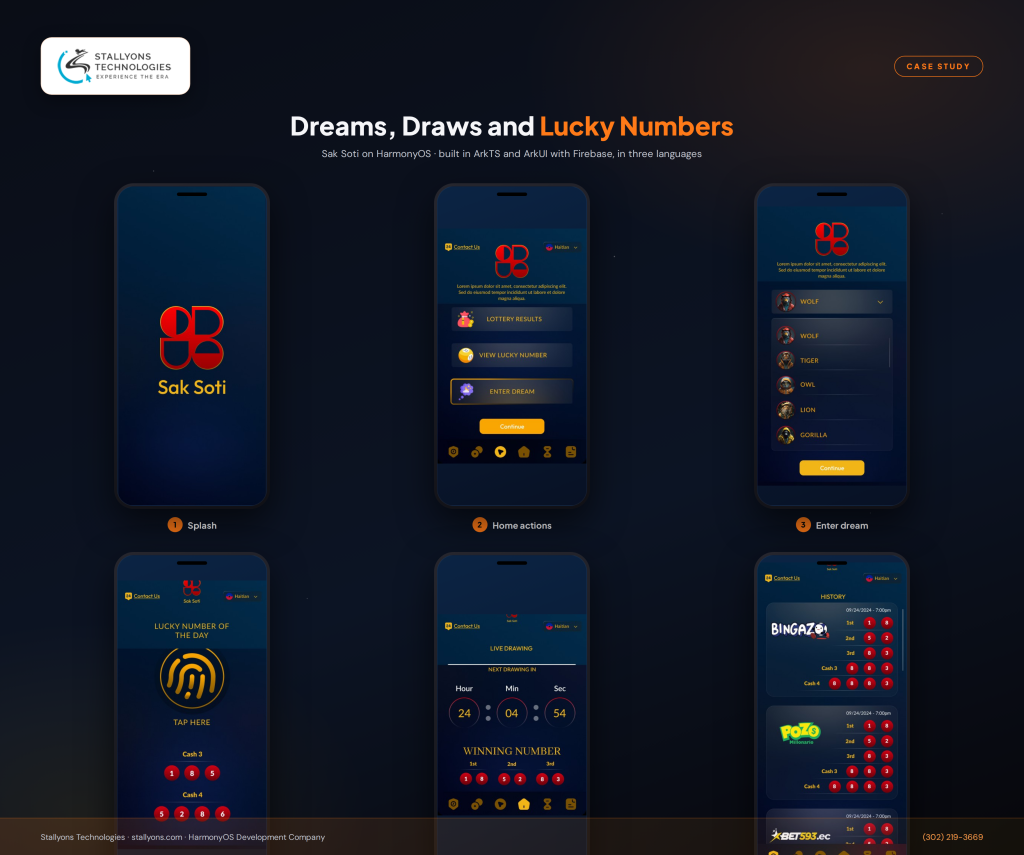
What we delivered is a lively, account-free entertainment app for lottery fans, built on HarmonyOS with ArkTS and ArkUI and backed by Firebase. Its main draw is the dream-to-numbers feature, wrapped in live results, on-demand daily picks, and a browsable stream of local ads. Players dive straight in and lose nothing on exit, they read every screen in the language they prefer, and a small admin panel keeps the dream gallery fresh while the ads keep the whole thing free and earning.
For a business owner, that is a rare thing: a beloved local tradition turned into a polished, multilingual product that funds itself. It is also proof that the right team can take a simple idea and ship it fast on Huawei’s platform without the cost and delay owners fear. If you would like to see the same team handle a very different brief, take a look at our HarmonyOS port of the DeepSkyCamera astrophotography app, where the challenge was faithfully rebuilding an existing Android interface rather than launching a fresh idea.
Ready to Bring Your Idea to HarmonyOS?
Whether you are launching something new or expanding a proven app onto Huawei’s growing platform, the winning formula is the same: a design people enjoy, a lean architecture that stays cheap to run, and a revenue model built in from day one.
Stallyons Technologies designs, builds, and ships HarmonyOS apps end to end, from the first screen to the admin panel and the ad engine behind it. If you have an idea worth playing, our HarmonyOS app engineering can take it from concept to AppGallery. Book a discovery call and tell us what you are building.