


Blog
A Classifieds Ads
Marketplace Built in Laravel
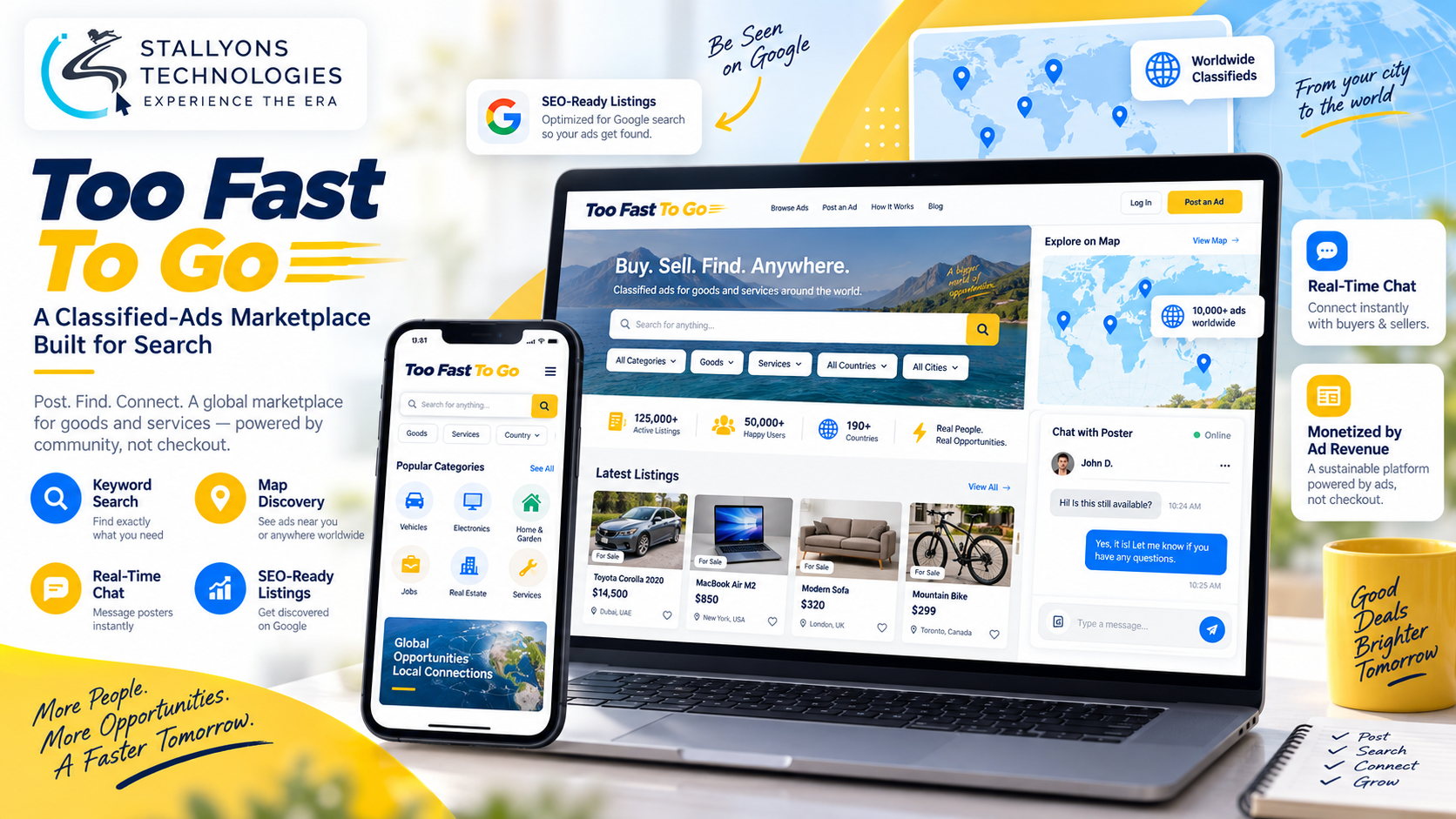
Most marketplaces obsess over checkout. Too Fast To Go has no checkout at all. Its revenue comes from Google, so the entire build is bent toward one goal: every ad has to be a page Google can crawl, index and rank. Get that right and traffic arrives; AdSense turns that traffic into money. It is a classifieds site engineered as an SEO machine first and a marketplace second.
Too Fast To Go is a classified-ads marketplace custom-built on Laravel, not a CMS. Users post and request ads, search by keyword, filter by goods, services and location, see ad locations on a map, and chat with other posters in real time. Each ad is served as its own server-rendered page, and the site earns through Google AdSense rather than any on-site payment.
Put simply, two requirements shaped everything: Google must see every ad’s keywords, so each ad is a server-rendered page with full metadata, structured data, a clean URL and a sitemap entry; and revenue comes from AdSense, so there is no checkout to build, only traffic to win and a lean admin to run it all.
The Starting Point: Getting Found on Google Is the Whole Business
A classifieds marketplace that earns from ads rather than fees has a particular set of needs, and being found on Google outranks all of them. A custom web development build, rather than an off-the-shelf CMS, was the right call precisely because search was the backbone. Six needs shaped it:
- Every ad must be findable on Google. The client’s revenue depends on traffic, so search engines have to index every ad’s keywords, which makes SEO the backbone, not an afterthought.
- Ads found many ways. Visitors search by keyword and filter by goods, services, and country and city, and all of those have to connect back to a single ad.
- Location matters. Posting an ad should capture the user’s location and show it on a map, with a world map of all ad locations, using a free map service.
- Posters need to connect. A standard real-time chat lets posters message each other and share images and documents.
- Monetised by ads, not payments. There is no on-site payment; the site earns through Google AdSense, so the build focuses on traffic and placement rather than checkout.
- Simple to run. The client needs a clean admin that surfaces only the important information, not a cluttered dashboard full of things they will never touch.
The Build: Every Ad Is a Search-Ready Page
Too Fast To Go is a custom PHP application on Laravel, built with a Blade and Tailwind frontend in clean yellow and blue. Users post or request ads with a description, the number of hours and other details; each ad gets its own detail page showing the content and how many times it has been viewed. Ads are found by keyword search and by filters for goods, services, and country and city, all connected to a single ad, so an ad is discoverable however a visitor looks without splitting it across duplicate pages. Because it is critical that Google indexes every ad’s keywords, each ad is served as a server-rendered page with full metadata, structured data, a clean URL and a sitemap entry.
Serving crawlable HTML with the SEO built into the page, rather than delegated to a plugin, is what a server-rendered Laravel development stack does well. When posting, the site captures the user’s location and shows it on a free Bing map, and a dedicated page plots every ad location on a world map. A separate real-time chat lets posters message one another and share images and documents, users sign in through Laravel’s authentication, and each user and ad carries a unique number, users starting with 3 and ads with 7. Revenue comes from Google AdSense placed around the site, so there is no checkout to build.
Technical Architecture
This is a custom Laravel (PHP) application shaped into a classifieds marketplace, so the architecture centres on custom ad models, keyword and faceted search, server-rendered pages built for SEO, Bing Maps for location, a real-time chat with uploads, and AdSense monetisation, all behind a lean custom admin. The subsystems worth calling out:
- Posting and requesting ads. Users post ads with a description, hours and details, or request them, and each ad has its own detail page with a view count, built on custom ad models in Laravel.
- Search and filtering. Ads are found by keyword search and by filters for goods, services, and country and city, all connected to a single ad, so a visitor narrows to what they want quickly.
- SEO for every ad. Because Google has to see every ad’s keywords, each ad is served as a server-rendered page with metadata, structured data, a clean URL and a sitemap entry, so ads surface in search as well as on-site.
- Location on the map. Posting captures the user’s location and shows it on a free Bing map, and a dedicated page plots all ad locations on a world map.
- Real-time chat. A separate chat lets ad posters message each other with a standard real-time experience, including image and document uploads.
- Accounts, IDs and monetisation. Users sign in through Laravel’s authentication, each user and ad gets a unique number, the site earns through Google AdSense rather than on-site payments, and a lean custom admin shows only what matters.
The path an ad travels from posting to revenue is the flow the whole build serves, and it runs in order:
- A user posts an ad with a description, hours and details, and the site captures their location for the map.
- The ad is served as its own server-rendered page with metadata, structured data, a clean URL and a sitemap entry.
- Visitors reach it by keyword search or by filtering for goods, services, and country and city, all tied to that single ad.
- Google indexes the ad’s keywords, traffic arrives, and AdSense placed around the pages turns that traffic into revenue.
Because there is no on-site payment, none of this depends on a checkout; the engineering effort goes into discoverability and clean placement instead.
Challenges Solved
Making every ad findable on Google came down to serving each one as a server-rendered page with metadata, structured data and a sitemap entry, so its keywords are indexed, which is the client’s most important requirement and the basis of its ad revenue. Building it custom without a CMS meant custom ad models, search, real-time chat and a lean admin all on Laravel, with no plugin bloat or unused dashboard, so the site does exactly what the brief needs and nothing it does not. Connecting many ways to find an ad meant tying keyword search and every filter back to a single ad, so it is discoverable however a visitor looks, without duplicate pages. Showing location on a free map meant capturing the poster’s location on a Bing map and plotting all ads on a world map, so location is visual without paying for a mapping service. Letting posters talk meant a real-time chat with image and document sharing, so deals happen on the site. And earning without payments meant AdSense monetising the traffic, with a lean, purpose-built admin and unique user and ad numbers keeping the records clear.
The Result
Too Fast To Go fits the client’s model precisely, on a fully custom build. Every ad is a search-ready page whose keywords Google can index, visitors find ads by keyword, filter, map and search, posters connect over real-time chat with image and document sharing, and the site earns from AdSense traffic with no checkout to maintain. A lean, purpose-built admin shows the client only what matters, and the unique user and ad numbering keeps records clean, so the whole thing is as easy to run as it is to find.
If you are building a search-first marketplace, a classifieds platform, or any content site where organic traffic is the revenue, you can hire Laravel developers who have built this server-rendered, SEO-first model, or tell us what you want indexed and we will build pages Google can read.
Frequently Asked Questions
Why build a classifieds site on Laravel instead of a CMS?
Because the client’s revenue depends on Google indexing every ad, and a server-rendered Laravel application produces crawlable HTML with the SEO built into each page rather than delegated to a plugin. Building custom also gave full control over the ad model, search, real-time chat and a lean admin, with no plugin bloat or unused dashboard.
How does the site make sure every ad is found on Google?
Each ad is served as its own server-rendered page with full metadata, structured data, a clean URL and a sitemap entry, so its keywords are indexed. That is the client’s most important requirement, since traffic from search is what AdSense turns into revenue.
How can visitors search and filter ads?
Visitors find ads by keyword search and by filtering for goods, services, and country and city, with every route tied back to a single ad. Posting also captures the user’s location for a free Bing map, and a dedicated page plots all ad locations on a world map, so ads are discoverable by keyword, filter and place.
How does the platform earn money without a checkout?
Revenue comes entirely from Google AdSense placed around the site, so there is no on-site payment or checkout to build. The engineering effort goes into traffic, discoverability and clean ad placement instead, which suits the client’s ad-based model and shortened the build.
Can posters contact each other on the site?
Yes. A separate real-time chat lets ad posters message one another with a standard experience, including image and document uploads, so conversations and deals happen on the site rather than off it. Users sign in through Laravel’s authentication, and each user and ad carries a unique number to keep records clear.