


Blog
PlanSure: A Construction
Readiness and Governance Dashboard
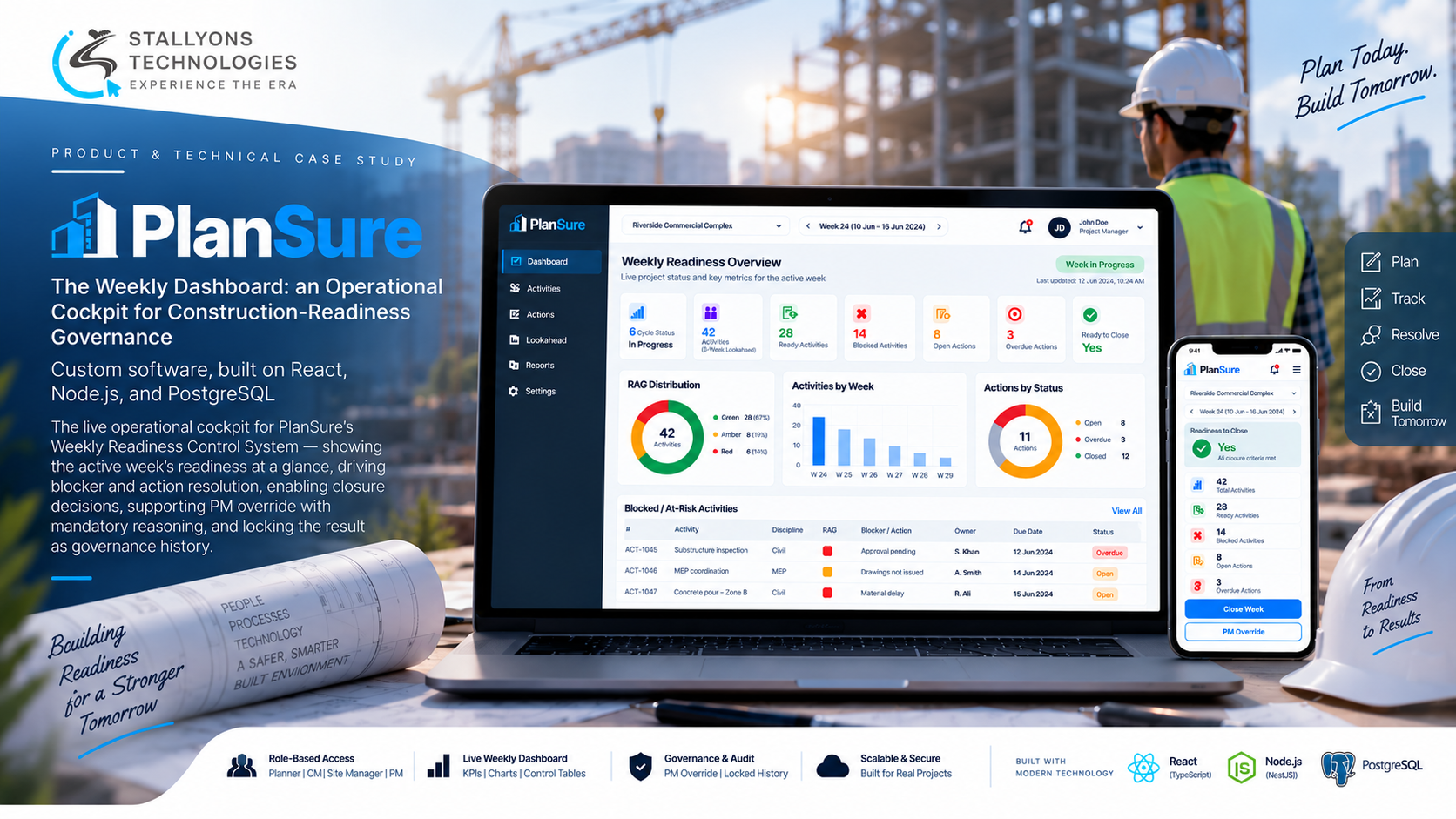
Every Monday, a construction project asks itself one question: can this week close, or not? On most projects the answer lives in someone’s head, argued over in a meeting and written down after the fact. PlanSure set out to make that answer a governed decision instead, one the software can show, defend, and lock into the record. The Weekly Dashboard is where that decision gets made.
It is the live operational cockpit for PlanSure’s Weekly Readiness Control System, a construction-readiness governance dashboard built as custom software on React, a Node.js API, and PostgreSQL. It is not a reporting page a manager reads after the week is over. It is the working surface a Planner, Construction Manager, Site Manager, or Project Manager opens mid-cycle to grasp the week’s readiness in seconds, clear blockers, decide whether the cycle can close, and lock the result as history.
Put simply, the dashboard moves a user from status, to action, to a governed close, then freezes that close into a record a separate Governance Dashboard reads as the project’s history.
The Starting Point: A Weekly Cycle That Needs Real Governance
Controlling a live weekly readiness cycle takes more than a page of charts. A manager opening the dashboard has to understand the active week’s readiness, workload, and accountability within seconds, not after digging through reports. And readiness is not the same as status: the page has to show which work is ready to move, how many activities are blocked by open actions, and how much of that action debt is already overdue.
The closure decision was the crux. The week could not close on someone’s say-so; it needed explicit logic that returns a clear yes, no, or escalate. When a week cannot close normally, the Project Manager has to be able to override closure, but only through a deliberate route with a mandatory reason and full audit visibility, because the PM stays accountable for delivery. Ownership of actions had to stay live, reassignable mid-cycle with a captured reason and preserved history. And once a week closed, its data had to lock into a snapshot that downstream governance could trust as history rather than a page that might still change.
The Build: From Status, to Action, to a Governed Close
The Weekly Dashboard is built as a top-to-bottom control surface rather than a dashboard of loose widgets, and that structure is the point. Delivering it as a custom software development build, rather than forcing it into a generic reporting tool, was what let the closure logic and the audit trail be first-class parts of the product instead of afterthoughts.
The page reads as one flow. A header fixes the active project, week, cycle status, and weekly RAG, so a user always knows exactly which cycle they are controlling. A card-based KPI strip shows the control metrics at a glance: cycle status, activities in the six-week lookahead, ready activities, activities blocked by actions, open actions, overdue actions, and readiness to close. A small set of charts, the RAG distribution, activities by week, actions by status, and action ownership, supports the weekly conversation without taking it over. Below that, large control tables for blocked or at-risk activities, the next-period plan preview, and the planner to-do output are the working centre where the meeting actually runs.
Closure itself is explicit, and it resolves in a defined order:
- Readiness logic checks whether planner review is complete, the planner to-do is generated, and overdue actions and blocked activities are acknowledged.
- The closure panel gathers the ready-to-close indicator, the open, overdue, and blocked counts, and the week lock status in one place.
- A Planner closes the week normally when the logic allows it, or a Project Manager overrides closure through a deliberate route with a mandatory reason.
- The close-out status records whether the week closed normally or by override, and the week’s data locks into a snapshot.
Actions can also be redistributed to a new owner mid-cycle, with a captured reason and preserved history, so accountability tracks reality through the week. Running that live cycle logic on a Node.js API over PostgreSQL kept the readiness state fast to read and the audit history reliable to write, which is why the backend was scoped through our Node.js development practice.
Technical Architecture
The architecture is a React operational dashboard over a Node.js API and a PostgreSQL database, with role-based access, built around live cycle control and a trustworthy record. Each subsystem answers one of the brief’s demands.
- Live cycle control. The dashboard surfaces the active project and week, the six-week lookahead, and the readiness mix of ready, blocked, and at-risk work, so a manager reads the live state within seconds.
- Actions and redistribution. Open, closed, and overdue actions are tracked against the activities they block, owners stay visible, and an action can be reassigned to a new owner with a captured reason preserved in history.
- Closure readiness. Explicit logic, planner review complete, planner to-do generated, overdue actions, and acknowledged blockers, decides whether the week can close or must escalate.
- PM override and authority. When a week cannot close normally, the PM overrides with a mandatory reason, and the close-out status records whether closure was normal or by override, keeping the decision auditable.
- Closure panel. One panel holds the ready-to-close indicator, the open, overdue, and blocked counts, the planner-close and PM-override controls, the reason field, and the week lock status.
- Locked record and governance. On close, the week’s data, activities processed, RAG counts, actions raised and closed, overdue actions, closure type, and any override reason, locks into a snapshot the Governance Dashboard reads as history.
The subsystems worth engineering most carefully were the closure logic and the locked snapshot, because that is where governance either holds or quietly leaks. If closure is a matter of opinion, or if a closed week can still be edited, the whole record stops being trustworthy. Building that correctly is exactly the kind of work teams hire full-stack developers for, where the React surface, the Node.js logic, and the PostgreSQL record all have to agree on one version of the truth.
Challenges Solved
The first problem was turning a page into a cockpit. Structuring the dashboard to move from status, to action, to closure, with the header, KPIs, charts, tables, and closure panel forming one control flow, meant it controls the live week rather than merely reporting on it. The second was making closure a governed decision: explicit readiness logic exposes whether the week can close or needs escalation, so closing is defined by planner review, overdue actions, and acknowledged blockers instead of judgement calls.
The rest was about accountability. A deliberate override route with a mandatory reason and audit visibility lets the PM close under exception while staying responsible, and the close-out status records how the week closed. Action redistribution with a captured reason keeps ownership honest through the cycle. And locking each closed week into a snapshot means operational data becomes reliable history rather than a page that can still shift. That combination of live control and audited governance suits capital-heavy programmes, including the property and construction work that real estate developers run week to week.
The Result
The outcome is a working cockpit that gives a construction team instant readiness awareness, drives blocker and action resolution, governs the closure decision including an audited PM override, and locks each week into a record the Governance Dashboard relies on. Readiness is clear within seconds, closure is defined by logic rather than opinion, exceptions are closed accountably, and history is trustworthy because a closed week can no longer change.
It fits how construction governance actually works because the closure logic, the override, and the locked record were designed as the core of the product, not features tacked onto a report. If you are building an operational governance tool where decisions have to be auditable, you can tell us about your control process and we will map your readiness logic, your override rules, and your history model to the right build.
Frequently Asked Questions
What does the PlanSure Weekly Dashboard do?
It is the live cockpit for controlling a construction project’s weekly readiness cycle. A planner or manager uses it to read the active week’s readiness in seconds, resolve blockers and actions, decide whether the cycle can close, and lock the closed week as governance history, rather than reading a report after the fact.
How does the dashboard decide whether a week can close?
Closure runs on explicit readiness logic, not opinion. The system checks whether planner review is complete, the planner to-do is generated, and overdue actions and blocked activities are acknowledged, then shows a clear ready-to-close indicator so the team can close normally or escalate.
What is the PM override, and why is it controlled?
When a week cannot close normally, the Project Manager can override closure, but only through a deliberate route that requires a mandatory reason and stays fully auditable. The close-out status records whether the week closed normally or by override, so the PM remains accountable for the exception.
What happens to a week’s data once it closes?
The week’s data locks into a snapshot, including activities processed, RAG counts, actions raised and closed, overdue actions, the closure type, and any override reason. A separate Governance Dashboard reads that snapshot as project history, and because it is locked, the record cannot change after the fact.
What technology is the dashboard built on?
It is custom software built on a React front end, a Node.js API, and a PostgreSQL database, with role-based access. That stack keeps the live readiness state fast to read on screen while writing a reliable, auditable governance record to the database.