


Blog
DeliverHub: A Multi-Role
Delivery Marketplace
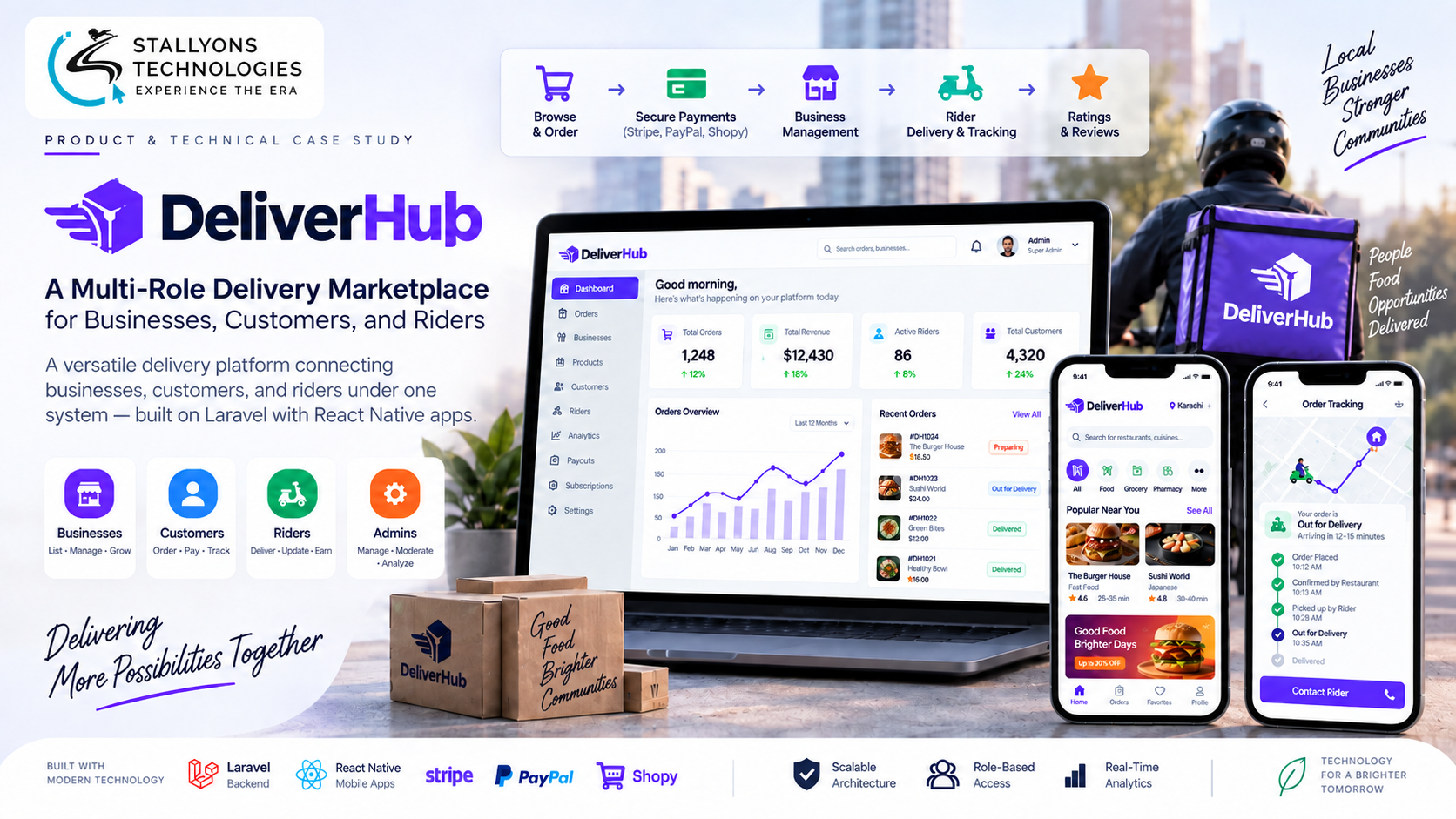
A single delivery order touches four different people before it is done. A business lists a product and sets the streets it will deliver to. A customer finds that product, pays for it, and waits. A rider picks it up, carries it, and marks it delivered. And somewhere above all of that, an admin watches the whole marketplace stay honest. Build one of those roles badly and the order breaks for everyone downstream.
DeliverHub is the platform that runs all four at once. It is a multi-role delivery marketplace built on a Laravel backend with a responsive web app and React Native apps for iOS and Android, and it serves businesses, customers, riders, and admins from the same system without letting any of them into each other’s tools.
Put simply, one backend carries the catalogue, the delivery rules, the money, and the order status, then hands each of the four roles only the part of that they are supposed to touch.
The Starting Point: Four Roles That Cannot Share a Login
A delivery marketplace is really four products wearing one coat. Businesses need a place to publish what they sell, price it, and say where and when they deliver. Customers need to browse, pay, and track. Riders need assignments, a way to talk to the business, and a status they can update on the move. Admins need to see and moderate all of it. The obvious wrong answer is to build four separate systems and try to keep them in sync. The harder, correct answer is one platform that knows who is looking.
On top of the four roles, the brief carried a few requirements that shaped everything after it. The catalogue could not be a plain product list, because every business defines its own delivery zones and times, so those rules travel with the products. The order had to move cleanly from customer to business to rider with a shared, current status. Money had to arrive through more than one payment gateway, and businesses had to be billable on recurring plans. And every part of it had to behave the same on a phone as it does in a browser.
The Build: One Laravel Backend, Access Decided by Role
DeliverHub runs on a Laravel backend that exposes a REST API, and every client, the responsive web app and both React Native apps, talks to that one API. Role-based access control sits at the centre: admins, businesses, customers, and riders sign in to the same platform, and their role decides which screens, data, and actions they ever see. There is one set of business rules to maintain instead of four drifting copies, which is the whole reason this was scoped as a custom software development project rather than four stitched-together tools.
Each role gets a build shaped to its job. Businesses create a profile, list products and services with names, descriptions, prices, and images, and set the delivery zones and times that then govern which orders they can accept. Customers sign up with Facebook or a verified email, browse, order, pay, track, and rate. Riders register, take assignments, coordinate with the business, update the order status as they go, and collect ratings of their own. Admins run the platform from a dashboard, managing and moderating users and businesses and reading the analytics.
The order itself follows a fixed path, and it was built to run in that order every time:
- A customer places and pays for an order, which is checked against the business’s delivery zone and available times.
- The business receives the order, confirms it, and prepares it for handoff.
- A rider is assigned, coordinates with the business, and updates the status through pickup and transit.
- The rider marks the order delivered, and the customer rates the business and the delivery.
Because the same Laravel backend powers the website and the apps published on both app stores, a business owner and a rider standing in the same warehouse see the identical, current state of an order, whichever device they happen to be holding.
Technical Architecture
Underneath, this is a Laravel REST API over a database, serving a responsive web client and two React Native clients, with role-based access threaded through every request. The architecture breaks into a handful of subsystems, each tied to one of the brief’s demands.
- Roles under one access model. Role-based access control keeps admins, businesses, customers, and riders on a single backend with their own tools and data, so nobody crosses into another role and there are no parallel systems to reconcile.
- Catalogue that carries delivery rules. Each business’s products travel with its delivery zones and available times, so an order can only be placed where and when that business actually delivers.
- Order lifecycle across parties. A single order record moves from customer to business to rider with shared status and tracking, so every party reads the same current state instead of a stale copy.
- Payments and subscriptions. PayPal, Stripe, and Shopy handle customer checkout, while subscription plans with limits, such as the number of listed products or the delivery radius, bill the businesses, so the platform earns from both sides.
- Notifications. Push notifications keep customers and riders current on order status, and email notifications cover business activity, so each party is told what it needs to know.
- One backend, every client. The web app and the React Native apps on both stores draw from the same API, so the logic lives in one place and the experience stays consistent across devices.
The two pieces most worth building carefully were the role model and the order lifecycle, because that is where a generic marketplace template usually leaks, either by mixing up who can see what or by letting an order’s status fall out of sync between the app and the web. Since the whole thing rides on Laravel, teams planning something similar often lean on our Laravel development practice to get the API and the access model right before a single screen is drawn.
Challenges Solved
The hardest problems all came from serving four audiences without fragmenting the platform. Role-based access control gave each role its own tools and data on one backend, so there was never a second or third system to keep in sync. Putting delivery zones and times on each business meant orders respected reality instead of a one-size rule, which matters the moment the platform carries more than one kind of business. A single order record shared across customer, business, and rider kept everyone on the same status rather than trading out-of-date messages.
Money and scale were solved together. Several payment gateways covered customer checkout, while subscription plans with limits billed the businesses, so the marketplace could take transactions and grow its recurring base at the same time. And running the whole thing from one Laravel API meant the website and the two mobile apps stayed consistent without duplicating business rules per client. A four-sided marketplace like this, with its own billing tiers and operational tooling, is the kind of platform that SaaS startups build a business around, and it was scoped to grow into exactly that.
The Result
The outcome is a working delivery marketplace where each of the four roles does its own job cleanly. A business publishes a catalogue, sets where it delivers, and manages its orders and plan. A customer browses, pays through the gateway they prefer, and tracks the delivery to their door. A rider takes an assignment, keeps everyone updated, and gets rated on the result. An admin watches the whole platform and steps in when needed. All of it runs from one Laravel backend, on the web and through apps on both stores, with the same order showing the same state everywhere.
It fits the business because the role model and the order lifecycle were built for how a real marketplace behaves, not bolted onto a template that assumes a single kind of user. If you are planning a multi-sided marketplace, you can hire Laravel developers who have built this exact four-role model, or tell us about your platform and we will map your roles, payments, and delivery rules to the right backend.
Frequently Asked Questions
What is a multi-role delivery marketplace?
It is one platform that serves several kinds of users at once. In DeliverHub’s case that is four: businesses that list products and set delivery rules, customers who order and pay, riders who fulfil and update the delivery, and admins who oversee everything, all from a single backend rather than four separate systems.
How do four roles stay separated on one platform?
Through role-based access control. Admins, businesses, customers, and riders sign in to the same Laravel backend, and their role decides which tools, data, and actions they can reach, so nobody sees another role’s screens and there is no crossed access to manage.
Can one delivery platform work on both web and mobile?
Yes. A single Laravel API powers a responsive web app and React Native apps for iOS and Android, published on both app stores. Because every client draws from the same backend, the business rules and the current order status stay identical across devices instead of being rebuilt per platform.
How are payments and business billing handled?
Customers check out through PayPal, Stripe, or Shopy, so they can pay with more than one gateway. Businesses are billed separately on subscription plans with limits, such as how many products they can list or how large their delivery radius is, so the platform earns from customer transactions and from recurring business plans.
Do businesses control their own delivery zones and times?
Yes. Each business defines the zones and times it delivers, and those rules travel with its catalogue, so an order can only be placed where and when that business actually operates rather than under a single platform-wide rule.