


Blog
AI Scientific: A
Survey-to-Document Cloud App
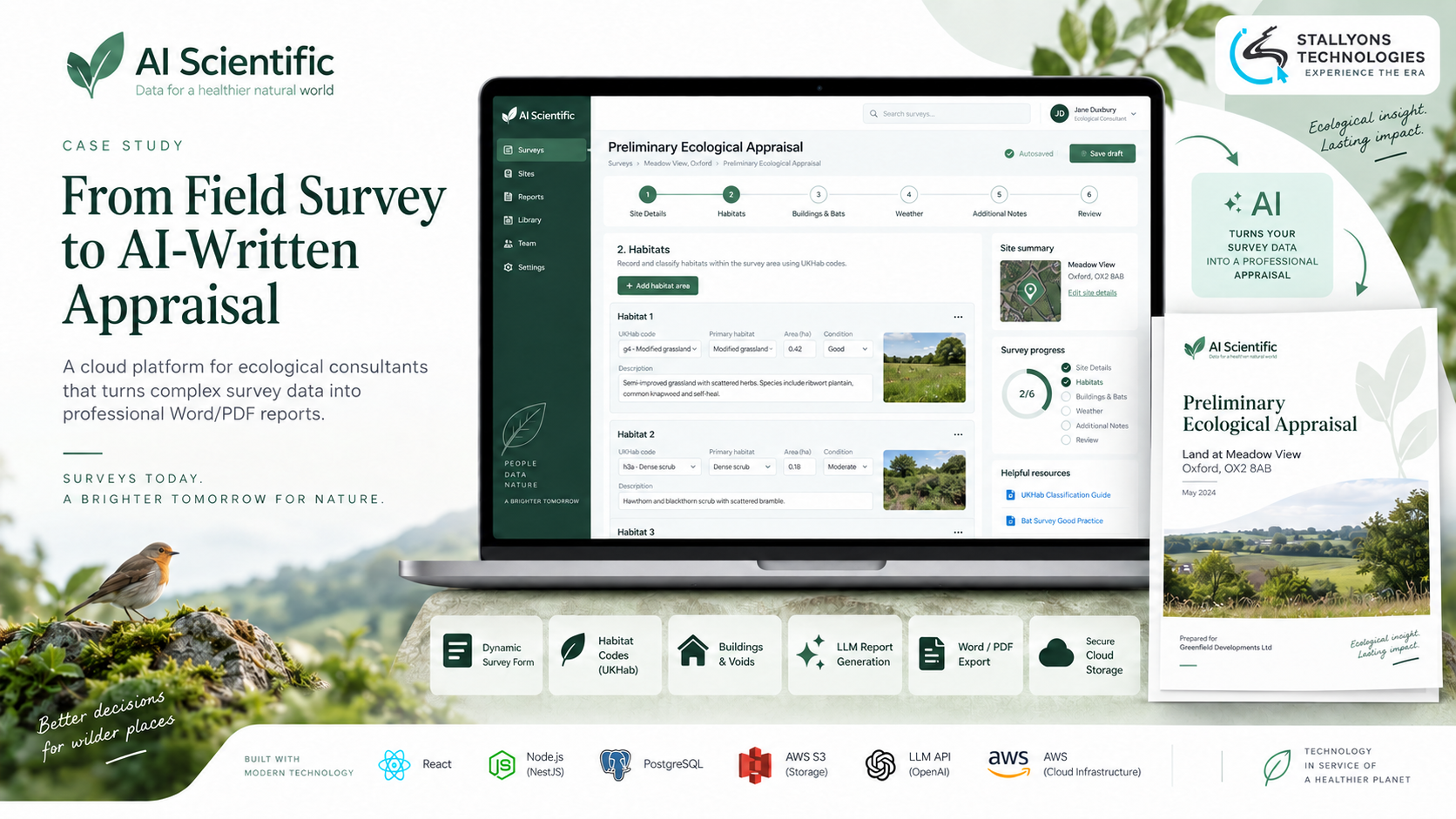
An ecological consultant spends a morning walking a site, recording the habitats present, the weather on the day, the species and their abundance, and whether any building could hold a bat roost. Back at a desk, all of that field detail has to become a formal Preliminary Ecological Appraisal, a written document the client can act on. The slow part is rarely the survey itself. It is turning pages of structured field notes into a coherent, readable report.
That is the job AI Scientific was built to take off the consultant’s desk. It is a cloud application where an ecological consultant logs in, completes a large, dynamic survey form, and an AI reads the finished fields and writes the appraisal as a formatted document ready to download.
Put simply, the consultant records the survey once in a form that expands to fit the site, the app generates the written appraisal from that structured data, and every survey and document is stored securely in the cloud so it is available from anywhere.
The Starting Point: A Field Survey That Resists Being a Form
A Preliminary Ecological Appraisal is not a short questionnaire. It captures hundreds of standard habitat codes across ten habitat groups such as grassland, woodland, heathland, wetland and marine, each with its own notes and a species list rated for abundance, alongside weather readings, a site description, invasive species, and a bats section that has to grow into a sub-form for every building and every void on the site. A form-builder that assumes a fixed shape cannot hold a survey like that.
The requirement was to turn this whole process into a working cloud tool, and the hard parts were specific:
- An enormous, nested form. Hundreds of habitat codes across ten groups, each needing notes and a species list, so the form cannot be hand-coded field by field.
- The same habitat, more than once. A surveyor may record one habitat type several times with different notes, so selections cannot be simple one-off checkboxes.
- Sections that must grow. The bats section needs a sub-form for each building, and within each building a sub-form for each void, built from the counts the surveyor enters.
- Turning fields into prose. A completed form is structured data, not a report, so something has to read it and write a coherent appraisal.
- A finished, formatted document. Consultants need a downloadable Word or PDF report, not a screen full of data.
- A secure, scalable cloud home. Surveys, documents, logins and the AI service all have to run reliably and hold varied survey data safely.
The Build: A Data-Driven Form Wired to AI Generation
The form is built data-driven. The hundreds of habitat codes and their option lists live in configuration rather than in hand-coded fields, so the form stays maintainable, new codes can be added without rebuilding it, and a surveyor can record the same habitat more than once, each instance carrying its own notes and a plant list where species are rated for abundance. The bats section is generated on the fly: the number of buildings entered creates that many building sub-forms, and within each, the number of voids creates that many void sub-forms, so the form fits the site instead of assuming a fixed layout. Running all of this as a secure, scalable app is the core of the cloud app development work behind the project.
Once a survey is complete, the path from field notes to finished report runs in a clear sequence:
- The consultant completes the survey, with the form expanding to cover every habitat, species, building and void on the site.
- The structured survey data, the fields, selections and notes, is passed to a large language model.
- The model reads that data and writes the Preliminary Ecological Appraisal as coherent prose consistent with what was entered.
- The written output is rendered as a formatted Word or PDF document and stored in cloud file storage.
- The client downloads a ready-to-use appraisal, with the survey and document both saved.
Underneath, a Node.js API handles authentication and role-based access, a database and cloud file storage hold the surveys and generated documents, and the app runs on cloud hosting so it is reachable anywhere and able to scale as more surveys are added.
Technical Architecture
The architecture is a React web app over a Node.js API, with an AI service for document generation and a cloud database and file storage, on cloud hosting. It centres on a handful of subsystems, each mapped to a part of the survey-to-document problem.
- A data-driven survey form. The habitat codes across the ten groups are defined in configuration rather than hand-coded, so the vast form stays maintainable and the same habitat can be selected more than once.
- Plant lists with abundance ratings. For each selected habitat, a notes field and a species list drawn from a shared tab let the surveyor record plants with their abundance, so the detail of the survey is captured rather than flattened.
- Dynamic building and void sections. The counts the surveyor enters generate the matching number of building sub-forms and, within each, void sub-forms, so the form grows to fit the site.
- AI document generation. A language model turns the structured survey into a written appraisal, work that sits in the same family as our machine learning builds, where structured input becomes a usable output.
- Formatted, downloadable documents. The generated report is produced as a formatted Word or PDF and stored, so the client downloads a finished file rather than reading data off a screen.
- A secure cloud app. Client login and role-based access, a database and file storage for surveys and documents, and the AI service all run in the cloud, so the tool is accessible, secure and able to scale.
Challenges Solved
The hardest problems clustered around one theme: holding real survey complexity without breaking the form or the report. A data-driven form kept hundreds of habitat codes manageable and easy to update. Repeatable selections let a surveyor record the same habitat several times, each with its own notes and plant list, so the survey was captured as it really is. Generating building and void sub-forms from the entered counts let the form fit any site rather than a fixed template. Passing the structured survey to a language model turned filled fields into a written appraisal, and rendering that output as a formatted, stored Word or PDF gave consultants a file they could actually hand over.
Preliminary Ecological Appraisals sit at the front of the planning and development process, which is why a tool like this fits the property developers, land teams and consultancies working in real estate and property development who commission these surveys before a site moves forward. The build was shaped around how that survey work is actually done, not around a generic form template.
The Result
The outcome is a cloud tool that turns a long, technical field survey into a finished appraisal with far less manual writing. A consultant records the site once in a form that expands to cover every habitat, species, building and void, and the AI drafts the report from it. The document comes out as a formatted Word or PDF, downloadable and saved alongside the survey, and the whole thing runs behind a secure login on cloud hosting that can scale as the caseload grows.
The tool fits the work because the form and the AI generation were built to carry real ecological complexity, not bolted onto a generic builder. If your organization standardizes on Microsoft’s cloud, you can hire Azure developers to build a form-and-document tool like this on Azure, or tell us about your workflow and we will map your survey and report generation onto the right cloud stack.
Frequently Asked Questions
What is AI Scientific?
It is a cloud application for ecological consultants. A user logs in, completes a Preliminary Ecological Appraisal in a large dynamic survey form, and an AI reads the finished fields and writes the appraisal as a formatted Word or PDF document to download, with every survey and report stored securely in the cloud.
How does the AI write the appraisal?
Once the survey form is complete, its structured data, the fields, selections and notes, is passed to a large language model. The model reads that data and writes a coherent Preliminary Ecological Appraisal consistent with what was entered, which is then rendered as a formatted document and stored for download.
How does the form handle hundreds of habitat codes and the same habitat more than once?
The habitat codes and option lists are defined in configuration rather than hand-coded, so the form stays maintainable and codes can be added without rebuilding it. Selections are repeatable, so a surveyor can record the same habitat several times, each instance carrying its own notes and abundance-rated species list.
How does the bats section grow to fit a site?
The bats section is generated from the counts the surveyor enters. The number of buildings creates that many building sub-forms, and within each building the number of voids creates that many void sub-forms, so the form expands to fit however many buildings and voids a site actually has.
Is the survey data stored securely?
Yes. The app runs behind client login with role-based access, and a database and cloud file storage hold every survey and generated document. Because it is cloud-hosted, the tool is reachable from anywhere and can scale as more surveys are added, while keeping the stored data secure.