


Blog
Streamer Community Platform:
Web App
A new streamer goes live on Twitch or YouTube and talks to an empty chat. No viewers, no reactions, and no obvious way to be found among thousands of other channels. Growing an audience from zero can take months of broadcasting to nobody, and most small creators give up before anyone arrives.
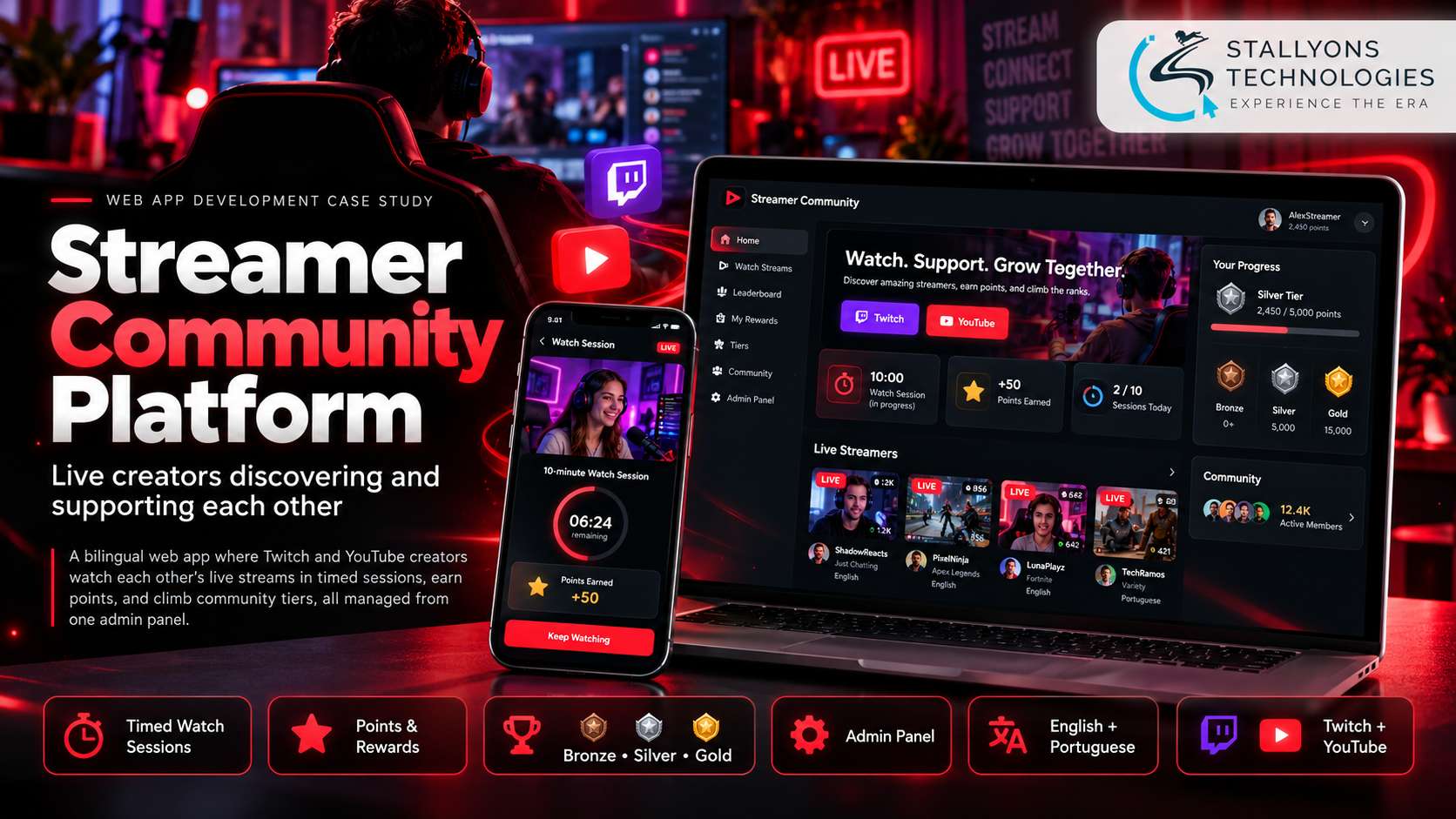
A start-up founder in Brazil wanted to fix that with a community where creators help each other get seen. Streamer Community Platform is the bilingual web app we designed and built for it: Twitch and YouTube creators take turns watching each other’s live streams in timed sessions, earn points for the time they give, and spend their standing to climb community tiers, with an admin panel that controls every rule. The front end runs in English and Brazilian Portuguese, and the whole thing was built from a blank page.
Put simply, you watch a fellow creator who is live right now, you earn points for watching, and those points help bring the community to your own channel next.
The Starting Point: A Fair Way for Small Creators to Find Each Other
The idea only works if the exchange feels fair and the owner can tune it. A platform that hands out points too freely gets gamed, and one that favours big channels defeats its own purpose. That set a clear list of requirements before any screen was designed.
- Discovery that is mutual. Small creators needed a steady way to be found by other creators, not another directory nobody browses.
- Points that reflect real time. Rewards had to track the actual minutes a member spends watching, with values the owner can adjust.
- Two platforms, two rule sets. Twitch and YouTube each have their own sign-in and their own rules for what a viewer can do.
- Two languages. The audience is Brazilian, so Portuguese came first, with English alongside it for wider reach.
- One place to control it all. Point values, bonuses, tiers, and plans all had to be editable from a single admin panel.
The Build: Watch a Stream, Earn Points, Climb the Tiers
The core loop had to feel effortless to a member while staying strict underneath, so a watch session could only reward time that was genuinely spent. Turning that balance of ease and fairness into a working product is the heart of this kind of web app development, where the interface hides a set of rules the owner never has to touch by hand. A session runs in a set order:
- A member signs up, connects their Twitch or YouTube channel, and lands on their dashboard.
- They click watch, and the app opens a random creator who is live right now, inside the platform, for a ten-minute session.
- When the session ends, the next one starts on its own, so members meet a steady run of new channels without searching.
- Time watched becomes points, with a ladder of daily bonuses layered on top for members who keep showing up.
- Points move members up through bronze, silver, and gold tiers, which change what the community does for their channel.
- A referral code at sign-up and a link to the community’s Discord help the whole group grow beyond the app.
Behind that loop, the administrator runs everything from one panel: point values, the daily bonus ladder, the tiers, the member plans, and the user accounts. Nothing is hard-coded, so the owner can raise a bonus step, add a tier, or change what a plan costs without a developer touching the back end. Because members buy into tiers and plans rather than paying once and leaving, treating the recurring side as proper subscription platform development is what keeps the community funded as it grows, instead of launching as a free tool with no way to pay for itself.
Technical Architecture
The platform is a Laravel application with a responsive front end in a dark black and red theme, drawn in Figma before any code was written. The real engineering is not the pages; it is the rules that decide who earns what, and the two different sign-in flows feeding into one points economy. Each layer has one job.
- Design. Original Figma screens, reworked into a layout of their own, approved by the client before the build started.
- Back end. Laravel in PHP handles accounts, roles, timed sessions, points, tiers, plans, and every rule in the admin panel.
- Database. MySQL stores members, channels, sessions, points, tiers, and plans.
- Streaming flows. Twitch sign-in and live streams, plus Google sign-in for YouTube lives, each handled on its own terms.
- Front end. A responsive web app in the dark theme, in English and Brazilian Portuguese, with different dashboards for members and administrators.
- Community links. A Discord link and referral codes push growth outside the app itself.
The part worth real care is the rotating session engine. Picking a creator who is actually live, timing the watch, crediting points only for time genuinely spent, and starting the next session on its own, all while respecting what each platform allows a signed-in viewer to do, is what makes the exchange feel fair rather than farmable.
Challenges Solved
The first challenge was giving the platform its own identity. The client’s references were existing sites, so a first draft risked looking like a copy of them. After that draft, the menus, layout, and text were reworked into an original design in the dark black and red theme, which is why the platform now reads as its own product rather than a clone of its inspirations. Starting in Figma and getting the look approved before any code was written is what made that rework a design decision rather than an expensive rebuild.
The second was YouTube’s own rules. The client asked to drop the Google sign-in to make the flow shorter, but YouTube only lets a signed-in account like or subscribe, which is the whole point of sending the community to a channel. We explained that the sign-in carries the action that makes a visit count, so it stayed on purpose rather than being cut for convenience. A third, quieter challenge was browser differences: testers saw roles, icons, and the bonus ordering behave differently across browsers, so each report was traced from the client’s own screen recordings and fixed in the feedback rounds, which ran with a small group of real accounts rather than on paper.
The Result
The platform was built in three stages, design, front end, and back end, each delivered and accepted, before moving into hands-on testing with the client and a small group of real creators. What exists is a working community where a member connects a channel, watches a live creator a moment later, earns points for the time they give, and climbs tiers that bring the community back to their own stream, all tunable from one panel. Referral codes and a Discord link carry the growth outside the app, and a desktop companion app is the planned next phase.
It works because the rules live in the admin panel, not in the code, so the owner can rebalance the economy without a developer. If you are building something similar, you can hire Laravel developers who have built this points-and-sessions logic, or tell us how your community should reward its members and our US-registered web development company will map the flows, tiers, and sign-ins. It fits any community or creator start-up launching a platform from scratch.
Frequently Asked Questions
What is the Streamer Community Platform?
It is a bilingual web app where small Twitch and YouTube creators watch each other’s live streams in timed sessions, earn points for the time they spend, and climb bronze, silver, and gold tiers. An admin panel controls the points, bonuses, tiers, and plans, and the whole platform was built from a blank page.
How does a watch session work?
A member clicks watch and the app opens a random creator who is live right now, inside the platform, for a ten-minute session. When it ends, the next session starts on its own, so members keep meeting new channels, and the time they watch is converted into points.
Why does it support both Twitch and YouTube?
Small creators broadcast on both networks, so the platform handles Twitch sign-in and live streams as well as Google sign-in for YouTube lives. Each has its own rules; YouTube, for example, only allows likes and subscriptions from a signed-in account, which is why that sign-in is kept.
Can the owner change how points and tiers work?
Yes. Point values, the daily bonus ladder, the tiers, and the member plans are all set in the admin panel. The owner can rebalance the community’s economy at any time without a code change or a developer.
What languages does the platform run in?
The front end runs in English and Brazilian Portuguese. The audience is Brazilian, so Portuguese leads, with English alongside it so the community can reach creators beyond its home market.