


Blog
Advanced Flight Search:
A Scalable Cloud App
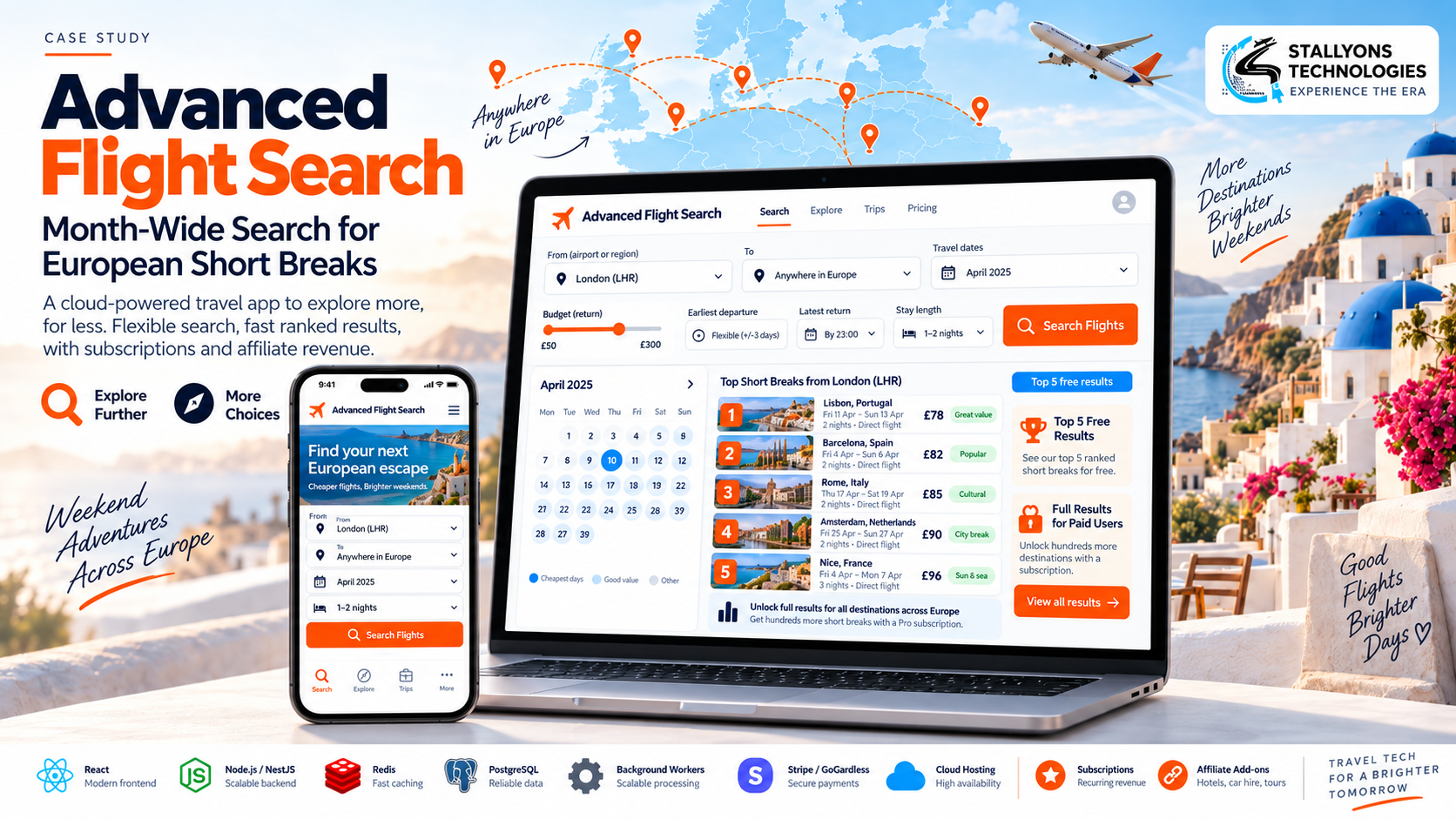
Someone wants a cheap break somewhere in Europe next month. Any weekend will do. They do not much care where they end up, as long as it is under a set budget, leaves early enough to make the day count, and gets them back in time for work on Monday. A normal flight search cannot help with that, because it wants a fixed origin, a fixed destination and a fixed date before it will do anything.
Advanced Flight Search starts from the opposite end. It is a cloud application for finding European day trips and short one-to-two-day breaks, where you search across a whole month, from a single airport or a whole region, to a specific place or everywhere, filtered by budget per person and by early departures and late returns, with the length of stay on the ground shown for each trip.
Put simply, it treats a loose “somewhere in Europe, sometime next month, under this budget” question as a space to explore rather than a single query to run, does the heavy work in the background, caches it, and returns ranked short breaks quickly, paid for through subscriptions and affiliate links.
The Starting Point: A Search Too Big to Run Live
The strength of the app is also its central engineering problem. A query like “a whole month, from a region, to everywhere” covers an enormous number of origin, date and destination combinations across low-cost carriers. Run that live on every request and the app would crawl. So the defining challenge was making a very broad, flexible search feel fast, and then making sure the product could pay for itself.
The problems the build set out to solve were:
- A huge, loose search space. A month, from many airports or a region, to everywhere covers far too many combinations to compute live on each request.
- Budget and timing filters. Results have to be filtered by budget band and by early departures and late returns, with each trip showing its length of stay, all derived from flight data.
- Low-cost-carrier coverage. The trips people actually book come from budget airlines like Ryanair, EasyJet and Wizz Air, so the search has to draw on a source that covers them.
- Free versus paid results. Free users should see the top five results and paid users the full set, so results have to be gated and billed reliably.
- Revenue beyond subscriptions. The app needs a second income stream through affiliate links for parking, hotels, car rental and tours.
- Broad searches at scale. All of this has to stay fast as usage grows, without the backend slowing down under heavy searches.
The Build: Search a Space, Not a Query
The heart of the solution is to treat a search as a space to explore instead of a single query to run. Broad searches, a whole month, a region or everywhere, run as background jobs, and their results are cached, so a heavy search is computed once and then served quickly while the app stays responsive. On top of that cached data, the backend filters and ranks server-side by budget band (under fifty pounds, fifty to a hundred, or a hundred plus) and by early departures and late returns, and computes the time on the ground for each trip. A flight-data source covering low-cost carriers feeds the whole thing. Making a broad search feel instant is exactly the kind of problem cloud app development exists to handle.
From the user’s side, a single loose search turns into ranked results through a clear sequence:
- The user sets a loose search: a month, one or many airports or a region, a place or everywhere, and a budget per person.
- The broad search runs as a background job rather than blocking the request.
- Its results are cached, so the heavy work is done once and reused.
- The backend filters and ranks by budget band and by early and late timing, computing the length of stay for each trip.
- Free users see the top five results and paid users the full set, with billing handled through Stripe or GoCardless.
Underneath, a Node.js API with background workers, a database, a Redis cache and cloud hosting keep the broad searches fast and the app able to scale, while affiliate links for parking, hotels, car rental and tours sit alongside the trips to earn from the whole journey, not just the subscription.
Technical Architecture
The architecture is a React web app over a Node.js API with background workers, a database and a Redis cache, a low-cost-carrier flight-data source, and Stripe or GoCardless billing, on cloud hosting. Each subsystem serves a fast, flexible search that pays for itself.
- Flexible, month-wide search. The search runs by whole month rather than a single date, from one or many airports or a region, to a specific place or everywhere, so the backend explores a large space of combinations rather than one query.
- Budget and timing filters. Results are filtered by budget band and by early departures and late returns, with the length of stay on the ground computed server-side for each trip.
- Low-cost-carrier flight data. A data source covering budget carriers such as Ryanair, EasyJet and Wizz Air feeds the search. Wiring that source and the affiliate partners in cleanly is API development work that keeps the results reliable.
- Caching and background work. Because a month-wide or everywhere search is expensive, broad searches run as background jobs and their results are cached, so the app stays fast and never repeats heavy work.
- Subscriptions and gating. Free users see the top five results and paid users the full set, with billing through Stripe or GoCardless, so the model is enforced at the point results are shown.
- Affiliate monetization. Affiliate links for airport parking, hotels, car rental and tours sit alongside the trips, so the app earns beyond subscriptions.
Challenges Solved
The central problem, a search too big to run live, was solved by treating broad searches as background jobs and caching their results, so a heavy “everywhere, all month” query is computed once and then served fast. Server-side filtering and ranking by budget band and timing, with stay length computed for each trip, surfaced the right short breaks quickly. A low-cost-carrier data source made sure the results showed the cheap flights people really book. Gating top five free and full for paid, billed through Stripe or GoCardless, gave the product a working subscription, and affiliate links across parking, hotels, cars and tours added a second revenue stream.
Turning loose inspiration into booked short breaks is squarely a travel and hospitality problem, and the build was shaped around how people actually plan cheap getaways: by budget and free weekend first, and only then by where.
The Result
The outcome is a flight-search app that answers a question most tools refuse to take: “where can I go cheaply in Europe next month?” A loose, month-wide or everywhere search returns ranked short-break options quickly, filtered by budget and timing and showing time on the ground, with a free tier of five results, a paid tier for the full set, and affiliate revenue running alongside. Because the broad searches are cached and processed in the background on a scalable cloud backend, the app stays fast as usage grows.
The performance-critical parts here, background workers, caching and scale under heavy load, are where infrastructure engineering earns its keep. If you are planning something with the same demands, you can hire DevOps developers who build for exactly this kind of load, or tell us about your product and we will scope the search, the caching and the billing together.
Frequently Asked Questions
How can the app search a whole month at once?
Instead of running a live query for a fixed date and route, it treats a month-wide or everywhere search as a space to explore. The broad search runs as a background job and its results are cached, so the heavy work is done once and then served quickly on later requests, which keeps a very large search fast.
Which flights and airlines does it cover?
The search draws on a flight-data source that covers low-cost carriers such as Ryanair, EasyJet and Wizz Air, so the results reflect the cheap short-break flights people actually book, rather than only full-service routes.
How does the free versus paid model work?
Free users see the top five results for a search and paid subscribers see the full set. Billing is handled through Stripe or GoCardless, so the tiers are enforced cleanly at the point the results are shown.
How does the app stay fast over such a large search space?
Broad searches run as background jobs on a Node.js backend with worker processes, and their results are held in a Redis cache. Heavy work is computed once and reused, and the app runs on scalable cloud hosting, so performance holds up as usage grows.
How does it earn revenue beyond subscriptions?
Alongside the trips, the app shows affiliate links for airport parking, hotels, car rental and tours and excursions. That adds a second revenue stream across the whole journey, on top of the paid subscription tier.