


Blog
Junk Removal Website:
WordPress Booking Wizard
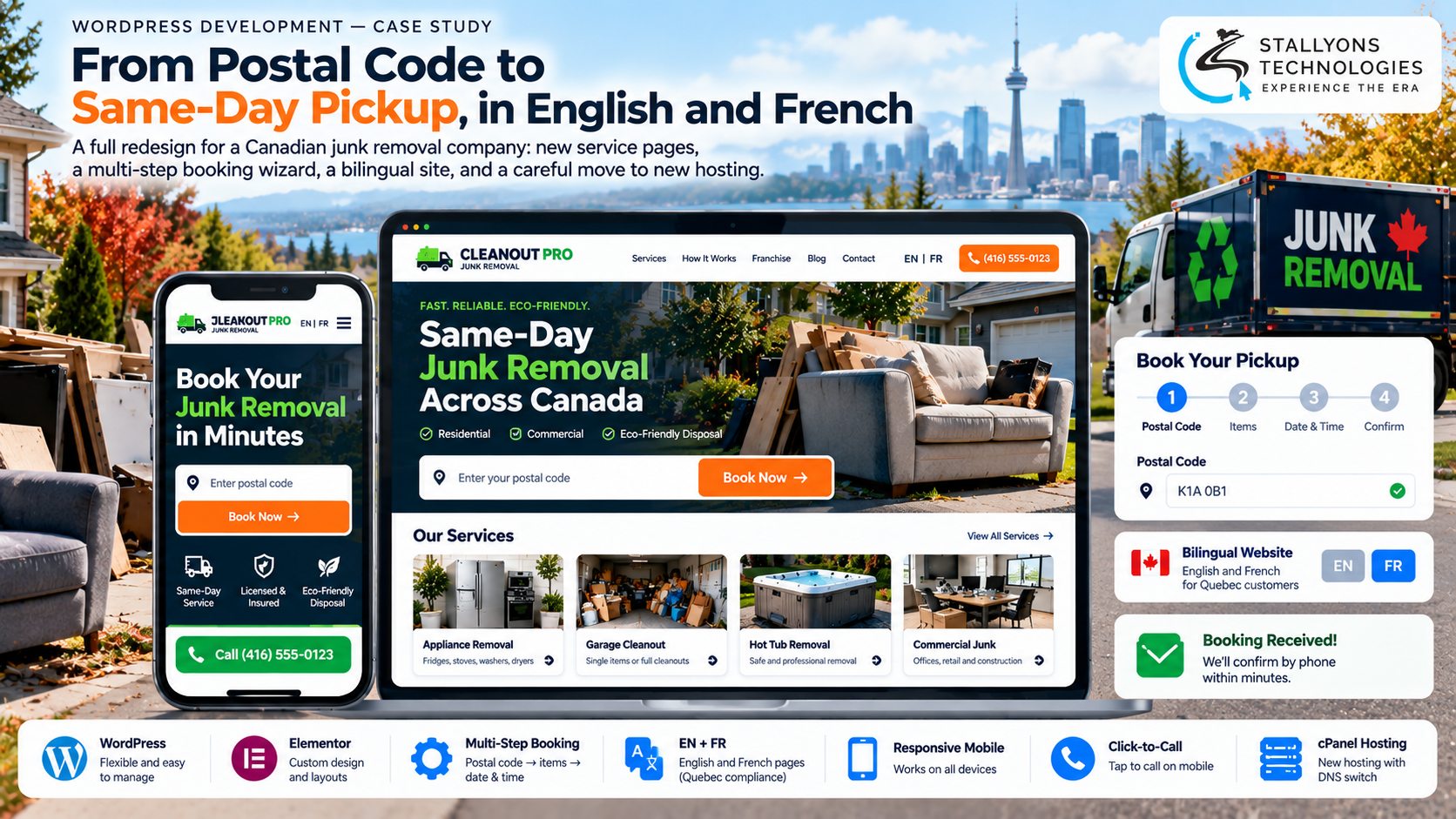
Someone wants an old hot tub gone before the weekend. They search on a phone, tap an ad, and land on a junk removal company’s website. If booking takes more than a minute, or asks for the same details twice, they close the tab and call the next company in the results. For a same-day service, the website is the booking desk, and a slow one hands the job to a competitor.
That was the problem a Canadian junk removal company brought to us. The business clears anything from a single appliance to a full garage or a hot tub, recruits franchise owners, and wins most of its customers through paid search. Its old site no longer matched the brand, the booking form missed details the office needed, and the files sat with a previous developer who would not release them. We designed and built a new site on WordPress and Elementor, with a page for each service, a franchise page, the existing blog carried over, and a multi-step booking wizard that starts from a postal code box in the header. The whole site works in English and French, as required for customers in Quebec.
Put simply, a visitor types a postal code, describes the job, picks a date and time, and the booking lands in the office inbox as a tidy email, on a phone, in either language, with nothing retyped along the way.
The Starting Point: A Website That Has to Take the Booking
For an ad-driven local service, the site is not a brochure. It has to turn a click into a complete booking the office can act on, on the small screen most visitors arrive with. That shaped a clear set of requirements, and each one had to hold up for a company running offices across several provinces.
- Book from every page. A visitor landing on any page, including an ad landing page, needed to be one step away from starting a booking.
- Capture what the office needs. The old form missed details such as the province and a preferred time, so the office had to chase customers before a job could be scheduled.
- Work properly on phones. Most ad traffic arrives on mobile, so layouts, images, and phone numbers all had to behave on a small screen.
- Run in two languages. A French version was required for customers in Quebec, and a visitor who chose French had to stay in French across the whole site.
- Move hosting without a safety net. The previous developer would not hand over the old site, so the move to new hosting had to be planned with no backup from the old server.
- Protect the rankings. The company ranked well on Google and ran ads to live pages, so changing addresses risked losing valuable links and landing pages.
The Build: From Postal Code to a Booking in the Office Inbox
The whole site points at one action, and getting an ad click to a finished booking in a few taps is the kind of work a focused WordPress web development team is built for, because the booking has to fit how this particular office already works rather than a generic contact form. A booking runs in a set order:
- The visitor lands on a page, enters a postal code in the header box, and presses Go.
- The booking wizard opens with the postal code already filled in, and walks them through the job in three short steps.
- They add contact details, address, province, and a preferred date and time in the familiar AM and PM format.
- On submit, the booking is sent to the office as a formatted email that keeps the layout the team already reads from.
- The visitor sees a confirmation and is returned to the homepage, so the next action is obvious.
- At any point they can switch to French, and the French menus and form keep them inside the French version of the site.
Behind that flow, the client’s own staff can edit text and publish blog posts without a developer, since the site is built in Elementor. The multi-step wizard itself was treated as a small web application rather than a plug-in form, which is why the postal code hands off cleanly, the province is a required field, and every booking email arrives complete.
Technical Architecture
The site runs on WordPress with Elementor for the page layouts. It was built and reviewed on our development server, then moved to the client’s new hosting. The pages were the easy part. The real engineering sat in the booking wizard’s details and in a hosting move that could not afford downtime. Each layer has one job.
- Pages and design. A bold homepage, a page per service, a franchise recruitment page, and the existing blog, all laid out in Elementor so staff can edit them.
- Booking wizard. A multi-step form that takes the postal code from the header, collects the job details over short steps, and enforces the fields the office depends on.
- Bilingual structure. English and French pages, menus, and the booking form are separate, linked versions, so a French visitor never falls back into English.
- Email notifications. Each booking is sent to the office inbox in a formatted layout that matches the way the team already processes jobs.
- Mobile behaviour. Responsive layouts and click-to-call phone numbers open the dialler straight from the header and the service pages.
- Hosting and launch. The site moved to the client’s own cPanel hosting with a DNS switch, timed with the client’s SEO advisor so the change happened in one planned step.
The part that needed the most care was the launch. With no files from the old developer, the new site had to be prepared in full on separate hosting, then cut over by DNS at a moment the SEO advisor agreed, so the company kept its rankings and its running ads instead of risking them on an unplanned switch.
Challenges Solved
The hardest problem was moving without losing search rankings. The company ranked well and ran ads straight to live pages, and the previous developer would not release the old site. We prepared the new hosting, held the switch until the client’s SEO advisor was ready, then changed the DNS and launched in a single step, so nothing went dark and no landing page was lost. The booking form was a second challenge: the first version followed the original designs, but the office needed more, so it was rebuilt from the client’s own step-by-step sketches, with province required, AM and PM time slots, and an email layout the team already used.
Two more issues were about control and fit. Many small design changes arrived page by page, so feedback was grouped into rounds and larger requests moved into a separate agreed milestone, which kept the project moving while the client still got the detail he wanted. Mobile was treated as its own design rather than a shrunk desktop: wide banners and a long truck image did not fit tall phone screens, so spacing, image sizes, and banners were tuned separately, and sideways scrolling was fixed.
The Result
The site now does one thing well. A visitor from an ad can enter a postal code and finish a same-day booking on a phone, in English or French, and the office receives a complete, formatted request it can confirm by phone. The client owns the site and its files outright, the staff can edit pages and add posts themselves, and the bilingual structure leaves room to grow into more French-speaking regions. The company approved the work and came back with requests for more pages.
If you run an ad-driven service and want the website to take the booking cleanly, you can hire WordPress developers who have built this postal-code-to-inbox flow before, or tell us how your bookings come in today and our US-registered team will map your job types, regions, and office process into one wizard. It suits any pickup, dispatch, or field service and logistics business that lives or dies on how fast a customer can book.
Frequently Asked Questions
What was built for the junk removal company?
A new WordPress and Elementor website with a bold homepage, a page for each service, a franchise page, the existing blog, and a multi-step booking wizard that starts from a postal code box in the header. The whole site runs in English and French.
How does the booking wizard work?
A visitor enters a postal code in the header and presses Go. The wizard opens with that postal code filled in, walks them through the job in short steps, then collects contact details, address, province, and a preferred date and AM or PM time. The booking is emailed to the office in a formatted layout.
Why does the site need a French version?
A French version is required for customers in Quebec. The English and French pages, menus, and booking form are separate, linked versions, so a visitor who picks French stays in French as they move around the site rather than dropping back into English.
How was the move to new hosting handled without losing rankings?
The previous developer would not release the old site, so the new site was prepared in full on the client’s own hosting, then switched over by DNS at a time agreed with the client’s SEO advisor. Launching in one planned step kept the rankings and the running ads intact.
Can the client update the site without a developer?
Yes. The site is built in Elementor, so the client’s own staff can edit text and publish blog posts. Walkthrough videos were provided to show how the translations and menus work, so the team can keep both language versions current on its own.