


Blog
Purely Nourishing: Squarespace
Programme Site
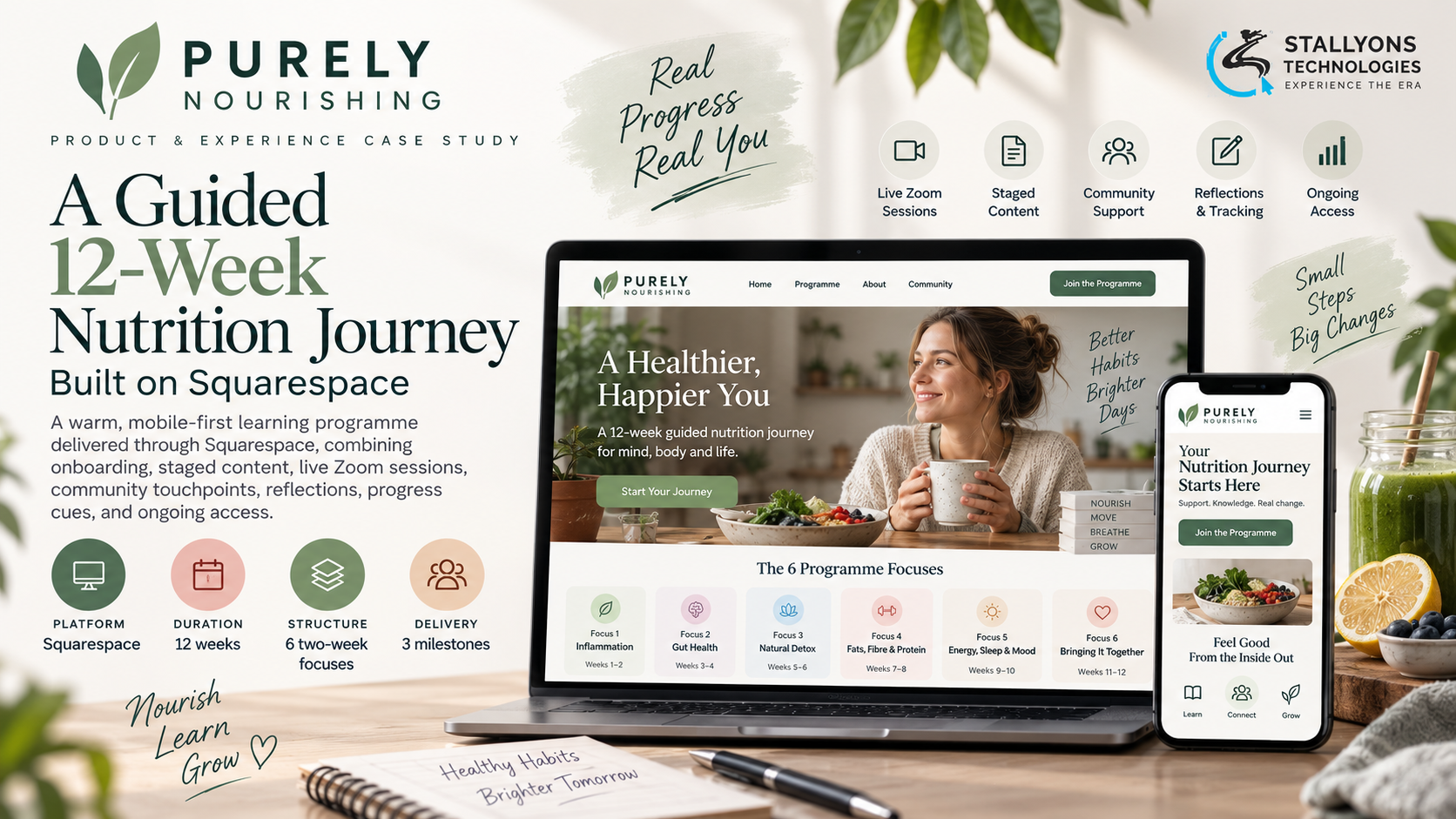
A twelve-week programme can go wrong before the first lesson. Everything is uploaded at once, the participant lands on a wall of modules, and the thing that was meant to feel like a supportive journey feels like a course library to get lost in. For a small-group programme built on trust, that first impression is most of the battle.
Purely Nourishing is a guided twelve-week nutrition programme for small groups of women, and this project is the Squarespace experience it runs on. It is organised around six two-week focuses, live Zoom sessions, staged access to content, community touchpoints, end-of-focus reflections, and clear progress cues, and it is built to feel warm and easy to follow on a phone.
Put simply, the site reveals the right content at the right stage instead of showing everything at once, ties each new focus to its Monday Zoom, collects a short reflection at the end of every focus, and keeps a participant always able to answer three questions: where am I, what do I do now, and where can I get support? The nutrition content is written by the programme’s own nutritionist. The build structures it, presents it, and makes the next step obvious.
The Starting Point: A Programme, Not a Course Library
The project was never simply about publishing nutrition content. The harder task was turning a twelve-week programme into a structured digital experience that feels calm, clear, and supportive from the first day to the final reflection. That set a clear list of requirements:
- Guide the progression. Participants need to move through six focuses in sequence without feeling lost or overloaded.
- Stage the content. Focuses two to six open around the Monday programme rhythm, while earlier focuses stay accessible to revisit.
- Handle two content shapes. Some focuses use four pillars, Sleep, Stress, Food, and Movement, while others run week by week, so the layout has to bend to the content.
- Blend live and on-demand. Each focus includes a Zoom session with a live join path and a recording path afterwards, so missing the call does not mean missing the focus.
- Store the reflections. End-of-focus responses need to be collected across all six focuses and kept available for later review or export.
- Work on a phone first. The programme is used heavily on mobile, so navigation, buttons, content blocks, and progress cues all have to stay easy on a small screen.
The Build: A Guided Cycle That Repeats Six Times
The experience is built around one repeating cycle rather than a pile of separate pages, so a participant learns the rhythm once and then simply follows it. Getting that rhythm right on Squarespace, warm, mobile-first, and clear at every step, is the substance of the Squarespace website design behind the programme. Each two-week focus runs the same way:
- The participant joins, works through a warm welcome and onboarding, and completes a baseline health and lifestyle check-in.
- The current focus opens on its scheduled date, while earlier focuses stay available to revisit.
- The focus opens with its Monday Zoom, offered as a live join and then as a recording afterwards.
- The teaching and activities follow a repeatable flow: an introduction, the lesson, something to try, resources, a community prompt, and an optional reflection.
- At the end of the focus, a short and friendly reflection is collected and stored.
- The next focus becomes upcoming, and the same cycle begins again.
Within a pillar or a week, the sections follow that same predictable pattern, and the buttons use plain labels such as Start, Watch, Listen, Try this, Download, Reflect, and Join the conversation. The programme home area answers the practical questions directly: the current focus and week, a clear Continue action, the next Zoom and its join path, current progress, and a way back to earlier focuses and to support.
Technical Architecture
Squarespace is the core platform, and the architecture is deliberately kept practical. The programme is a branded, responsive, member-facing experience, and anything that needs an outside service is treated openly as an integration rather than dressed up as native Squarespace behaviour. The parts that carried it:
- Squarespace platform and structure. Six structured focuses with consistent navigation and repeatable content patterns.
- Staged content access. Focus one is available from the start; later focuses open on the agreed programme calendar, while previous ones stay accessible.
- Live sessions. Six Zoom touchpoints, each with a clear live-session path and a recording path afterwards.
- Reflections. A form-based or agreed data-capture flow collects end-of-focus responses and retains them across all six focuses for later review or export.
- Community and progress. Community touchpoints linked from the content, visual progress cues across the six focuses, and an optional habit tracker with no leaderboard and no failure state.
- Reminders. An agreed notification workflow around Zooms, content releases, check-ins, and reflection points, tuned so it supports without over-notifying.
The care here is as much about experience as engineering, which is why it sits alongside UI/UX design as much as any platform work. Where a feature would need automation Squarespace does not natively provide, such as a personalised end-of-programme PDF, it is treated as a separate, agreed integration rather than presented as built in. That honesty is what keeps the build reliable rather than fragile.
Challenges Solved
The key design problem was sequencing: giving enough guidance to keep participants moving without making the programme feel rigid or clinical. Overwhelm was reduced by revealing the right content at the right stage instead of all at once. Rhythm was created by tying each new focus to its Monday Zoom. Reflection was supported by collecting and keeping every end-of-focus response. And the programme was kept human with warm language, optional tracking, and a clear sense of progress, so missing a live Zoom does not block anyone because the recording is there, and skipping the optional tracker never creates a failure state.
It is the kind of structure online education and course creators need when a programme has to feel like a guided journey instead of a dumped content library.
The Result
The outcome is a warm, mobile-first Squarespace programme that a participant can follow from the welcome through to the Week 12 reflection without ever having to work out the structure herself. The right content appears at the right time, each focus opens with its Zoom, reflections are captured and kept, and progress stays visible throughout. Placeholders let the full experience be designed and tested while final content arrives over time, and the whole journey, from join to Week 12, is tested before launch, along with staged access, mobile screens, and the reflection data.
The build works because it measures progress through participation and reflection rather than pressure or competition. If you are planning a programme like this, you can hire UI/UX designers who build guided experiences on Squarespace, or tell us about your programme and we will map its stages, sessions, and reflections into a build participants can actually follow.
Frequently Asked Questions
What is Purely Nourishing built on?
Squarespace. It is a branded, responsive, member-facing experience built around six two-week focuses, live Zoom sessions, staged content access, community touchpoints, reflections, and progress cues, with anything that needs an outside service treated as a clearly labelled integration rather than native Squarespace functionality.
How does the staged content access work?
Focus one is available from the start of the programme, and the later focuses open on the agreed programme calendar. Earlier focuses stay accessible so participants can revisit material, and future focuses can be shown as upcoming until their scheduled release, which keeps the journey guided without feeling locked down.
What happens if a participant misses a live Zoom?
Nothing breaks. Each focus offers the Zoom as a live join and then as a recording afterwards, so missing the live session does not block progress. The same forgiving approach applies to the optional habit tracker, where skipping it never creates a failure state.
Are the end-of-focus reflections saved?
Yes. Each focus closes with a short, friendly reflection, and the responses from all six focuses are collected and retained so they can be reviewed later or exported. The reflection data is one of the things verified during QA before launch.
Does the programme rely on automation Squarespace does not support?
No. The implementation uses the simplest reliable Squarespace setup and agreed integrations. Where something would need behaviour Squarespace does not provide natively, such as a personalised end-of-programme PDF, it is treated as a separate integration rather than presented as built in.