


Blog
DriveCare: React Native
Car-Servicing Marketplace
Getting a car serviced usually runs on guesswork. You cannot describe the noise properly, you get one quote with nothing to compare it against, and once the car is handed over you hear nothing until someone calls. DriveCare was built to take all three of those problems away and make the whole job visible from a phone.
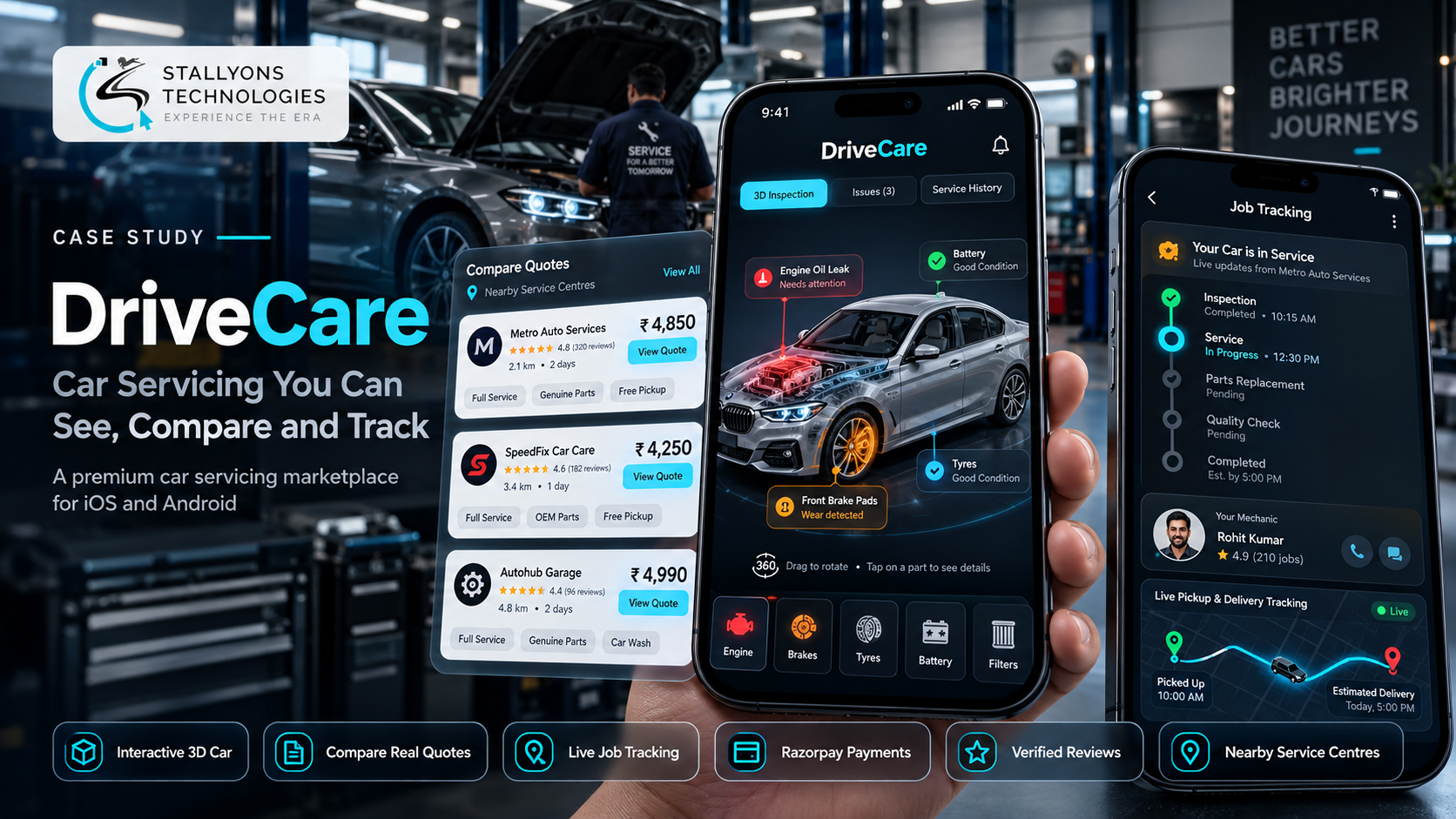
DriveCare is a premium car-servicing marketplace for iOS and Android. An owner inspects their own car as an interactive 3D model, taps the part that has a problem, and picks the issue from a list. Nearby service centres send real quotes, the owner compares price, ratings and verified reviews, chooses one, and then follows the job live, from inspection through to the assigned mechanic’s details and GPS tracking during pickup and delivery. It is built in React Native for both platforms, with a Laravel backend and Razorpay payments.
Put simply, DriveCare turns a vague phone call into a structured request. You tap the issue on a 3D model of your car, competing centres in your area quote on it, you book and pay, and you watch every stage of the service happen in real time. No phone tag, no surprise bill, and no wondering where the car is.
The Starting Point: A Marketplace, Not a Booking Form
A simple “book a garage” screen would not have solved the real problem, which is trust. For DriveCare to replace the habit of going back to the same garage, it had to make the job clear, competitive and visible from start to finish. That set a specific list of requirements.
- Let owners show the problem, not describe it. Most owners are not mechanics, so the app had to let them point at the fault on their own car rather than type a description a centre might misread.
- Put real quotes in competition. Each request had to reach several nearby centres so the owner could compare price, ratings and reviews side by side instead of accepting the first number.
- Make the service visible end to end. Once a car was handed over, the owner had to see the current stage, who had the car, and where it was during pickup and delivery.
- Keep every review honest. Ratings had to unlock only after a job was marked complete, so every review came from a real, finished service.
- Serve four roles at once. Customers, service centres, mechanics and an admin each needed their own view, with everyone seeing the same job state.
- Run well on everyday phones. A detailed 3D car had to load and rotate smoothly on the mid-range devices most owners actually carry.
The Build: From a Tap on a 3D Car to a Booked Job
A job runs as a clear sequence rather than a form submission. Getting an interactive 3D car to run smoothly on a mid-range phone, and turning a tap on it into a structured service request, is the heart of the React Native app development behind DriveCare. The customer flow goes in order:
- The owner logs in with an OTP and adds their car by brand, model, variant and distance driven.
- They rotate the 3D car, tap an area such as a door, drill into parts like the mirror or lock, and pick the issue, or describe a symptom and let the app suggest where to look.
- The request goes to relevant service centres in the area, who each send a quote.
- The owner compares price, ratings and verified reviews, and selects a centre.
- The centre assigns a mechanic, and the owner follows a live timeline with GPS tracking during pickup and delivery.
- After the job, the owner pays through Razorpay, rates the centre, and gets a reminder when the next service is due.
On the other side, each garage works from a simple web dashboard that receives requests with the car details and selected issues, sends quotes, and manages accepted jobs. It assigns a mechanic or pickup person, who uses a lightweight mobile view to update each stage and share live location. Role-based access keeps it clean, so a mechanic only sees jobs assigned to them and the admin oversees the whole platform.
Technical Architecture
DriveCare is a marketplace that serves four roles at the same time, so the architecture is built around keeping them in sync as a job moves from quote to completion. Each layer does one job.
- Mobile apps. React Native powers both the customer and the mechanic apps from a single codebase across iOS and Android.
- 3D rendering. React Three Fiber with glTF models renders the tappable car, with each model optimised for mobile so it loads fast and rotates smoothly.
- Backend and API. A Laravel REST API handles OTP auth, role-based access and the booking logic. Keeping four roles consistent behind one clean interface is the kind of API development that makes the rest of the product possible.
- Real-time layer. WebSockets push stage updates from the centre and GPS from the mechanic’s phone, so the owner’s timeline changes the moment something does.
- Data. MySQL holds users, vehicles, jobs, quotes and completed-job outcomes with relational integrity.
- Integrations. Razorpay for payments, Google Maps for live tracking and centre search, and Firebase Cloud Messaging for push alerts and next-service reminders.
The part worth engineering carefully was the join between the 3D car and the request it produces. Every tappable area had to map to its sub-parts and link to a list of common issues, built as a reusable library the admin can extend, so new car models and new faults can be added later without touching the core platform.
Challenges Solved
The harder problems were the ones that make or break a marketplace. Smooth 3D on everyday phones was solved by optimising each model and testing on real iOS and Android devices. Vague requests were solved by mapping every tap to structured issues. Fake reviews were solved by unlocking ratings only after a completed job. And a cold-start data problem was handled honestly, with a predefined issue database and patterns shown as history rather than guarantees.
The through-line was coordination. A single job touches the customer, the centre, the mechanic and the admin, with live GPS during pickup and delivery, which is the same real-time, multi-party tracking that logistics and field-service operations rely on every day.
The Result
The outcome is an app that replaces guesswork with a service the owner can see, compare and follow. Owners show the fault on a 3D model instead of describing it, several centres quote on the same request, every review comes from a finished job, and the owner follows the car from inspection to delivery. DriveCare is live on both the Apple App Store and Google Play.
The build works because it was designed as a real marketplace rather than a booking screen bolted onto a garage. If you are planning a product like this, you can hire React Native developers who have shipped this 3D-inspection-to-booking flow, or tell us about your product and we will map your two-sided flow to a build. We work as a React Native app development company that ships marketplaces, not just screens.
Frequently Asked Questions
What is DriveCare?
DriveCare is a car-servicing marketplace for iOS and Android. An owner inspects their car as an interactive 3D model, taps the part with a problem, receives competing quotes from nearby service centres, books and pays, and then tracks the whole job live, including GPS during pickup and delivery.
How does the 3D car inspection work?
The owner sees a 3D model of their own car, rotates it, taps an area such as a door, drills into parts like the mirror or lock, and picks the issue from a list. If they are unsure, they can describe a symptom in their own words and the app suggests which areas to check, so centres receive a clear, structured request.
What technology is DriveCare built with?
The customer and mechanic apps are built in React Native for iOS and Android. The 3D cars use React Three Fiber with glTF models, the backend is a Laravel REST API with a MySQL database, live updates run over WebSockets, and it integrates Razorpay, Google Maps and Firebase Cloud Messaging.
How does DriveCare keep reviews and pricing honest?
Every request goes to several centres that compete on price, so the platform never sets prices itself. Ratings unlock only after a job is marked complete, which means every review comes from a real, finished service rather than an anonymous rating.
Can new car models and services be added later?
Yes. The mapping between a car’s parts and its common issues is built as a reusable library managed from the admin panel, so new car models, parts and faults, including EV-focused categories, can be added without changing the core platform.