


Blog
B2Print: A Bilingual
Shopify Print Store
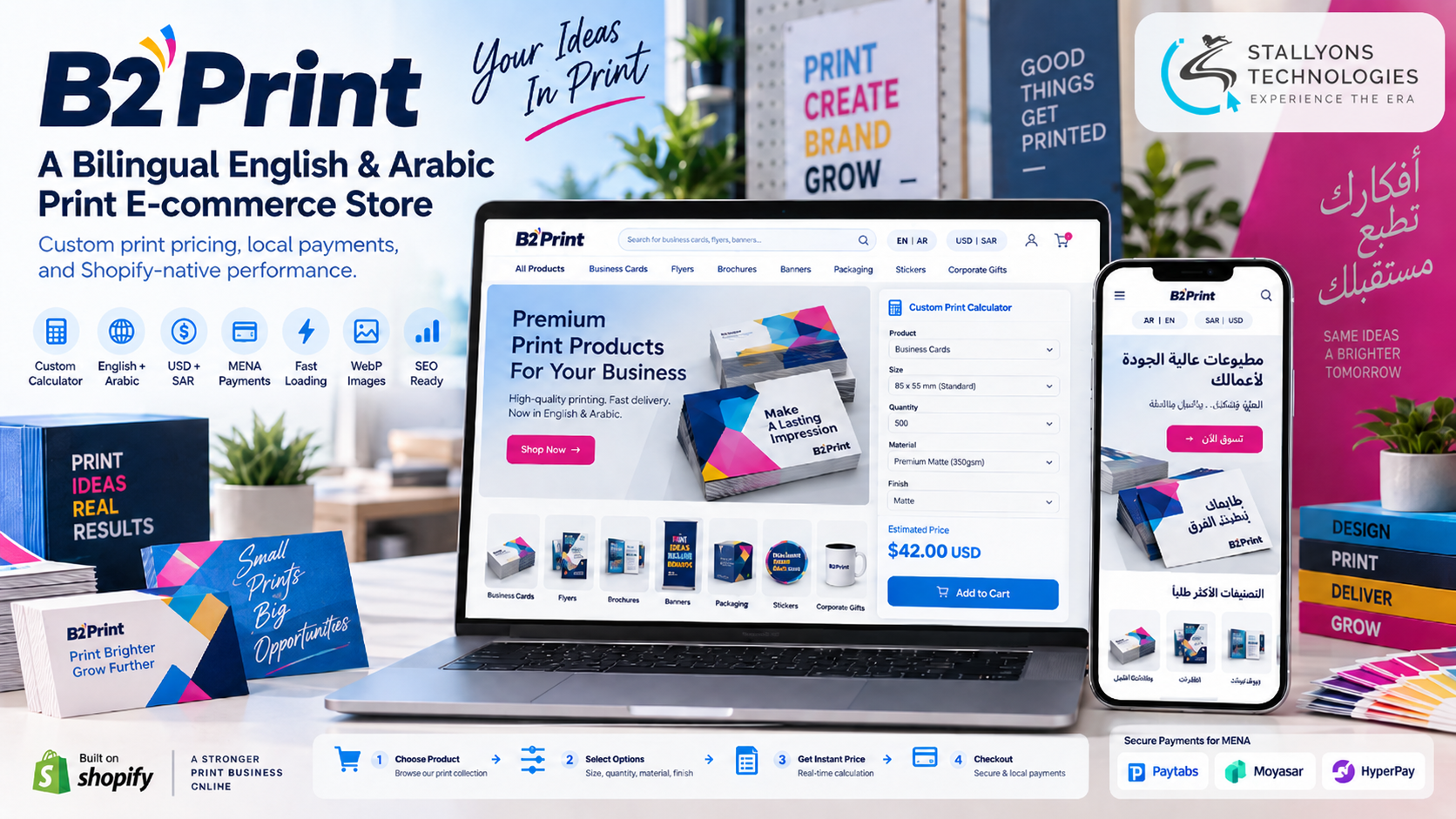
A designer in Riyadh opens the site in Arabic, reads right to left, and prices a run of 500 business cards in Saudi Riyal. A marketing lead in Chicago opens the same store in English, reads left to right, and prices the same job in US Dollars. Neither of them is buying a fixed-price product. Each is configuring a custom print job, and each expects the store to feel like it was built for them.
That is what this project delivers. B2Print is a print-products store built on Shopify for b2print.com, made to match the look and features of a reference print site while serving two audiences from one catalogue: English left to right in US Dollars for a global market, and Arabic right to left in Saudi Riyal for the MENA region, with a cost calculator that prices every custom job.
Put simply, one Shopify store carries print products such as business cards, flyers and banners, lets a customer configure size, quantity and material and see the price before checkout, then switches language, reading direction and currency so each visitor gets a shop that reads as if it were made for their market.
The Starting Point: A Reference Site, Two Languages and Custom Print Pricing
The brief was originally written around WordPress themes and plugins that do not run on Shopify. The job here was to deliver the same store on Shopify, match the reference site closely while staying original and inside copyright and trademark law, and build each requirement with its Shopify equivalent. In practice the hard parts were six:
- Custom jobs need real pricing. Print products are not fixed-price items; the price depends on size, quantity, material and finish, so the store needs a cost calculator rather than a plain add-to-cart button.
- Two languages, two directions. The site has to work in English left to right and Arabic right to left, which is a real layout requirement rather than translated text alone.
- Two currencies, two audiences. MENA visitors should see Saudi Riyal and everyone else US Dollars, with the option to switch, so pricing feels local to each visitor.
- Regional payments. Checkout needs MENA gateways such as Paytabs, Moyasar and HyperPay, rather than international cards alone.
- Match the reference. The look and features have to track the reference site while the build stays original and lawful.
- Fast, secure and found. Images must be WebP, the store must load quickly and be secure against attacks, and it must be set up for on-page SEO.
The Build: Shopify Equivalents for a WordPress Brief
The storefront is a customized Shopify theme that mirrors the reference look, is responsive across devices, and supports right-to-left layout for Arabic. Print products are set up with their options, size, quantity, material and finish, and a price-calculator app quotes each custom job from those options, so a print product behaves like a real print order rather than a fixed-price item. Where the brief named a WordPress theme, page builder, calculator plugin or multilingual plugin, the equivalent Shopify theme, section, app or setting is used instead, which keeps custom code to a minimum. This is the kind of Shopify development that reproduces a platform-specific brief without dragging the whole toolchain along with it.
For a customer ordering a custom job, the path runs in a clear order:
- Open a print product, a business card, flyer or banner, and choose its options for size, quantity, material and finish.
- The price-calculator app quotes the job from those options, so the price reflects the real print order before anything is added to the cart.
- Set language, reading direction and currency, English left to right in US Dollars or Arabic right to left in Saudi Riyal, or accept the default for the visitor’s market.
- Add the configured job to the cart and check out through a MENA gateway such as Paytabs, Moyasar or HyperPay, or with a standard card.
Language and currency run on Shopify Markets: English displays left to right in US Dollars and Arabic displays right to left in Saudi Riyal, with MENA visitors defaulting to the Arabic and Riyal experience and everyone able to switch manually. Because that same Markets foundation is what a store leans on when it adds more regions, currencies and higher volume later, a build like this scales cleanly into Shopify Plus development when the catalogue and the markets it serves grow.
Technical Architecture
Under the hood this is a Shopify build that matches a reference site and delivers each named WordPress requirement with a Shopify equivalent. The architecture centres on a customized, RTL-capable theme, print products priced by a calculator app, bilingual and multi-currency delivery through Shopify Markets, MENA payment gateways, and the platform’s built-in WebP, speed and security. It breaks down into a handful of subsystems, each mapped to a requirement:
- Print catalogue and calculator. Products carry their options, size, quantity, material and finish, and a price-calculator app quotes each job from them, so a print product prices like a real order.
- Bilingual, bidirectional storefront. The theme runs English left to right and Arabic right to left with translated content, so both language experiences read naturally rather than being an overlay of one on the other.
- Multi-currency by market. Shopify Markets shows US Dollars to global visitors and Saudi Riyal to MENA visitors, with manual switching, so pricing is local to each audience.
- MENA payment gateways. Regional gateways such as Paytabs, Moyasar and HyperPay are integrated for checkout, alongside standard cards, so MENA customers can pay the way they expect.
- Images, speed and SEO. Images are served as WebP through Shopify’s content delivery network, the theme is tuned for quick loading, and on-page SEO is configured and left editable after delivery.
- Security and licensing. Security against malware, DDoS and attacks is handled by the hosted platform, and only properly licensed themes and apps are used.
A store that prices custom jobs and serves two markets from one catalogue is squarely retail and ecommerce work, where the calculator and the localization are the difference between a print shop that fits its buyers and a generic template that does not.
Challenges Solved
The harder problems clustered around honouring a WordPress-shaped brief as a bilingual Shopify print store. Each named WordPress theme and plugin was replaced with a Shopify theme, app or setting, so the functionality matched the reference while the whole store stayed in one maintainable ecosystem. Print pricing was handled by a calculator app that quotes each product from its size, quantity, material and finish, so customers see a real price for a custom order rather than a fixed one that does not fit print work.
Localization was treated as two full experiences rather than a translated overlay: English left to right in US Dollars and Arabic right to left in Saudi Riyal, each with its own currency and manual switching, so each audience gets a native-feeling site. Regional gateways such as Paytabs, Moyasar and HyperPay let MENA customers pay as they expect, WebP images and an optimized theme keep the store fast, the hosted platform covers security, and on-page SEO is set up and left editable after handover.
The Result
The outcome is a single Shopify store that matches its reference site and serves both a global and a MENA audience well. A visitor prices a custom print job through a real calculator, reads the store in their own language and reading direction, sees prices in their own currency, and checks out through a gateway they recognise. Images load as WebP, the platform handles security, and the on-page SEO is left in place and editable for the team after delivery.
The store fits the business because the calculator and the bilingual, bidirectional localization were built for how a print shop and its two audiences actually work, not bolted onto a generic template. If you are planning a bilingual or multi-currency store like this, you can hire Shopify developers who have delivered exactly this model, or tell us about your catalogue and we will map your products, pricing and markets to the right Shopify setup.
Frequently Asked Questions
Can one Shopify store run in both English and Arabic with right-to-left layout?
Yes. A customized theme delivers English left to right and Arabic right to left as full experiences with translated content, and Shopify Markets pairs each language with its own currency, so a single store reads naturally in both directions rather than showing one language as an overlay of the other.
How do you price custom print jobs on Shopify?
Print products are set up with their options, size, quantity, material and finish, and a price-calculator app quotes each job from those options. The customer sees a real price for the configured order before adding it to the cart, which suits print work far better than a single fixed price.
Can MENA customers pay with local gateways and see Saudi Riyal?
Yes. Regional gateways such as Paytabs, Moyasar and HyperPay are integrated alongside standard cards, and Shopify Markets shows Saudi Riyal to MENA visitors and US Dollars to everyone else, with manual switching, so regional customers see local pricing and pay the way they expect.
Can you rebuild a WordPress or WooCommerce brief on Shopify?
Yes. Here a brief written around WordPress themes and plugins was delivered on Shopify by replacing each one with its equivalent Shopify theme, section, app or setting, plus a price-calculator app, so every feature the brief called for shipped on Shopify while the store stayed in one maintainable ecosystem.
How is the store kept fast and secure?
Images are served as WebP through Shopify’s content delivery network and the theme is tuned for quick loading, while the hosted platform handles security against malware, DDoS and attacks. Only properly licensed themes and apps are used, and on-page SEO is configured and left editable after delivery.