


Blog
Should I Take
the Job: Custom Decision Engine
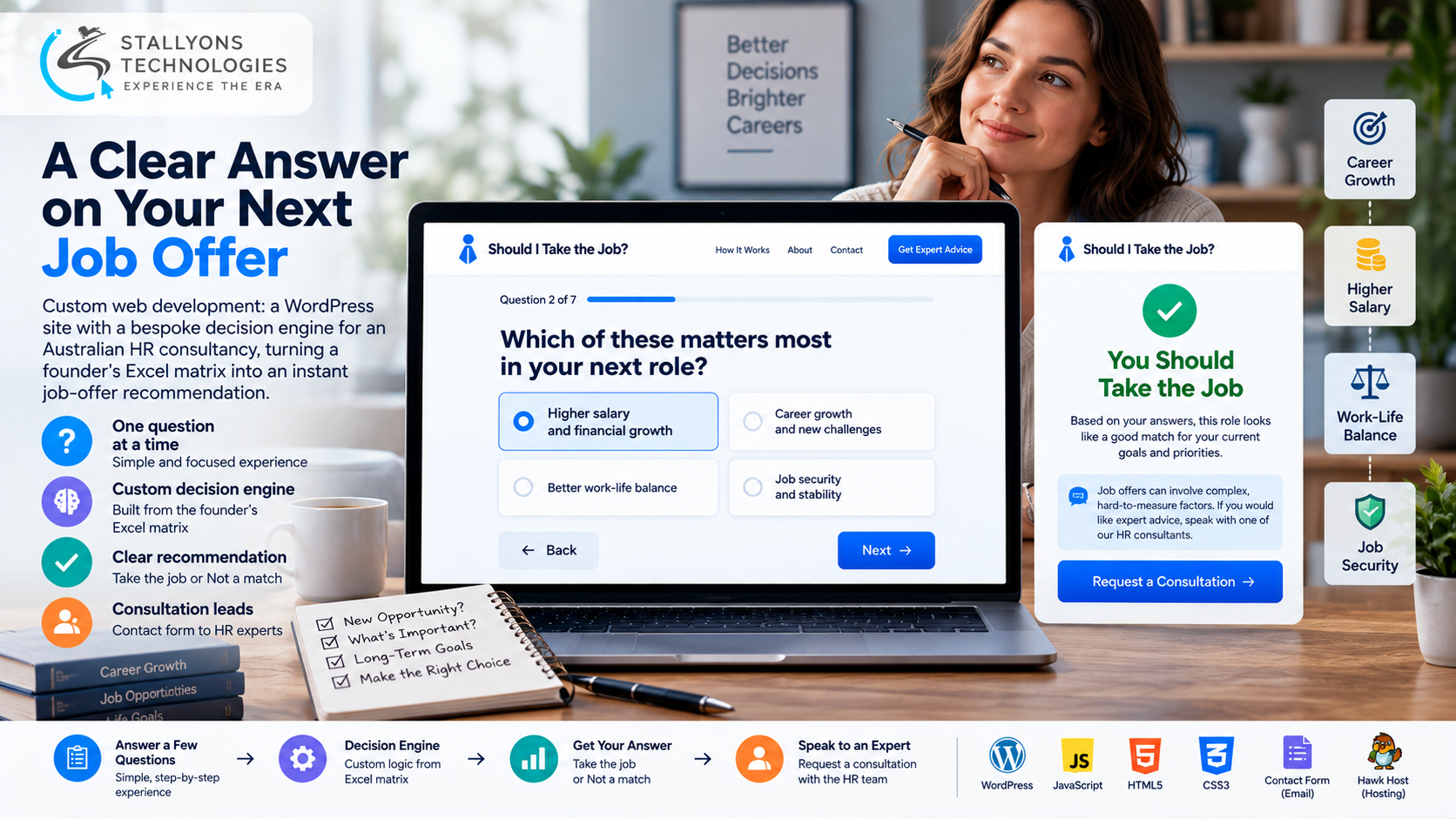
A job offer is one of the bigger decisions most people make, and it is often settled on gut feeling alone. Salary pulls one way, growth another, work-life balance a third, and long-term goals somewhere else entirely. An Australian HR and talent consultancy wanted to give job seekers a quick, free way to get a structured first answer, and a natural path from that answer to a paid conversation with its career consultants.
Should I Take the Job? is the website we built to do exactly that. A visitor answers a short run of multiple-choice questions, starting with their current life goal, and the site returns a clear recommendation: take the job, or this role does not match your goal right now. The founder had already designed the decision logic as an Excel matrix and owned the domain, but off-the-shelf quiz builders could not run his exact rules, so this was delivered as a custom web development project.
Put simply, someone with an offer on the table answers a few questions, gets a clear yes-or-no recommendation built from the founder’s own HR logic, and is then invited to book a paid consultation with a human expert. No account, no stored answers, and nothing more complicated on screen than one question at a time.
The Starting Point: A Spreadsheet That Had to Become a Website
The idea and the logic were ready; what was missing was a way for anyone other than the founder to use them. His matrix lived in long, nested Excel formulas, which no visitor could ever touch directly. That shaped a tight set of requirements.
- Run the founder’s exact rules. Tools like Typeform or uQuiz score answers or follow simple branches. They could not apply his combination logic, where the chosen life goal changes what every other answer means.
- Feel effortless to use. The founder wanted a very minimal, modern look, one question at a time, with nothing on screen to distract from the decision.
- Turn answers into leads. The result page had to do more than give a verdict. It had to invite the visitor to request a paid consultation and send their details to the consultancy.
- Respect privacy. Visitors should not need an account, and their answers should not be stored anywhere.
- Stay easy to change. The founder expected to refine the questions over time and wanted to edit them himself without rebuilding the site.
- Run on real hosting. The site had started on a free WordPress.com plan, which blocks the plugins and custom code a working quiz and contact form need.
The Build: One Question at a Time, Then an Answer
The visitor lands on a calm, single-colour page and answers one multiple-choice question at a time, moving back and forward as they like. When the last answer is in, the site checks the full set against the founder’s matrix and shows the recommendation straight away, with no extra submit step. Rebuilding a spreadsheet’s logic as reliable, testable code is the quiet core of this custom software development services project. A session runs in a simple order:
- The visitor opens the site and is asked for their current life goal first, because that answer sets the context for the rest.
- They work through the remaining multiple-choice questions, one per screen, using back and next controls.
- The decision engine applies the founder’s rules in the browser the instant the last answer is given.
- A clear result appears: take the job, or this role does not match your current goal.
- Under the result, a short note explains that offers involve factors a quiz cannot weigh, and invites expert advice.
- If the visitor wants help, they submit a short form, which emails their details straight to the consultancy.
The recommendation is not generic scoring. The founder’s Excel drop-downs and nested IF formulas were rewritten as a bespoke JavaScript rules engine, then checked against his spreadsheet so every combination returns the same answer he intended. Running that engine in the browser, inside a lightweight WordPress site, is what makes the tool feel instant while keeping it firmly in the territory of a genuine interactive web application development build rather than a hosted quiz widget.
Technical Architecture
The site is a custom JavaScript decision engine delivered inside a minimal, self-hosted WordPress site. The challenge was never the number of pages. It was translating long spreadsheet formulas into dependable code, keeping the design genuinely minimal, and moving the site off a free plan that could not run it. Each piece was chosen to keep the site fast, private, and easy for the founder to manage.
- WordPress (self-hosted). The founder edits text, colours, and questions himself, with a short video guide for changes such as the background colour.
- Decision engine. A bespoke JavaScript rules engine reproduces the founder’s Excel matrix exactly and runs instantly in the visitor’s browser.
- Minimal design. HTML and CSS deliver a responsive, one-question-at-a-time layout in his chosen colours and fonts, with a footer disclaimer.
- Lead capture. A WordPress contact form on the result page sends each consultation request to the consultancy by email.
- Privacy by design. No accounts, and no answers stored anywhere; only the details a visitor chooses to submit are ever sent.
- Hosting and domain. The site was built on staging, then migrated to standard hosting once the domain transfer from WordPress.com cleared.
The piece worth engineering carefully was the decision engine itself. Working through the spreadsheet with the founder confirmed that the life-goal answer drives everything and that only a small, defined set of combinations leads to “take the job”. Rebuilding that as clear JavaScript and testing it against his sheet is what lets the site give an answer he trusts.
Challenges Solved
The first challenge was turning long nested Excel formulas into rules anyone could maintain. Early versions of the matrix did not cover every question, so we worked through it with the founder, established that the life goal sets the context, and rebuilt the whole thing in JavaScript, checked combination by combination against his spreadsheet. The second was design: minimal is easy to say and hard to picture, so after seeing a first version the founder supplied a short design document, and the look was adjusted to match, with no boxes around the heading, white-bordered answers, and white text throughout.
The last challenges were practical. A free WordPress.com plan blocked the plugins the site needed, so rather than jump to an expensive business plan, the founder was moved to affordable standard hosting that kept full WordPress editing. Because a newly registered domain cannot be transferred for a short period, the finished site waited on staging and was migrated the moment the domain could move.
The Result
The outcome is a free, private tool that gives job seekers a clear, structured answer and ends every result with an invitation to speak to a human expert. The founder owns all of the code, runs it on his own hosting and domain, edits the questions himself, and pays no monthly quiz-builder subscription. A useful free answer builds trust at exactly the moment someone is weighing an offer, which is what turns casual visitors into qualified consultation enquiries.
It works because the founder’s own logic was rebuilt faithfully instead of being squeezed into a generic quiz tool. If you have a decision process or an internal spreadsheet you want to turn into a public tool, you can hire dedicated developers who do this kind of bespoke software development, or tell us about your logic and we will map it to a site you can run yourself. The same approach fits any careers, learning, and professional-development brand that wants a free tool to bring in paid work.
Frequently Asked Questions
What does the Should I Take the Job? site do?
It is a free web tool that helps someone decide whether to accept a job offer. The visitor answers a short series of multiple-choice questions, starting with their current life goal, and the site returns a clear recommendation along with an invitation to book a paid consultation with an HR expert.
Why build a custom decision engine instead of using a quiz builder?
Hosted quiz builders only score answers or follow simple branches, carry their own branding, charge monthly, and keep visitor data on their servers. The founder’s rules needed a bespoke engine, where the life goal changes the meaning of every other answer, run on his own domain with no data stored and full ownership of the code.
Is any personal data stored?
No. Visitors do not create an account, and their answers are never saved. Only the details someone chooses to enter in the consultation form are sent, and those go straight to the consultancy by email. A footer also notes that the result is not legal or financial advice.
Can the founder change the questions himself?
Yes. The decision tool runs inside a self-hosted WordPress site, so the founder can update the wording, colours, and questions without a developer. A short video guide covers common changes such as adjusting the background colour.
Why did the site need to move off a free WordPress.com plan?
A free WordPress.com plan blocks the plugins and custom code the quiz and contact form rely on. Rather than pay for an expensive business plan, the site was moved to affordable standard hosting that supports those features, and the domain was transferred across once its initial lock period ended.