


Blog
How a React
Native App Development Company Built Restjoy: A Multilingual, Map-Discoverable Menu Platform
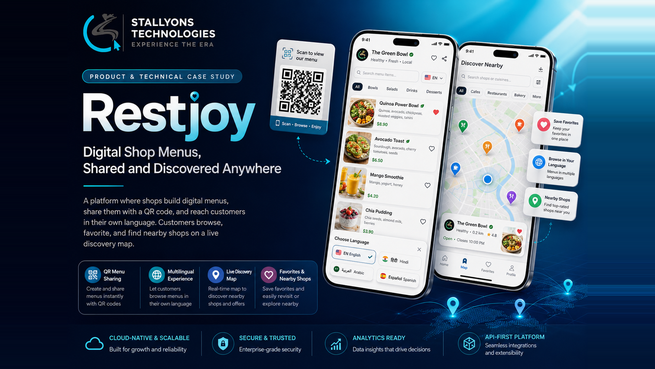
Anyone planning a mobile product usually wants the same three outcomes. Ship to iOS and Android without funding two separate teams. Launch quickly enough to test the market before the budget runs out. And finish with an app that can actually make money. Restjoy delivers on all three, and it shows what focused product thinking and engineering can do when the two pull in the same direction.
Restjoy is a platform where a shop builds its menu once, shares it with a single QR code, and gets discovered on a live map, while customers read every menu in their own language and never pay anything. It sits squarely in restaurant and hospitality software, where small venues need to look modern without a big budget. In this case study, we walk through the problem, the build, and the business model, so you can see how the same approach to mobile app development could work for your own product.
The Problem Restjoy Set Out to Solve
Small shops want a simple way to show a menu, reach new customers, and look modern. Most tools do not fit them. They are priced for large chains, they speak only one language, or they demand technical skill the owner does not have. Restjoy was built to close five gaps at once.
- Paper menus go stale. Every price or item change means a reprint, and there is no fast way to update what a customer actually sees.
- Language blocks sales. A tourist or a new resident often cannot read the local menu, so the shop loses business over words alone.
- Sharing is clumsy. A photo, a link, or a phone number never gives someone a full, live menu they can browse.
- New customers are hard to find. A shop on a quiet street is easy to miss, and there is no simple map that guides nearby customers to it.
- Cost is a barrier. Many platforms charge from day one, which does not suit a small shop that needs to start free and pay only as it grows.
Solving these together is a product challenge, an engineering challenge, and a payments challenge inside a single build.
Why React Native Was the Right Choice
Building two native apps would have meant two codebases, two teams, and double the cost for every feature. For a product that needs to reach the market quickly, that is the slow and expensive path. Choosing React Native let Restjoy ship one codebase to both iOS and Android, which mapped directly to the founders’ goals.
- Lower build cost, because the product is built once rather than twice.
- Faster time to market, because new features arrive on both platforms together.
- A leaner team that is simpler to manage and fund.
- Lower risk, because React Native is a mature framework already trusted by some of the largest consumer apps in the world.
This is the practical value that skilled React Native mobile app developers bring. The framework is only half the story. The other half is knowing how to use it to hit a business target, which is where experienced React Native app development earns its place.
What Stallyons Built
Restjoy gives a shop everything it needs in one place, and it gives the customer a clean experience across the app and the web.
The shop owner signs up and uploads photos, then builds an All Menu from categories and adds items to each one. Every item can carry a photo, a rating, a favorite button, and a description that expands for more detail. The owner can add an About Us page, set a default language, and choose which menu a first-time visitor sees. When the shop is ready, Restjoy generates a QR code the owner can print or post anywhere.
The customer signs up for free and sees each shop in their own language, set at first by their country of registration and changeable by hand at any time. They can browse menus, open item descriptions, mark favorites, leave ratings, and add items to a cart. To open a new shop, they scan its QR code, which deep links straight into that shop on the right screen.
On mobile, the customer can also open a discovery map that shows nearby shops on Google Maps, colored by how popular each one is. A tap on a colored spot opens that shop, exactly as a QR scan would.
The Four Choices That Make Restjoy Defensible
A menu builder is easy to copy. Restjoy is harder to copy, because four decisions give it real depth.
Stored translations, not slow live translation
Rather than translating a menu every time it opens, Restjoy translates the content once, across around 20 languages, and stores it as text or in a JSON file. Menus load fast, and only new or edited items are translated again, which keeps both speed and cost under control. The trade-off is honest: the translations are machine-made and cached, so every time an owner edits an item it has to be translated again, and a dish name that carries local meaning can come back reading oddly in another language until someone reviews it. For most menus that is a fair price to pay for menus that open instantly in twenty languages.
A QR code that opens a real, live shop
Each QR code is built on deep linking, so a scan opens the exact shop on the right screen, inside the app if it is installed or on the web if it is not. The same deep link powers the discovery map, so one simple action works in two places.
A discovery map driven by real activity
The heatmap colors each shop by how many times its QR code has been scanned, from green for fewer scans to red for the most, within about 50 kilometers of the customer. Customers get a fun way to find busy places, and shops get a reason to share their code widely.
Free for customers, fair for shops
Customers never pay, so nothing holds them back. Shops get a full month free to set everything up, then choose to stay on a free plan or upgrade. The cost sits only with the businesses that gain value, which keeps the customer side open to everyone.
The Technical Architecture Behind the Build
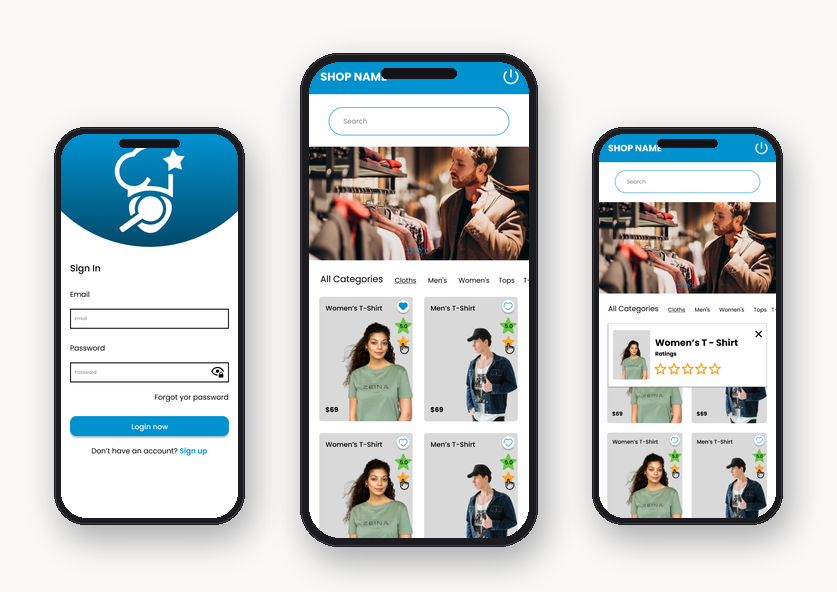
Restjoy is one platform with three faces: a cross-platform mobile app, a website, and an admin panel. They share the same Laravel backend and the same data. The demanding parts are keeping translations fast, making QR deep links open the right shop, and drawing a live map colored by real scan counts. Every choice serves speed, reliability, or revenue.
The mobile app is built in React Native for both iOS and Android, so one codebase serves both phones and a lean team can ship updates faster. Alongside it, a web front end delivers the same content inside a browser, and a web admin console lets staff manage shops, plans, languages, and reported content in one place. Underneath, a Laravel (PHP) backend handles accounts, menus, payments, and business rules against a relational database that holds shops, menus, items, ratings, and scan counts. Translation runs through Google Translate with the results stored as text or JSON, so content is translated once and served ready. Sharing is handled by QR codes with deep linking that open the exact shop in the app or on the web, Google Maps powers the discovery map and location pins, and PayPal and Stripe take monthly or yearly shop subscriptions. Shop photos, item images, and logos sit in cloud storage.
This is the kind of stack that separates custom React Native app development from an off-the-shelf template. The translation pipeline, the deep-link engine, the scan-based heatmap, and the plan and limit engine all sit behind a single mobile front end, and each one was engineered to keep the product fast while it grows.
A Business Model Built to Earn
Restjoy charges only shops, and only when they want the full feature set. Customers are free for life, and every new shop gets one month of full access to set up and see the value before it pays anything.
| Feature | Free shop | Premium shop |
|---|---|---|
| Menus (All Menu) | 1 menu | Up to 30 menus |
| Items | Up to 8 items | Up to 500 items |
| Free trial | 1 month full access | 1 month full access |
| Core features | Photos, QR code, About Us, translation | All free features included |
| Price | Free | Around 14.99 per month or 150 per year |
| Payment | No card needed | PayPal or Stripe |
When the free month ends, a shop that does not upgrade moves to the free plan without losing any work. Extra items are simply switched off, and the owner picks which ones to keep visible until an upgrade brings the rest back. This freemium model is what turns a useful app into a platform that earns from the businesses that grow with it.
We took the same revenue-first approach when we built KickBackChef, a real-time on-demand marketplace with React Native, where a booking and payment engine sat at the center of the product from day one. Restjoy and KickBackChef are different products, yet both prove the same rule. When the business model is designed into the build, the app is ready to make money the moment it goes live.
What This Means When You Want to Hire a React Native Team
Restjoy shows the difference between a developer who simply writes code and a partner who understands the business behind the app. Teams that hire React Native developers who think in outcomes get a product that ships to both platforms at once, launches sooner, and has a clear path to revenue.
If you are planning a cross-platform product of your own, the checklist is short. Look for a team that plans the revenue model early, engineers the hard parts before the screens, and treats speed and reliability as core features rather than afterthoughts. That is the standard Stallyons builds to on every project.
Frequently Asked Questions
How long does it take to build a React Native app like Restjoy?
A focused first version usually takes a few months, depending on the feature set. A platform with stored translations, QR deep linking, and a live map needs more planning, but a single React Native codebase keeps the timeline far shorter than building two separate native apps.
Why choose React Native over two native apps?
Cost and speed. React Native lets you build and maintain one codebase for iOS and Android, so features reach both platforms together and the budget stretches further, which is exactly why lean teams choose it to reach market faster.
Can React Native handle maps, payments, and multiple languages?
Yes. Restjoy runs Google Maps, PayPal and Stripe payments, and around 20 languages behind a React Native front end, with a Laravel backend doing the heavy lifting.
Do I need separate teams for iOS and Android?
No. That is the point of cross-platform development. One team of React Native mobile app developers can ship and maintain both apps, which lowers cost and keeps the product consistent across devices.
Can Stallyons build a platform like this for my business?
Yes. Stallyons delivers full React Native app development, from product strategy and design to backend, payments, maps, and launch, for cross-platform products on iOS and Android.
Start Your React Native Project With Stallyons
Restjoy proves a simple point. Pick a framework that ships to both platforms at once, build the hard parts first, and design the economics to earn from the start. If you are planning a cross-platform product of your own, our React Native app development services can turn your idea into a live, revenue-ready app. The best first step is to book a discovery call, and we will map out the product, the platforms, and the revenue model before any code is written.