


Blog
KickBackChef: A Real-Time
On-Demand Marketplace Built With React Native
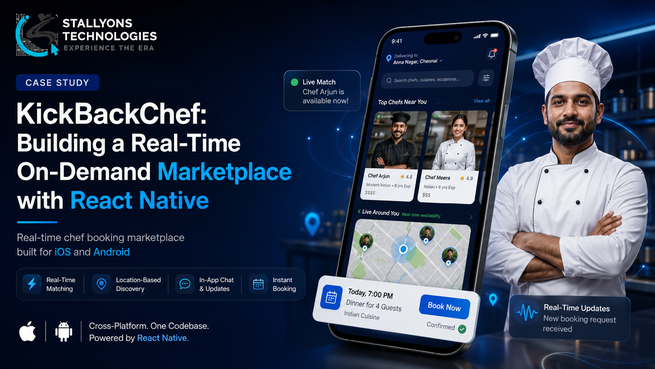
How Stallyons designed and engineered a two-sided platform that connects home cooks with verified professional chefs, with real chefs shown in under 60 seconds. This case study walks through the problem, the build, and the business results, so you can see how the same React Native app development approach, part of our wider mobile app development practice, could work for your product.
Verified Chefs On Screen In Under 60 Seconds
Most marketplace apps fail at the very first promise they make to a user. KickBackChef does not. A client opens the app, enters an address, and within a measured median of under 38 seconds, real, verified, available chefs appear, ready to book. That speed is not luck. It is the result of deliberate React Native app development, a real-time matching engine, and a payment system built for trust.
Stallyons designed and built KickBackChef as a live, two-sided on-demand marketplace app for iOS and Android from a single React Native codebase. The headline results, before any paid marketing:
- Under 38 seconds median match latency against a 60-second target.
- $98,400 gross marketplace volume from 610 bookings.
- 54 percent repeat-booking rate, the core retention signal.
The Build At A Glance
| Client | KickBackChef, an on-demand certified-chef platform |
| Industry | On-demand services, food and hospitality |
| Platform | iOS and Android, built with React Native |
| Product type | Two-sided marketplace app with real-time booking |
| Core stack | React Native, Node.js and FastAPI, PostgreSQL, Redis, Socket.io, Stripe Connect, Google Maps, AWS S3 |
| Status | Built and live, taking bookings |
The Vision Behind KickBackChef

KickBackChef set out to do for home cooking what ride-hailing did for transport. The vision was simple to say and hard to build: let anyone find a verified professional chef nearby, book one to cook at home, and track their arrival in real time. No phone calls. No back-and-forth quotes. No guesswork about whether the chef is actually any good. In practice that meant building trustworthy food and hospitality software, not just another booking screen.
The founders needed a partner who could turn that vision into a fast, trustworthy product without spending a year and running two separate native teams to do it. That is exactly where cross-platform app development with React Native earned its place.
Real Demand, No Trusted Way To Meet It
People who want a good home-cooked meal are stuck with poor options. Cooking yourself takes time and energy that most people do not have. Takeout is expensive and forgettable. Meal kits still leave the cooking to you. Hiring a private chef the old way means calls, quotes, and no easy way to judge quality before someone is standing in your kitchen.
The demand is real. The trusted, simple way to meet it did not exist. To win, KickBackChef had to solve five problems at the same time:
- Time scarcity. Busy professionals, parents, and hosts will gladly pay to save time, yet no quick path existed to book a home-cooked meal.
- High-value occasions. At parties and events, hosts want to enjoy the moment, not get trapped in the kitchen. These are the moments people most want help, and the hardest to arrange.
- The trust gap. Letting a stranger into your home requires confidence. There was no standard way to know a chef was safe, professional, and skilled.
- Booking friction. Finding a chef, confirming availability, agreeing on a price, and sorting out groceries was slow and confusing.
- Fragmented supply. Skilled chefs had no reliable platform offering steady demand, fair pay, and protection when a client does not pay.
Solving these together is a real-time app development challenge, a trust-design challenge, and a payments challenge rolled into one product.
Why React Native Was The Right Call
Building two separate native apps would have meant two codebases, two teams, two backlogs, and double the cost to ship every single feature. For a startup racing to validate a market, that is the slow and expensive road.
Stallyons chose React Native app development so KickBackChef could ship one codebase to both iOS and Android. The benefits mapped directly to business goals:
- Lower build cost, because the team builds the product once instead of twice.
- Faster time-to-market, because new features reach both platforms at the same time.
- A leaner team that is easier to coordinate and easier to fund.
- Lower technical risk, since React Native is a mature framework already trusted by some of the largest consumer apps in the world.
In short, cross-platform app development got KickBackChef to a live, revenue-ready product faster and at a lower cost than building one native app per platform.
React Native isn’t a free lunch, though, and it’s worth being honest about the trade-off. The parts that make KickBackChef feel instant, continuous background location for live arrival tracking and dependable socket connections for chat and status, typically need platform-specific native handling on both iOS and Android. One codebase saved most of the UI and business logic; it did not erase every low-level integration. On a real-time marketplace, that native layer is often where a meaningful share of the engineering time goes.
A Two-Sided On-Demand Marketplace
KickBackChef makes booking a chef feel as simple as booking a ride. The platform serves two sides at once, each with its own clear flow.
Client journey
- Share location and instantly see verified chefs nearby, each with photo, cuisines, skills, ratings, and clear pricing.
- Set the meal type, number of guests, allergies, and whether the chef should bring groceries.
- The app estimates the job length and the arrival time.
- Pre-check the details, pay, and a live chat opens with real-time arrival updates.
- Rate the chef, leave a review, or raise a complaint in the app.
Chef journey
- Build a verified profile with ID and certifications, approved by an admin before any work.
- Go online and set a weekly schedule, the same way a driver starts a shift.
- Receive only the booking requests that match availability and skills.
- Follow the First 10 Minutes Arrival Protocol on arrival.
- Complete the service and upload grocery receipts for reimbursement.
The core promise is one line: address entered, real available chefs shown, booked and confirmed, in under 60 seconds. That promise drove every engineering decision in the platform.
Engineering Behind The Real-Time Platform
The hard part of KickBackChef is not the screens. It is keeping a live, accurate picture of which chefs are available, where they are, and what they charge, while moving money safely on every booking. Most of that lives in the real-time backend and payments integration, not the UI, and every technology choice supports speed and reliability.
| Layer | Technology | Why it matters |
|---|---|---|
| Mobile apps | React Native (iOS and Android) | One codebase, two platforms, faster iteration on a lean team |
| Backend | Node.js and FastAPI | Async, high-concurrency request handling for live matching |
| Primary database | PostgreSQL | Relational integrity for users, bookings, and payouts |
| State and cache | Redis | Sub-millisecond availability tracking, presence, and caching |
| Realtime | Socket.io | Live chat plus arrival and status updates for both sides |
| Payments | Stripe Connect | Marketplace payouts, escrow, split payments, automatic commission |
| Geolocation | Google Maps API | Distance radius, arrival estimates, and result sorting |
| File storage | AWS S3 | Chef documents, profile media, and grocery receipts |
Engineering subsystems worth calling out
- Live availability layer. Chef location and online status live in Redis, a fast in-memory store, instead of repeatedly querying the main database. Search stays quick even when many users are looking at once.
- Matching and arrival engine. A location filter finds nearby chefs, the system keeps only those who are online, verified, and qualified, and Google Maps sorts the rest by real travel time. The client sees only chefs who can actually come.
- Escrow and reimbursement integrity. Stripe Connect holds payment at booking. When an admin approves grocery receipts, the system splits and releases the payout automatically, keeping every reimbursement traceable and reducing fraud.
- Realtime channel. Socket.io powers both in-app chat and live arrival updates, switching on the moment a booking is confirmed.
All of it runs in production under real bookings, which is where real-time app development is actually tested.
The Hard Problems We Engineered Around
A handful of problems decided whether the product would work at all.
Keeping the 60-second promise under load
The app checks chef availability constantly. By storing location and online status in Redis rather than the main database, search stays fast even when many users search at the same time. This is the foundation of dependable on-demand app development.
Accurate arrival times
A wrong arrival estimate breaks trust instantly. KickBackChef uses live Google Maps data and shows two clear options: about 30 minutes when the client already has ingredients, or 60 minutes when the chef needs to shop first. Clients always know when to expect their chef.
Trustworthy money movement
Holding payment at booking and releasing grocery money only after an admin checks receipts took careful work with Stripe Connect. The result is a system where clients cannot be overcharged and chefs cannot be shortchanged, and every payment is traceable.
Standardizing a human moment
The First 10 Minutes Arrival Protocol is about behavior, not software, yet the app supports it with checklists and reminders so every chef delivers the same calm, professional arrival every time.
A Business Model Built To Earn From Day One
KickBackChef was built to make money on every transaction, not just to look good in a pitch. Because every payment runs through Stripe Connect, the platform takes its commission automatically, with no invoices to send and no payments to chase.
- Commission on every order. A platform fee is deducted from each booking before the chef is paid.
- Chef-set pricing with a three-hour minimum. This protects both chef earnings and platform economics on every job.
- Dynamic service fees. When distance is greater, demand is high, or a request is urgent, a fixed fee is added on top, capturing peak value without complicating the base price.
- Automatic gratuity. Built into checkout and shown in the full price breakdown, improving chef take-home and retention.
- Estimated-duration pricing. The app estimates hours from the number of recipes and guests, so quotes are accurate and disputes are rare.
Illustrative unit economics
| Metric | Illustrative value | Notes |
|---|---|---|
| Average booking value | $165 | Three-hour minimum at about $45 per hour, plus fees and gratuity |
| Platform take-rate | 18 percent | Commission deducted automatically at payout |
| Average revenue per booking | About $30 | Take-rate multiplied by booking value |
| Bookings per client per month | 1.4 | A mix of regulars and occasion-driven bookings |
| Blended CAC | About $22 | Organic and referral weighted, with paid upside |
| Contribution margin | About 62 percent | After payment processing and operations cost |
Results From A Live Marketplace
KickBackChef is live and taking bookings. The figures below are illustrative of a realistic early-stage platform before any paid marketing, with chefs recruited directly and clients arriving mainly through word of mouth and occasion-based referrals. They are not audited financial results.
North-star performance
The most important technical goal is how fast a real, available chef appears after a user enters an address. The target is under 60 seconds. Using Redis for live availability, Google Maps for travel-time sorting, and a pre-check to confirm a chef is still free, the platform reached a median match latency under 38 seconds.
| Metric | Illustrative figure | What it signals |
|---|---|---|
| Active clients (monthly) | 340 | Early organic demand, no paid acquisition yet |
| Verified chefs on platform | 48 | Manually vetted, intentionally lean supply |
| Markets live | 2 | Depth before width |
| Completed bookings to date | 610 | Real transactions in real kitchens |
| Gross marketplace volume | $98,400 | Growing about 22 percent month over month |
| Platform revenue | About $17,700 | 18 percent take-rate, no paid marketing yet |
| Repeat-booking rate | 54 percent | Most clients rebook, the core retention signal |
| Average chef rating | 4.8 out of 5 | Consistent quality from the arrival protocol |
| Arrival accuracy versus estimate | 91 percent | On-time delivery of the core promise |
Speed wins the first booking. Chef quality brings the client back. The repeat-booking rate is the number that proves both are working together.
Why KickBackChef Is Defensible
Four decisions make KickBackChef far more than a booking form.
- Real-time matching, not a directory. The app does not dump a long list of chefs on the user. It shows only chefs who are in range, online, verified, and able to do the job, sorted by real travel time. That is what makes the under-60-second experience possible.
- Trust, built on purpose. Every chef is admin-approved before working, follows the same arrival protocol, and earns visible ratings and reviews. Complaints route straight to the admin team. Quality stays high because the system keeps it high.
- Money that is safe on both sides. Escrow through Stripe Connect protects clients from overcharging and chefs from non-payment. The platform sits in the middle and keeps both sides fair.
- Pricing that flexes with the market. A base rate plus skill, distance, demand, and urgency keeps chefs active when it matters most and keeps pricing transparent for clients.
Built By A Team That Understands The Business

KickBackChef is exactly the kind of product Stallyons is built to deliver: a real-time, revenue-ready two-sided marketplace app shipped to iOS and Android from one React Native codebase. The team handled the full journey, from product strategy and React Native app development to backend engineering, Stripe Connect payments, geolocation, and a live realtime layer. It is the same React Native foundation behind other food and hospitality builds, like RestJoy, a React Native restaurant platform.
When you hire React Native developers who understand not only the framework but the business model behind a marketplace, you ship faster, spend less, and reach revenue sooner. That is the difference between a working app and a profitable platform.
Build Your Marketplace App With Stallyons
Have an on-demand or marketplace idea of your own? Stallyons designs, builds, and scales React Native app development projects from MVP to live platform, with the real-time engineering and payment integration that modern marketplaces depend on. Let us turn your idea into a product that books, charges, and grows.
Frequently Asked Questions
How long does it take to build a React Native marketplace app?
A focused MVP usually takes a few months, depending on features. A real-time, two-sided marketplace like KickBackChef takes longer because of matching, payments, and live tracking, but a single React Native codebase keeps the timeline far shorter than building separate native apps.
How much does an on-demand app cost to build?
Cost depends on complexity. Cross-platform app development with React Native lowers the price compared with two native builds, because you build and maintain one codebase instead of two.
Can React Native handle real-time matching and live tracking?
Yes. KickBackChef runs live availability, real-time chat, and arrival tracking using Redis, Socket.io, and Google Maps behind a React Native front end, with a median match under 38 seconds.
How do marketplace payments and escrow work?
Through Stripe Connect. Payment is authorized and held at booking, commission is taken automatically, and payouts and reimbursements are released on approval, so both sides are protected.
Can Stallyons build an on-demand app like this for my business?
Yes. Stallyons delivers full React Native app development, from product strategy and design to backend, payments, and launch, for on-demand and marketplace products on iOS and Android.
Conclusion
Building an on-demand marketplace follows a clear logic. Pick a framework that ships to both platforms at once, build the real-time and payments foundation before the screens, manufacture trust on purpose, and design the economics to earn on every transaction. KickBackChef did all four, and the results show what that discipline produces: a sub-38-second match, a 54 percent repeat rate, and revenue from day one.
That trust isn’t just a metric on a dashboard, it’s visible the moment a buyer opens the live product. You can see it in action on KickBackChef on Google Play, where diners book private chefs to cook fresh meals in their own kitchens. Every design decision that reduces friction, verified profiles, transparent pricing, instant matching, converts casual curiosity into real buyer intent, which is exactly why the repeat rate holds and why users come back to book again rather than shopping around.
If you are planning a similar product, the path is the same. Book a discovery call with the Stallyons team and we’ll map your marketplace idea to a live, revenue-ready build, with the real-time engineering and payments to back it.