


Blog
De Dietrich: A
WooCommerce Quote-Request Store
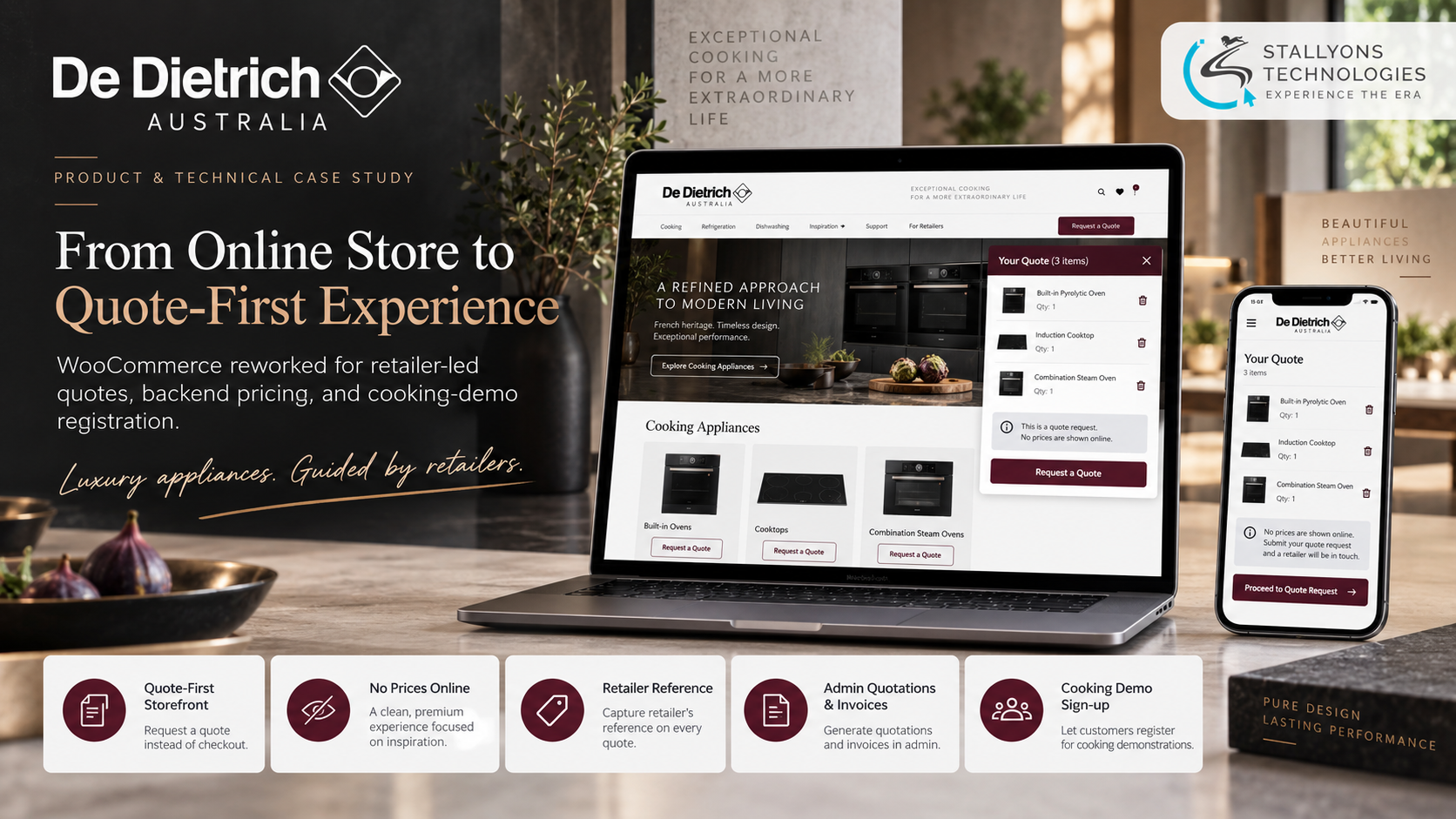
A shopper falls for a De Dietrich oven, adds a couple of matching pieces to what looks like a cart, and reaches the end expecting a price and a Buy button. There is no price, and there is no Buy button. Instead there is a Request a Quote, a field recording which retailer served them, and a note that a real quotation is on its way. That is deliberate.
This project reworks De Dietrich Australia’s existing WordPress and WooCommerce site into a quote-first WooCommerce store. De Dietrich sells premium kitchen appliances through retailers rather than direct online, so the storefront was rebuilt to match how the business actually sells: no customer logins, no prices in the customer path, a Request a Quote flow with a price-free quote cart, and a Retailer’s Reference on every submission.
Put simply, the store stops pretending to be a checkout. Customers assemble a quote instead of a cart, each quote records which retailer served them, and admins turn that request into a priced quotation and then an invoice from the backend, while each retailer admin only ever sees the business tied to their own reference.
The Starting Point: A Store That Implied Something the Business Does Not Do
The site had been built as a standard online store, but De Dietrich Australia does not sell appliances directly online. It works through retailers and quotes. Login, registration, a wishlist, Add to Favourites and a priced cart all pointed a customer toward buying on the spot, which is not an option the business offers. The storefront was promising a transaction it could not complete.
Reshaping it around quotes and retailers meant solving several problems at once:
- The store implied direct purchase. Logins, a wishlist, Add to Favourites and a priced cart all suggested online buying, so the storefront had to stop signalling a checkout it does not run.
- Prices should not drive the customer flow. Quotes, not prices, are how the business engages a customer, so no price should appear anywhere in the quote path.
- Retailers need crediting and scoping. Which retailer served a customer has to be captured, editable, shown on documents, and used to control what each retailer admin can see.
- Quotes and invoices need managing. Admins have to turn a request into a quotation with pricing and discounts, then an invoice, in one consistent format.
- Access has to be separated. Retailer admins should see only their own referenced quotes and orders, while the head admin sees everything.
- Events need real sign-ups. The cooking demos needed a proper registration flow with contact capture, notifications and correct pricing, not just an RSVP label.
The Build: From Cart to Quote, With the Retailer on Every Line
Login, registration and My Account were removed, the wishlist icon became a Quote Cart, and every Add to Favourites button became Request a Quote. Clicking Request a Quote opens a small popup offering Continue Shopping or Add to Quote. Adding to quote shows the quote cart in the same popup, laid out like a shopping cart but carrying no prices. All of this is standard WooCommerce development reshaped so the storefront behaves like an enquiry tool rather than a till.
For a customer who wants a prospect quote, the path runs in a fixed order:
- Add appliances to the Quote Cart through the Request a Quote popup, with no prices shown at any step.
- Open the quote page and complete the contact form: name, email, phone, and billing and shipping addresses with a same-as-billing checkbox.
- Choose a Retailer’s Reference from a dropdown, including an N/A option when no retailer served them, and submit the request.
- An admin reviews the submission in the WordPress backend, where every field, including the Retailer’s Reference, is editable and an N/A quote can be reassigned to a retailer later.
- The admin generates and sends a quotation with product pricing, discounts and promo codes, then an invoice in the same format, both showing the Retailer’s Reference.
Because the whole model turns on crediting and scoping by retailer rather than a simple checkout, this sits squarely in B2B ecommerce development: one field ties together who gets credited, what appears on the documents, and who is allowed to see the record.
Technical Architecture
This is a modification of an existing WordPress and WooCommerce site rather than a build from scratch, so the architecture centres on converting the storefront and cart into a quote flow, capturing and using the Retailer’s Reference, moving pricing into admin-generated documents, scoping access by retailer, and adding event registration. A few subsystems are worth calling out.
- Quote flow and cart. The wishlist becomes a Quote Cart and Add to Favourites becomes Request a Quote, opening a popup to continue shopping or add to quote, with the quote cart mirroring a shopping cart but without prices.
- Quote form and Retailer’s Reference. The quote page collects contact details, billing and shipping addresses, and a Retailer’s Reference dropdown including N/A, all editable in the backend, with admin control over the dropdown options and the ability to reassign N/A later.
- Quotation and invoicing. Admins generate a quotation with pricing, discounts and promo codes and an invoice in the same format, both showing the Retailer’s Reference, so pricing lives on the documents rather than the storefront.
- Roles and scoped access. Retailer Admins can view only the quotations, invoices and orders tied to their own Retailer’s Reference, while the Owner or Head Admin has full access across every retailer.
- Cooking-demo registration. Register Now opens a popup that captures name, phone and email with a follow-up note, sends notifications to the backend with an email alert to the Head Admin, and corrects or removes the Free label.
- Storefront adjustments. Login, registration and My Account are removed, and the changes are applied responsively so the storefront stays clean and on brand across devices.
A retailer-led, quote-based model like this is common wherever a brand manufactures premium goods and sells them through a dealer network rather than direct, which is why it maps neatly onto the needs of appliance manufacturers and their dealer networks who protect pricing and credit the retailer on every deal.
Challenges Solved
The hardest work was turning a store into a quote system without leaving traces of the old checkout behind. Logins, the wishlist, Add to Favourites and the priced cart were converted into a Request a Quote flow and a price-free quote cart, so the site matches a business that sells through retailers instead of implying direct purchase. Prices were kept out of the customer flow entirely; pricing, discounts and promo codes appear only on the admin-generated quotation and invoice.
Making the Retailer’s Reference do real work was the other half of it. The reference is captured on every quote, editable and reassignable in the backend, printed on quotations and invoices, and used to scope what each retailer admin can see, so one field drives crediting, documents and permissions together. Retailer admins work only with their own referenced quotes and orders while the head admin keeps full oversight, and the cooking-demo sign-ups were rebuilt into a real registration flow with contact capture, backend notifications and corrected pricing.
The Result
The outcome is a storefront that fits the business. A customer browses appliances and builds a quote with no logins and no prices in their way, records which retailer served them, and submits a request that an admin turns into a priced quotation and invoice. Every quote is credited to a retailer, pricing stays in the backend under the brand’s control, retailer admins see only their own data, and the cooking demos capture real sign-ups that reach the head admin. The store finally behaves the way De Dietrich Australia actually sells.
If you run a retailer-led or quote-based business on WooCommerce, you can hire WooCommerce developers who have converted a live store into exactly this quote-first model, or tell us how your sales flow works and we will map it onto the right storefront, documents and access rules.
Frequently Asked Questions
Can a WooCommerce store work without showing prices or online checkout?
Yes. Here the customer path was rebuilt as a Request a Quote flow with a price-free quote cart, and logins, registration and the priced cart were removed. Customers assemble a quote instead of buying, and prices only appear later on the admin-generated quotation and invoice.
How do you credit the retailer who served a customer?
Every quote captures a Retailer’s Reference chosen from a dropdown, including an N/A option. The reference is editable in the backend, can be reassigned to a retailer later, is printed on the quotation and invoice, and controls which retailer admin can see the record.
Can retailers see only their own quotes and orders?
Yes. Access is scoped by the Retailer’s Reference. Retailer admins view only the quotations, invoices and orders tied to their own reference, while the Owner or Head Admin has full access across every retailer, so each retailer works with their own data under central oversight.
Where do pricing and discounts appear if the storefront has no prices?
Pricing, discounts and promo codes live on the admin-generated quotation and invoice, not on the storefront. Customers never see prices in the quote flow, so the experience stays quote-first while the business keeps full control of what each quote is priced at.
Can you convert an existing WooCommerce store into a quote-request system?
Yes. This project modified an existing WordPress and WooCommerce site rather than rebuilding it, converting the wishlist and cart into a Quote Cart and Request a Quote flow, adding the quote form and Retailer’s Reference, and moving pricing into admin-generated documents, all applied on the live storefront.