


Blog
NestHappy Case Study:
A Trust-Led Home Services Marketplace That Runs Itself
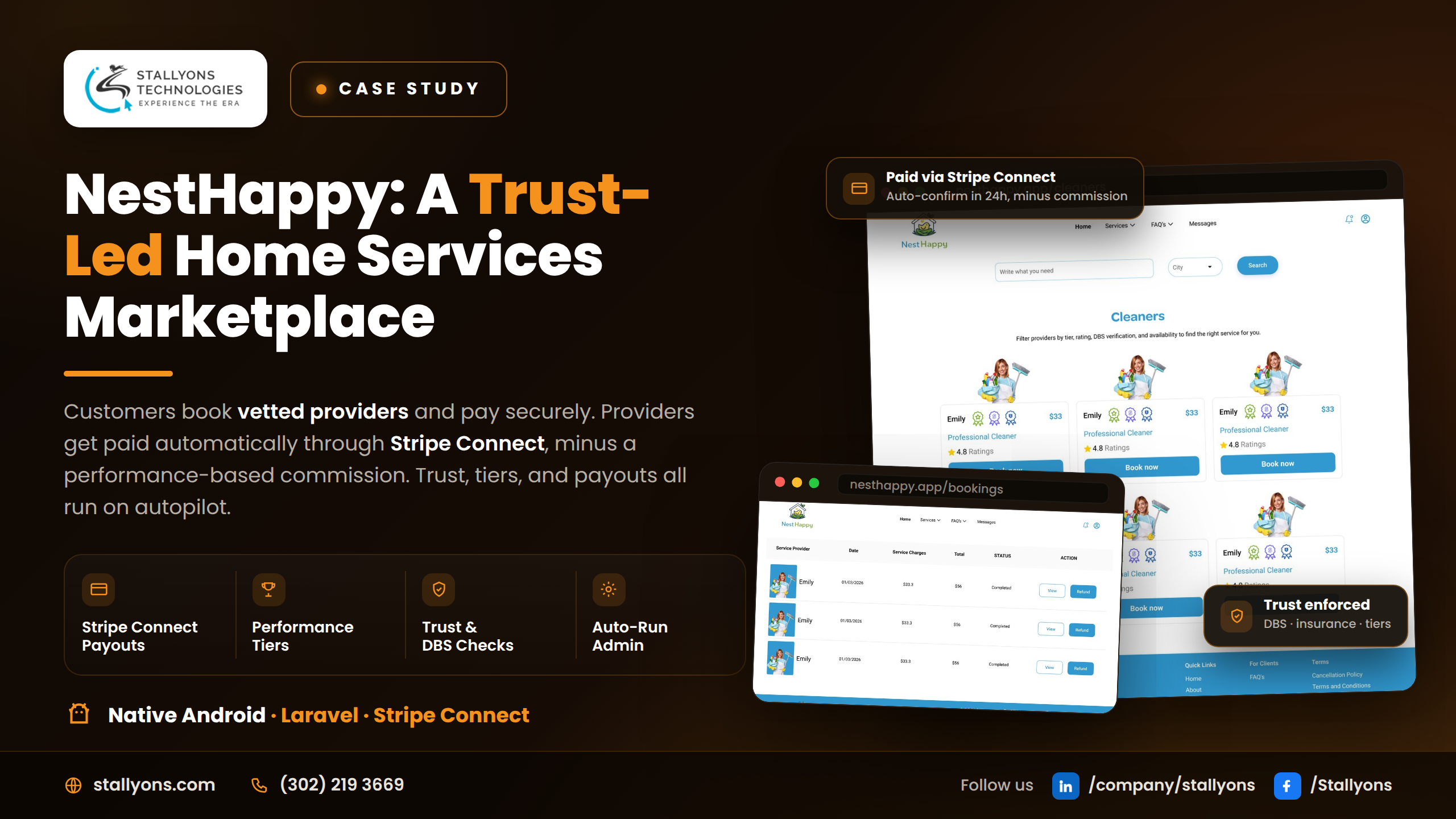
Hiring someone to clean your home means letting a stranger into your most private space. That single, uncomfortable fact is why home-services marketplaces are so hard to get right. Customers want the help but worry about trust. And the best providers, the reliable, insured, punctual ones, get treated exactly like the careless ones, wait around to be paid, and often have to chase customers for money they’ve already earned.
NestHappy was built to fix both sides of that at once. It’s a trust-led home-services marketplace, based in Bristol and built to grow across the UK, delivered as a native Android app with a web admin dashboard, the kind of custom marketplace platform where the two-sided logic matters more than the booking screen. What makes it interesting isn’t just the booking screen; it’s that trust, payments, payouts, commissions, and performance tiers were all engineered to run automatically. The owner steps in only when a genuine human decision is needed. This case study walks through how that machine was built.
Put simply, customers book vetted providers and pay securely; providers get paid automatically through Stripe Connect, minus a performance-based commission; and trust, tiers, and payouts all run on autopilot inside a native Android app.
The Problem: A Market Where Neither Side Is Well Served
Most home-services tools fail customers and providers at the same time. Pulling the pain points apart shows why a shallow booking app was never going to be enough.
Trust is hard to judge. A customer can’t easily tell whether a provider is vetted, insured, and reliable, and letting an unknown person into your home is a real worry, not an abstract one. On top of that, good providers aren’t rewarded: on most platforms a careful, five-star provider earns the same deal as a careless one, so quality never pays off. Payments are slow and uncertain, with providers waiting or chasing money while customers worry about paying before a job is done well. And when things go wrong, bad actors are punished bluntly, with simple auto-ban rules that can unfairly destroy a good provider over a single unfair review.
Underneath all of that, running such a business by hand simply doesn’t scale. Managing bookings, payouts, commissions, insurance, and disputes manually is slow and error-prone, and no small-business owner can keep up. Finally, most people book on their phones, so a web-only service misses the way customers actually behave. The brief, then, was ambitious: build a marketplace that proves trust with systems, rewards quality, moves money fairly, and mostly runs itself, on mobile first.
The Solution: One Automated, Trust-Led Platform, Three Roles
NestHappy answers all of that with a single automated platform serving three roles, each getting exactly what they need.
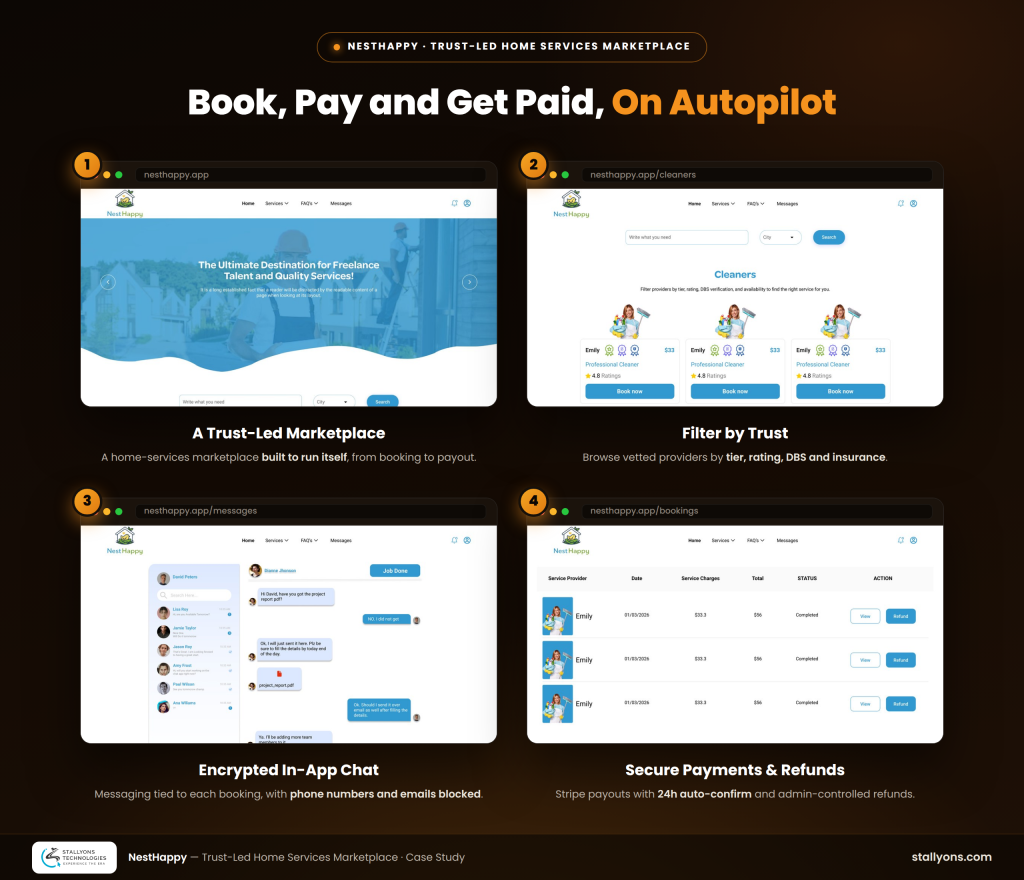
The customer signs up in the Android app, browses services with clear fixed prices, and adds any extras. They filter providers by tier, reviews, DBS status, and insurance, then book and pay the full amount securely through Stripe. The money is held safely until the job is done. They message the provider through encrypted in-app chat, and when the work is finished they confirm it, or, if they raise no dispute within 24 hours, the system confirms it for them.
The provider registers and pays a fee that includes a right-to-work check, with an optional DBS check at any time. They complete Stripe Connect onboarding, upload proof of insurance, build a profile, and manage availability. They accept bookings, do the work, mark it complete, and get paid automatically through Stripe Connect, with their tier’s commission taken off, and they can see a full breakdown of every payout.
The owner runs everything from one admin dashboard: setting services, prices, locations, and tier rules without a developer, reviewing flagged accounts, monitoring insurance and Stripe health, handling disputes, and viewing financial reports built for the VAT agent model. Almost everything else happens on its own.
The Booking and Payment Flow: The Backbone
The money flow is the heart of the platform, and it runs on Stripe Connect with no manual work for a standard job. It’s worth following step by step:
- The customer books a service with add-ons and confirms the total.
- The customer pays the full amount via Stripe, with the commission set as an application fee.
- Stripe holds the funds while the booking is live.
- The provider accepts. If they decline, the customer is refunded automatically.
- The provider performs the job and marks it complete.
- The customer confirms, or 24 hours pass with no dispute and the system auto-confirms.
- Stripe Connect transfers the net amount to the provider, and the platform keeps the commission.
- Both sides leave reviews, which feed the next weekly tier evaluation.
The elegance is in the payout trigger: money is released either when the customer confirms, or after a configurable 24-hour window passes with no dispute. A dispute simply pauses that timer for admin review. There’s no wallet, no manual transfer, and no chasing. The honest edge of that design is that silence counts as approval: a customer who is simply slow to respond, away, or distracted lets the 24-hour window expire and the payout goes through, so the dispute window is the only brake, and a genuinely unhappy but inattentive customer has to remember to raise a flag inside that day rather than after it.
Commission, Tiers, and VAT: Making Quality Pay
Commission on NestHappy isn’t flat. It rewards good providers with a better rate as they climb three tiers, and the whole structure is designed to fit the VAT agent model.
| Tier | Commission | Who it’s for |
|---|---|---|
| Standard | 20% | The default tier for every new provider |
| Trusted | 18% | The first upgrade, rewarding consistent quality and reliability |
| Elite | 15% | The top tier, for exceptional, high-volume providers |
Crucially, tiers are earned on measurable performance, not vibes. A weekly scheduled job evaluates every provider against their tier’s thresholds over a rolling 60-day window, looking at completed jobs, average rating, cancellation rate, reliability strikes, and recent activity, then promotes or demotes them one tier at a time. Moving up from Standard to Trusted needs at least 15 lifetime jobs, a 4.6+ rating, a cancellation rate under 5%, no active strikes, and at least 5 recent jobs; Elite raises those bars further. Because no one drops two levels at once, a single bad week can’t wipe out months of good work. Every threshold is adjustable by the owner without touching code.
On tax, NestHappy acts as an agent between customer and provider, charging commission only. So once the business is VAT-registered, VAT applies to that commission, not the whole booking value, and the provider handles their own tax on the service. Financial reports keep the gross booking value, the commission, and the provider payout cleanly separated, ready for VAT returns and HMRC.
The Trust and Safety Systems: Trust as a Working Machine
Plenty of platforms say they’re safe. NestHappy proves it with systems that run whether or not anyone is watching.
Reliability strikes. A provider gets a strike for cancelling less than 24 hours before a booking or for not showing up. Cancelling earlier is only a warning, and customer cancellations never count against the provider. Strikes expire automatically after a set period (60 days by default), only active strikes count against tier upgrades, and the admin can remove a strike for a genuine emergency.
Suspension review, not auto-ban. When an account collects enough bad reviews (three by default), it’s flagged for the owner to review with the full picture, the reviews, booking history, cancellations, and strikes, who can then dismiss, warn, suspend, or ban, with every action logged. This protects good providers from a few unfair reviews while still keeping quality high.
Insurance enforcement. Every provider must upload Public Liability Insurance, and a daily check marks cover as active, expiring soon, or expired. Reminders go out as expiry nears. If cover lapses, the provider is paused, removed from search, and their future bookings are held, with the customer offered a reschedule, a switch, or a refund. Valid new cover brings them straight back.
Stripe account health. A provider’s Stripe account can become restricted after onboarding. The platform watches for this through Stripe webhooks and a daily check, and if an account is restricted, the provider is blocked from new bookings and removed from search automatically, with the owner alerted. When Stripe lifts the restriction, the provider is reactivated and any held payouts are released.
Admin Control: A Business One Person Can Run
The platform was built so the owner can run everything alone, without a developer on call. From the dashboard they control services and prices, add or disable service areas for expansion, configure every tier threshold and the evaluation frequency, review flagged accounts with full context, manage bookings and override refunds and payouts through Stripe, tune reliability-strike rules, act on restricted Stripe accounts, and pull commission and VAT reports separated for the agent model. If it should be adjustable, it’s adjustable from the panel.
The Technical Architecture
NestHappy is a native Android app written in Java, paired with a web admin dashboard, both running on a single Laravel REST API over MySQL. The genuinely hard parts, moving money safely with Stripe Connect, running scheduled automation reliably, and keeping trust checks always current, are exactly what the architecture is built around. Delivering a marketplace with this much automation and money-movement, and keeping it maintainable for a non-technical owner, is the kind of work that separates real engineering from a template, and it’s why the choice of Android app development partner matters when money and trust are on the line.
The stack is deliberately conventional so a non-technical owner can maintain it. The customer and provider apps are native Android in Java; the owner’s web console and the apps both talk to a single Laravel (PHP 8.2+) REST API over MySQL 8.0+, which holds every business rule and indexes users, bookings, payments, tiers, and strikes. Stripe Connect (Express) moves the marketplace money, taking commission as an application fee and paying providers out automatically. Real-time encrypted chat runs on WebSockets and Pusher, filtered through the OpenAI API so phone numbers and emails can’t be passed around; Firebase Cloud Messaging and Laravel Mail cover native push and transactional email; insurance documents and profile photos sit in Laravel Storage on AWS S3; and the Laravel Scheduler and queue run the tier evaluation, insurance checks, strike expiry, and Stripe health checks in the background.
A few subsystems carry the product. The Stripe Connect payment flow handles the Stripe Connect and payments integration: it takes payment through the platform account, sets the commission as an application fee, holds funds, and transfers the net to the provider’s Express account on confirmation. The tier evaluation engine runs weekly over a rolling 60-day window and moves providers one tier at a time. The trust and enforcement jobs run daily to track insurance expiry, check Stripe health, and expire old strikes, pausing or reactivating providers as needed. The suspension review system flags accounts with full history instead of banning them outright. And encrypted messaging ties chat to a booking, delivers it in real time, and filters it through the OpenAI API so personal contact details can’t be shared around the platform.
It’s the same native-Android-plus-Laravel foundation behind our other builds, including AppyStay, our native Android social app for hostels, and the KeyCouture Shopify migration, where a live fashion app was moved onto a new backend with zero lost features.
Illustrative Outcomes
NestHappy is an MVP built to prove the model in Bristol before expanding. The commission rates and windows below are the real configured values; any performance-style figures are illustrative of a plausible early-stage operation, not audited results.
The shape it’s built to produce: a 20% baseline commission for new providers and 15% for Elite, a 24-hour auto-confirm window before automatic payout, a 60-day rolling performance window checked weekly, payout release measured in hours rather than weeks, insurance compliance enforced automatically, and, tellingly, zero manual steps for a standard job. That last one is the whole point: the platform runs end to end on its own.
What Makes It Defensible
Four choices lift NestHappy above a simple booking site. Trust is enforced, not just claimed, through right-to-work checks, optional DBS, tracked insurance, and verification badges, with automatic pausing when cover or a Stripe account lapses. Performance pays through tiers earned on real 60-day metrics, which is fairer than judging a provider on one bad day. Money moves on its own the right way, held and released by Stripe Connect with commission taken cleanly as an application fee in a VAT-agent-friendly structure. And fairness beats blunt auto-bans, because flagging accounts for human review with full context protects good providers while still keeping quality high.
The Challenges We Solved
Making trust automatic meant turning it into scheduled jobs: insurance tracked daily, Stripe accounts watched through webhooks, strikes expiring on their own, and providers paused or restored without anyone lifting a finger. Moving money fairly and on time meant leaning on Stripe Connect to hold funds and release them on confirmation or after the 24-hour timer, with disputes pausing the clock. Rewarding quality without being unfair meant a multi-metric tier engine over a rolling window plus suspension review instead of auto-ban. And keeping the app and admin in step meant one Laravel REST API serving both, so the logic is built once and both sides always agree.
The Result
NestHappy is a fully automated, trust-led home-services marketplace, delivered as a native Android app in Java on a Laravel and MySQL backend, with Stripe Connect at its core and a web dashboard for the owner. A customer books a vetted provider, pays securely, and confirms the job from their phone. A provider gets vetted, accepts work, and is paid automatically, minus a commission that rewards their performance. The hard parts, payments and payouts, weekly tier evaluation, insurance, Stripe health, and reliability strikes, all run on their own, and bad reviews lead to a fair review rather than a blunt ban. The owner runs and tunes the entire business from one dashboard, with no developer needed, and owns all the code and accounts. It’s built to grow from one city and one service to many, without a rebuild.
Have a Marketplace or Automated Platform in Mind?
NestHappy is what happens when the product logic and the engineering are designed together: payments, payouts, trust, and automation working as one system rather than bolted-on features. If you’re planning a marketplace, a booking platform, or any app where money movement and trust are central, our team ships the whole thing, native Android app, Laravel backend, Stripe integration, and an owner-friendly admin, and you can hire Android developers from us to sit alongside your own team. Building a payout-and-trust engine like this is precisely where a seasoned Android app development team earns its keep.
Have a marketplace or automated platform in mind? Book a discovery call and we will map the money flow and trust systems before a line of code is written.
Frequently Asked Questions
Can you build a marketplace app with Stripe Connect payments and payouts?
Yes. NestHappy runs entirely on Stripe Connect: the customer pays up front, funds are held, commission is taken as an application fee, and the net is paid out to the provider automatically on confirmation or after a 24-hour auto-confirm window.
How does the commission and tier model work?
Providers sit in Standard, Trusted, or Elite tiers with commission rates of 20%, 18%, and 15%. A weekly job evaluates real performance over a rolling 60-day window and moves providers one tier at a time. Every threshold is configurable by the owner without code.
Can you build both a native Android app and a web admin dashboard on one backend?
Yes. Both the Android app and the owner’s dashboard run on a single Laravel REST API over MySQL, so the customer app, the provider experience, and the admin always share the same data and rules.
How do you handle provider verification, insurance, and trust?
Through automated systems: right-to-work checks at registration, optional DBS, tracked Public Liability Insurance with daily expiry checks, Stripe account-health monitoring via webhooks, and reliability strikes, with providers paused and restored automatically as their standing changes.
Can the owner run and change the platform without a developer?
Yes. Services, prices, locations, tier thresholds, the evaluation window, strike rules, and review settings are all adjustable from the admin dashboard, so the owner can run and tune the business independently.