


Blog
hydrocomAI: An OpenAI
Appointment-Scheduling Voice Agent
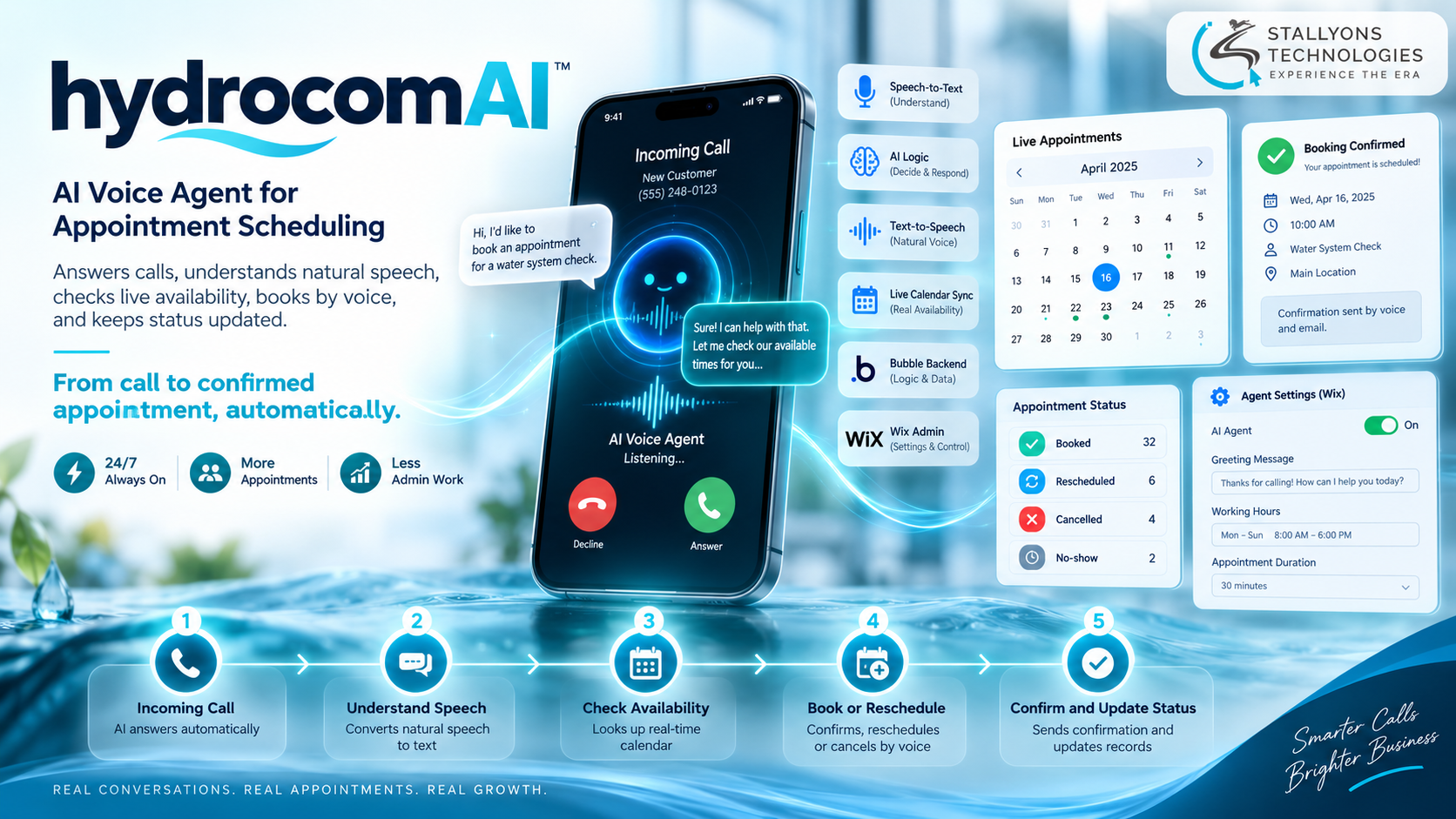
The phone rings at a busy front desk while the receptionist is already on another line. In most businesses that call either waits, goes to voicemail, or is lost, and with it a booking. The premise of this project is simple: what if that call is always answered, on the first ring or two, by something that can actually book the appointment, not just take a message?
That is what hydrocomAI does. It is an AI appointment-scheduling voice agent that works over a single channel, the phone, and handles the whole appointment call by voice. It answers the incoming call, greets the caller, works out what they want, checks the calendar for real availability, books, reschedules or cancels, confirms the details out loud, and updates the appointment’s status. Its job is to take incoming appointment calls off the front desk and book them straight into the system.
Put simply, the agent answers every appointment call, understands natural speech rather than menus, offers only genuinely open times, books and confirms by voice, and keeps each appointment’s status correct, from booked through completed, cancelled, rescheduled or no-show. Behind the voice sits an AI pipeline, and the business stays in control of the greeting, hours, duration, time zone, limits, and whether the agent is on at all.
The Starting Point: Replacing Call-Handling, Entirely by Voice
For a voice agent to actually replace receptionist call-handling, taking a message is not enough; it has to complete the booking on the call. That raised a clear set of requirements, all of which had to work by voice alone, because the caller has no app, no form, and no keypad menu to fall back on.
- Answer every incoming call. The agent had to pick up within a ring or two and greet the caller, so no appointment call is missed.
- Understand the caller by voice. It had to detect intent from natural speech, whether the caller wanted to book, reschedule, cancel, or ask about times, with no menus.
- Offer only real availability. It had to check the live calendar against working hours and appointment duration, and never offer a taken slot or double-book.
- Book, reschedule and cancel by voice. It had to guide the caller through each flow, collect the details, and save the result to the system.
- Confirm clearly. It had to repeat the details and confirm out loud, so the caller ends the call sure of what was booked.
- Keep status correct and handle the awkward moments. It had to update each appointment’s status and cope gracefully with no slots, silence, or an unclear date.
The Build: A Booking Call, Handled End to End
A call runs as a natural conversation, not a phone tree. The agent answers within a ring or two, greets the caller with the business’s name, then listens and works out the intent. Making a phone call flow like this, understood, checked against a real calendar, and completed by voice, is the substance of the OpenAI application development behind the agent. A booking runs in a set order:
- The agent answers within a ring or two and greets the caller by the business’s name.
- It listens and detects the intent from natural speech, book, reschedule, cancel, or a question about times.
- For a booking, it asks the caller’s name and the date they want.
- It checks the system calendar and offers the open times, for example ten in the morning or two in the afternoon.
- The caller chooses, and the agent repeats the details and asks for confirmation.
- On a yes, it saves the appointment and gives a spoken confirmation before the call ends.
Rescheduling and cancelling work the same way: the agent finds the existing booking by name or phone number, updates or cancels it, and confirms the change by voice. It is also built for the moments that trip up a script. If there are no slots on the requested date, it says so and offers another. If the caller goes quiet, it checks whether they are still there and, after a couple of tries, ends the call politely. If it does not catch a date, it asks the caller to repeat it. The caller’s phone number is captured automatically, and every appointment is stored with its name, date, time and status. The business configures the greeting, working hours, appointment duration, time zone and limits, and turns the agent on or off, so calls reach it when it is active and a human or voicemail when it is not.
Technical Architecture
The agent runs over a voice-and-AI pipeline, with a calendar and a backend behind it and the business’s own front-end in front. Each stage does one job, and together they turn a spoken request into a saved, confirmed appointment.
- Telephony. The telephony layer receives the incoming call and connects it to the agent within a ring or two.
- Speech-to-text. Speech-to-text turns the caller’s words into text so the agent can work from what was actually said.
- AI engine. The AI engine detects intent and drives the conversation, deciding what to ask, what to check, and what to confirm. Tuning that spoken back-and-forth is the heart of the AI voice agent development here.
- Text-to-speech. Text-to-speech gives the agent its voice, so it greets, offers times, and confirms out loud.
- Calendar and Bubble backend. A calendar holds availability and a Bubble backend holds appointments and their status, from booked through completed, cancelled, rescheduled or no-show.
- Wix front-end and admin. The business’s Wix front-end and admin settings hold the configuration, the greeting, hours, duration, time zone, limits, and the on/off switch.
The part worth engineering carefully was the join between the AI engine and the live calendar, because that is where double-booking and dead-air failures happen. Checking real availability before any time is offered, and handling silence, no slots or an unclear date without derailing, is what makes the agent trustworthy on a real phone line.
Challenges Solved
The hardest problems were the ones that break a naive voice bot. Missed calls were solved by answering automatically within a ring or two. Menu-style rigidity was solved by detecting intent from natural speech. Double-booking was solved by checking the live calendar against working hours and appointment duration before offering any time. Managing bookings by voice was solved with guided flows that find or create a booking and save it. Uncertainty was solved by confirming out loud and storing a clear status, and the awkward moments, no slots, silence, an unclear date, were solved by offering another date, checking if the caller is there, or asking them to repeat.
The through-line was completing the booking on the call, not just capturing a message, which is exactly what real estate and other appointment-driven businesses need when every missed call is a missed viewing or a lost booking.
The Result
The outcome is an agent that answers every appointment call, understands natural speech, offers only genuinely open times, books and confirms by voice, and keeps every appointment’s status correct. Callers speak normally and are understood; the calendar is never double-booked; every booking is confirmed out loud; and the business controls the hours, duration, greeting and whether the agent is on at all. Work that used to tie up the front desk is handled on the line, day or night.
The build works because it was designed to finish the job by voice, checking real availability and coping with the awkward moments, rather than reading a rigid script. If you are planning a voice agent like this, you can hire AI/ML engineers who have built this speech-to-booking pipeline, or tell us about your booking process and we will map your calendar and rules to an agent that books by voice.
Frequently Asked Questions
What does the hydrocomAI voice agent do?
It handles appointment calls entirely by voice over the phone. It answers the call, greets the caller, detects intent from natural speech, checks the live calendar, books, reschedules or cancels the appointment, confirms the details out loud, and updates the appointment’s status.
How does the agent avoid double-booking?
It checks the live calendar against the business’s working hours and appointment duration before it offers any time, so it only ever offers genuinely open slots. Because availability is checked first, the agent cannot offer a taken slot or create a conflict.
What happens if there are no slots, or the caller goes silent?
The agent is built for those moments. If there are no slots on the requested date, it says so and offers another. If the caller goes quiet, it checks whether they are still there and, after a couple of tries, ends the call politely. If it does not catch a date, it asks the caller to repeat it.
Can the business control how the agent behaves?
Yes. The business configures the greeting, working hours, appointment duration, time zone and limits, and turns the agent on or off. When it is active, calls go to the agent; when it is off, they go to a human or voicemail.
What technology runs behind the voice agent?
A voice-and-AI pipeline: telephony receives the call, speech-to-text hears the caller, an AI engine detects intent and drives the conversation, and text-to-speech speaks the replies. A calendar holds availability, a Bubble backend holds appointments and status, and the business’s Wix front-end and admin settings hold the configuration.