


Blog
A Fitment-Driven Motorcycle
Audio Store on PrestaShop
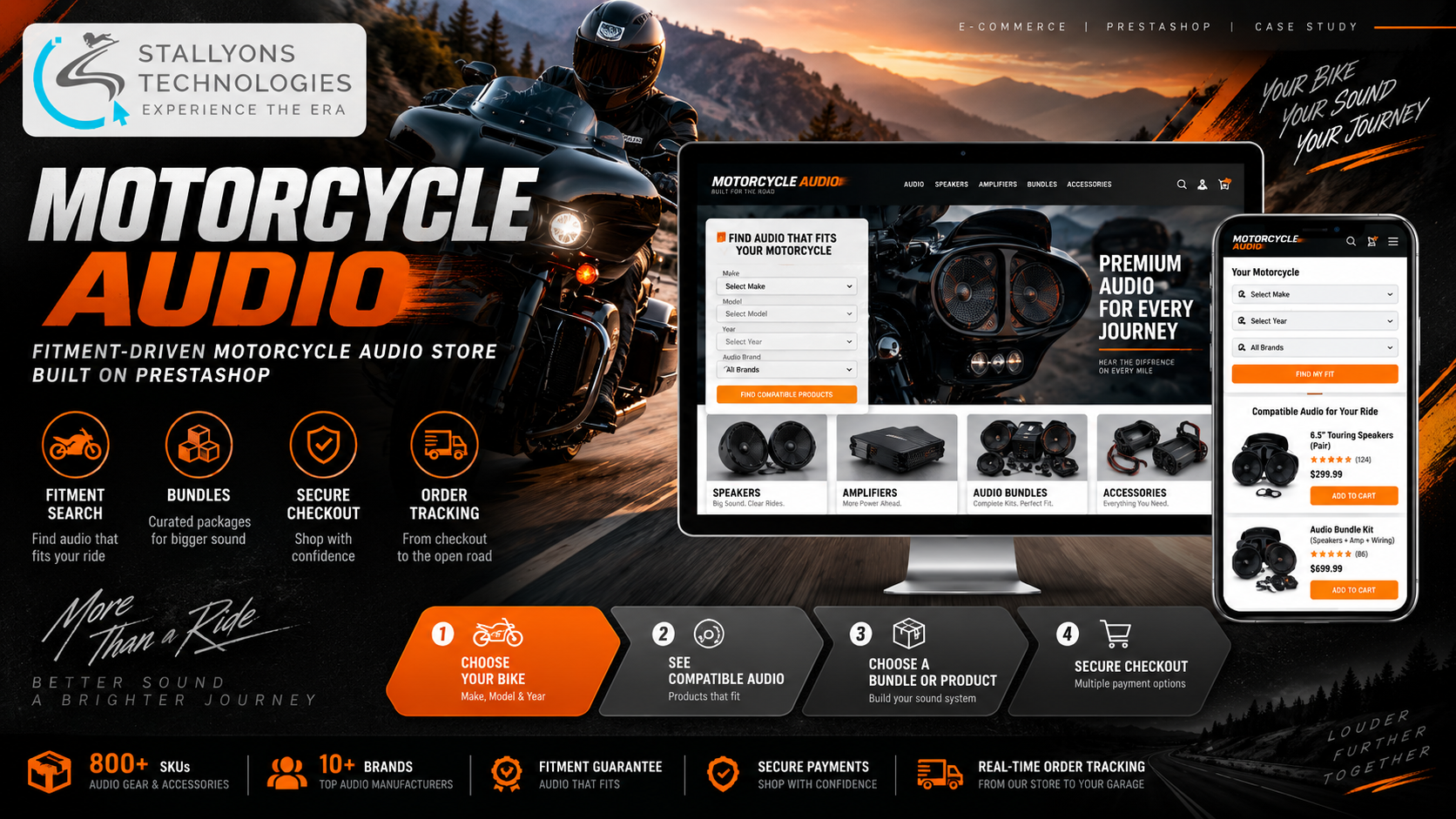
A rider with a 1992 Harley-Davidson Street Glide wants to add speakers and an amplifier, and the only question that matters to them is whether the gear fits that exact bike. Show them a catalogue organised by brand alone and they have to guess. Show them a store that filters by make, model, and year, and they see only what fits, then check out in a few clicks. The difference between those two experiences is the whole project.
That is what this store delivers. Motorcycle Audio is a fitment-driven motorcycle audio store built on PrestaShop, with a clean black, white, and orange design in the spirit of Harley-Davidson. It carries gear from established brands, including Rockford Fosgate, Precision Power, Diamond Audio, Hertz SPL, Kenwood, Infinity and Harman Kardon, Cicada, and Soundz, and is organised so a rider can find audio that fits their specific motorcycle.
Put simply, the catalogue works along three axes at once. Every product carries its motorcycle make, model, and year alongside its brand and product type, so the same amplifier is reachable by bike, by brand, and by category. The build is sized to carry 800 or more SKUs across 10 or more brands, with bundles, multi-gateway checkout, and clean, search-friendly URLs from day one.
The Starting Point: Fit Is Everything, and the Catalogue Is Large
Selling motorcycle audio well is harder than a typical store, because fit matters, the catalogue is large and sourced from many vendors, and buyers expect to shop by their exact bike. The brief came with a specific set of demands:
- Fitment is everything. A part that does not fit the customer’s make, model, and year is useless, so the store has to let people filter to their exact motorcycle, not just browse brands.
- A large, multi-vendor catalogue. With dozens of SKUs across ten or more brands, the store starts at several hundred products and grows past a thousand, each needing images, descriptions, and specs sourced from vendor sites and loaded from a spreadsheet.
- Brands and product types both matter. Customers think in brands, like Rockford Fosgate or Kenwood, and in product types, like amplifiers, speakers, or full systems, so the catalogue has to work along both.
- Bundles need to sell as bundles. Some gear ships as packages that have to be viewable and purchasable as one unit, and the key ones deserve their own landing pages.
- Real checkout expectations. Buyers expect several payment options, confirmation emails, and order tracking, not a bare cart.
- Roles, content, and SEO. The business needs separate Admin and Manager access, a blog and events calendar, editable pages, and clean, search-friendly URLs from the start.
The Build: Fitment as a First-Class Dimension
Motorcycle Audio is built on PrestaShop, whose native model fits the brief closely. Audio brands become manufacturer pages, product types become categories, and each product carries its motorcycle make, model, and year, so the catalogue works by brand, by type, and by fitment at once. PrestaShop’s faceted search powers a fast filter that lets a customer narrow by make, model, year, and brand and sort the results, so a rider reaches the right gear in a few clicks rather than scrolling a wall of parts that may not fit.
Each product page carries detailed descriptions, specifications, images, pricing, and any bundles, with packages built as PrestaShop product packs so a bundle can be viewed and bought as one item, and the key bundles get their own landing pages for promotion. The store’s black, white, and orange look was built to feel fast and minimal in the Harley-Davidson spirit, the kind of storefront where deliberate UI/UX design keeps a large catalogue calm rather than cluttered.
From the rider’s side, the path from landing on the store to a confirmed order runs in a clear sequence:
- Filter the catalogue by make, model, and year, and optionally by brand, to see only gear that fits the bike.
- Open a product or a bundle, read the specifications, and add it to the cart, with packs added as a single item.
- Check out through Stripe, PayPal, or Google or Apple Pay.
- Receive an order confirmation email.
- Log in to the customer account to track the order through to delivery.
Technical Architecture
PrestaShop suits this store because the brief’s hardest parts map onto features it already has, which let the build focus on the distinctive work, motorcycle fitment, the bundle landing pages, and a fast, minimal storefront, rather than re-implementing a catalogue. The architecture centres on a handful of subsystems.
- Fitment catalogue. Every product carries its make, model, and year alongside its brand and product type, so the same SKU is reachable by bike, by brand, and by category.
- Faceted search and sorting. PrestaShop’s layered navigation exposes make, model, year, and brand as filters with sorting, giving customers a quick path from a large catalogue to the products that fit.
- Bundles and landing pages. Packages are built as product packs so they can be viewed and purchased as one item, and key bundles get dedicated CMS landing pages for promotion and search visibility.
- Checkout and payments. A standard cart and checkout integrate Stripe, PayPal, and Google or Apple Pay, send an order confirmation email, and expose order status and tracking in the customer account.
- Roles and content. Employee profiles give Admin full control and Manager a scoped set (customer service, products, reports), while CMS pages, a blog, and an events calendar cover About Us, manufacturer details, news, and events.
- Bulk catalogue population. A defined CSV template maps the spreadsheet SKUs and pricing to PrestaShop fields, and a consistent product template keeps sourced images, descriptions, and specs uniform across brands as the catalogue scales past a thousand items.
Meeting the brief with configured PrestaShop features, brands as manufacturers, bundles as packs, bulk loading as CSV import, and the Admin and Manager split as employee profiles, rather than fragile custom code, is what keeps the store easy to run and extend. If you are building a fit-sensitive catalogue on the platform, our PrestaShop development team scopes which requirements the platform already covers and which need bespoke work on top.
Challenges Solved
The hardest problems came down to making a large, fit-sensitive catalogue easy to shop. Make, model, and year on every product, turned into fast filters by faceted search, let a rider narrow hundreds or thousands of SKUs to the few that fit in a few clicks, so the store answers the compatibility question before anything else. Populating hundreds of vendor-sourced SKUs consistently meant a defined CSV template and product layout, so images, descriptions, and specs stay uniform across ten or more brands as the catalogue grows. And selling bundles as bundles meant product packs plus dedicated landing pages, so a package is a purchasable unit rather than a loose list of parts.
Checkout, roles, and discovery finished the job. Stripe, PayPal, and Google or Apple Pay, with confirmation emails and account-based tracking, gave buyers the modern flow they expect, while the Admin and Manager split kept operations tidy, and clean fitment URLs with per-page metadata kept the store search-friendly as more models and years were added. A fitment-driven store like this maps naturally onto the needs of automotive and vehicle-parts businesses whose catalogues live or die on getting compatibility right.
The Result
The outcome is a store organised around the one question a rider asks first: will this fit my bike? Fitment features plus faceted search turn a large, multi-brand catalogue into a quick path to compatible gear. Brands, packs, imports, and roles all use native PrestaShop features, so the store is straightforward to run and extend. Bundles are purchasable as a unit and promoted on their own pages. Multiple gateways, confirmation emails, and order tracking meet buyer expectations. And a blog, events calendar, CMS pages, and clean fitment URLs support discovery as the catalogue grows past a thousand items.
The store fits the business because it is built around fitment and on maintainable platform features, not bolted onto a generic template that treats every SKU the same. If you are planning a fit-sensitive or multi-brand storefront, you can hire PHP developers who have built exactly this kind of PrestaShop store, or tell us about your catalogue and we will map your products, fitment data, and bundles to a store riders can shop in a few clicks.
Frequently Asked Questions
How does a fitment filter work on a PrestaShop store?
Each product carries its motorcycle make, model, and year as catalogue data, and PrestaShop’s faceted search turns those into filters. A customer narrows by make, model, year, and brand and sorts the results, so a rider with a specific bike sees only the gear that fits it rather than the whole catalogue.
Can a large, multi-brand catalogue be loaded in bulk?
Yes. A defined CSV template maps spreadsheet SKUs and pricing to PrestaShop fields, and a consistent product template keeps sourced images, descriptions, and specs uniform across brands. That lets a catalogue of 800 or more SKUs across ten or more brands load in bulk and stay consistent as it grows past a thousand items.
How are product bundles handled?
Bundles are built as PrestaShop product packs, so a package can be viewed and purchased as a single item rather than as separate products, and the key bundles get their own CMS landing pages for promotion and search visibility.
What payment options and order tracking does the store support?
Checkout integrates Stripe, PayPal, and Google or Apple Pay, sends an order confirmation email, and lets customers log in to their account to track order status and shipping, which matches what buyers expect from a modern store.
How are Admin and Manager access separated?
PrestaShop employee profiles scope Manager access to customer service, products, and reports, while Admin keeps full control over uploads, orders, and content. That keeps day-to-day operations tidy and access appropriate without a developer involved for routine changes.