


Blog
App Store 4.3(a)
Rejection: How We Revamped an iOS App for Approval
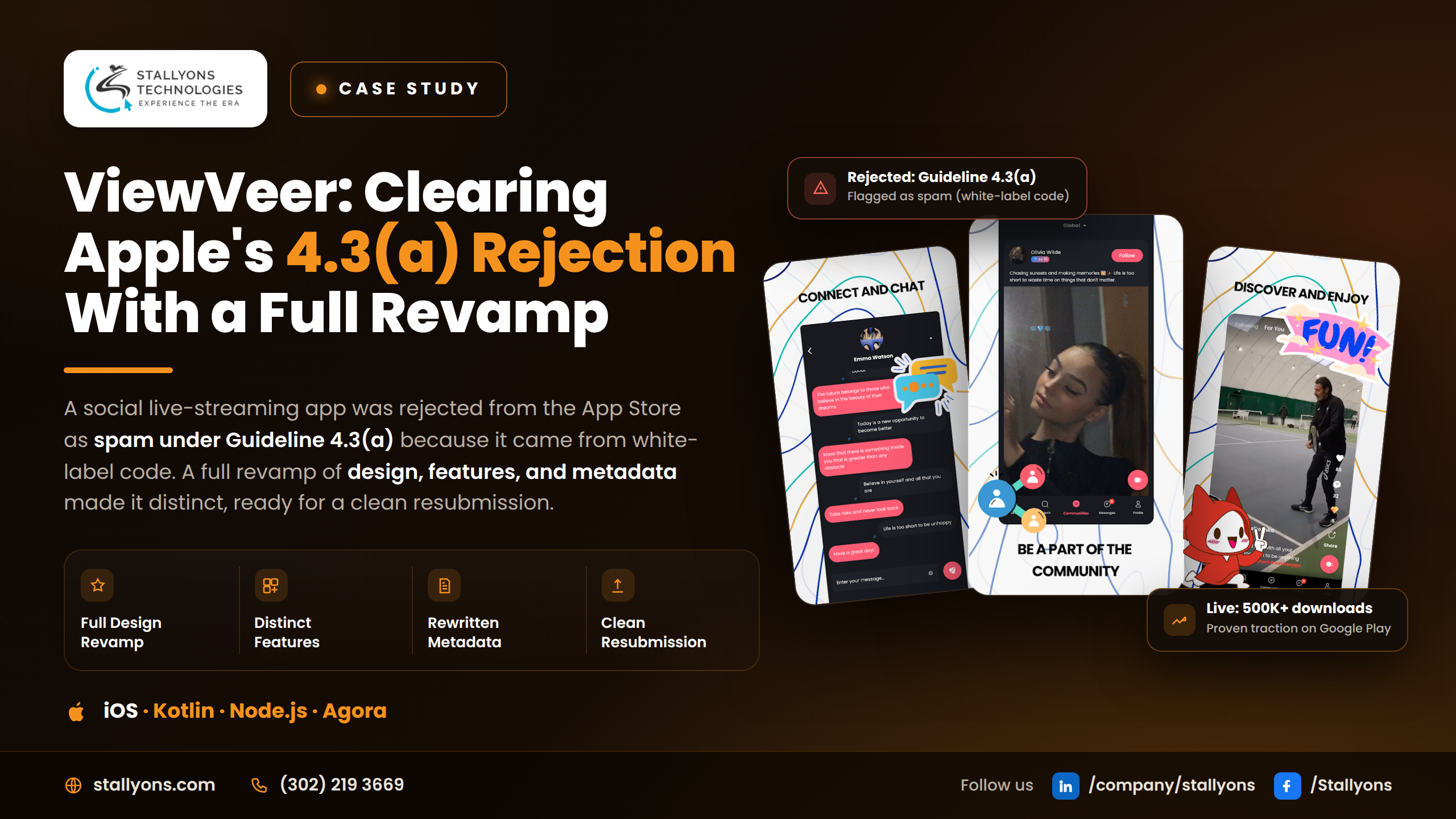
There’s an email every app developer dreads. It arrives from App Review, it’s polite, and it ends your week: “Guideline 4.3(a) – Design – Spam.” For ViewVeer, a social live-streaming app, that email was the only thing standing between it and the App Store. The app already worked. It was already live and doing well on Android, with 500K+ downloads on Google Play. And yet Apple kept turning it away, again and again, under a rule designed to fight spam. This is the story of how it was rebuilt, through careful mobile app development, to earn its place.
In one line: ViewVeer was rejected by Apple as spam under Guideline 4.3(a) because it came from white-label code. A full revamp of design, features, and metadata made it distinct, ready for a clean resubmission.
Why Apple Flagged It: The White-Label Trap
To fix a 4.3(a) rejection, you first have to understand it. Guideline 4.3(a) is Apple’s anti-spam rule. It exists to stop the store filling up with apps that are basically copies of each other, so users can actually find something new.
ViewVeer tripped it for one specific reason: it was built on white-label source code, a finished app template that a company rebrands and ships as its own. It’s fast and cheap, but it has a catch, because many different apps end up sharing the same underlying code, the same layout, and the same flow. Apple can see that at review time.
In Apple’s own framing, the app shared a similar binary, metadata, or concept with other apps from other developers, with only minor differences, and that reads as spam that clutters the store. Concretely, three things were working against it:
| What Apple flagged | Why it happened |
|---|---|
| Similar binary | The app’s code closely matched other white-label apps built from the same template |
| Similar metadata | The name, description, and screenshots looked like other apps |
| Similar concept | The overall design and flow felt generic, not unique to ViewVeer |
The core challenge, then, was to make ViewVeer different enough, in code, look, and store presence, that a reviewer sees its own app rather than one of many near-identical clones.
You Can’t Tweak Your Way Past 4.3(a)
The trap people fall into is treating a 4.3(a) rejection like a checklist bug. It isn’t. Apple looks at the whole app, so the whole app has to change in a way a reviewer can see at a glance. That meant working on three fronts at once, with a popular, well-designed app (RedNote) used purely as a reference for a fresh, modern feel while ViewVeer kept its own name, colors, and identity throughout.
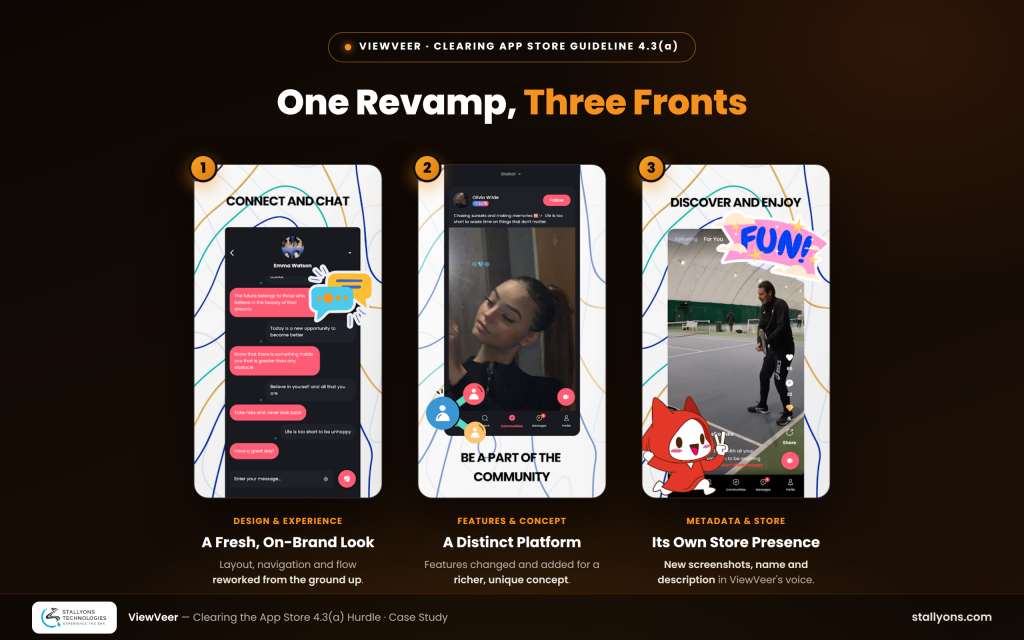
The Revamp, Front by Front
Design and experience. The most visible change came first. A white-label app looks like every other app from the same template, so ViewVeer’s look and feel were reworked from the ground up, the layout, the navigation, the live and video screens, all refreshed and rebranded so a reviewer opening the app sees a considered, distinct product rather than a familiar template with a new logo on top. RedNote informed the sense of quality and freshness; it was never copied, because that would just swap one similarity problem for another.
Features and concept. Design alone doesn’t satisfy 4.3(a), because Apple also weighs what the app actually does. So ViewVeer’s core of social live-streaming was strengthened and surrounded with a fuller feature set: going live, uploading videos, sending and earning virtual gifts, discovery and exposure for creators, social following and interaction, and a genuinely two-way live experience. Shaped into one branded whole, that reads as a concept of its own, not a repackaged template.
Metadata and store presence. Metadata is the first thing both users and reviewers compare, so every bit of it was rewritten to be unmistakably ViewVeer: a distinct name, a description in its own voice telling its own story, screenshots remade to show the new design and real features, and keywords tuned to its actual purpose. Fresh, branded, honest metadata removes exactly the surface-level similarities Apple flags first.
The Technical Side: Change the Binary, Not Just the Skin
ViewVeer is built in Kotlin for iOS, with a Node.js backend, a MySQL database, and live streaming powered by Agora. Because Apple had flagged the binary itself, the revamp deliberately changed real code and structure, not just the surface, so the app reads as genuinely different under review. The delicate part was doing all of that without disturbing the live streaming that users depend on, keeping Agora’s real-time video solid while the app around it was reworked, and leaving the Node.js and MySQL backend stable so the effort could focus on the parts Apple actually inspects. Navigating a rejection like this, knowing which changes move the needle with App Review and which are wasted effort, is where experienced iOS app development earns its keep, and where teams often hire iOS developers who have cleared App Review before rather than learn the rules on a live rejection.
Under the hood, the Kotlin app layer for iOS is where the design and feature revamp actually happened, the Node.js backend handles accounts, content, gifts, and core logic, MySQL keeps reliable storage for users, videos, streams, and gift records, and Agora powers the real-time live video and audio that going live depends on.
The Resubmission: Getting It Through Review
Revamping the app was only half the job; the other half was getting it past Apple. A 4.3(a) rejection needs a clean, careful resubmission that shows the app has truly changed. In practice that meant confirming the design, features, and metadata were all clearly distinct, making sure the binary and structure reflected real change rather than a reskin, a pre-submission QA review to catch anything a reviewer would, preparing a fresh store listing with the new name, description, and screenshots, submitting through App Store Connect, and being ready to explain plainly to a reviewer how the app now stands apart, working through any further notes until it’s approved. The goal throughout was to clear 4.3(a) the honest way, by genuinely being a distinct app, not by trying to trick the review. It is worth being straight about one thing: 4.3(a) is a judgment call made by a human reviewer, so even a thorough, genuine revamp can come back with a further round of notes before it clears. The aim was to make the difference so obvious that the decision was easy, not to promise a single-pass approval.
This was a very different kind of iOS project from our offline iOS museum audio guide app, where the challenge was accessibility rather than approval, but both came down to the same thing: sweating the details Apple and real users actually notice.
The Challenges We Solved
Escaping the white-label trap meant changing the app deeply enough, in design, features, and code, that it no longer reads as one of the crowd, which is harder than it sounds because the change has to be real, not cosmetic. Using RedNote as a reference without copying it meant borrowing a sense of quality and freshness while building ViewVeer’s own look. Changing the app without breaking streaming meant reworking everything around Agora while its real-time video kept running. And satisfying a strict reviewer meant aiming for honest, visible difference backed by a clean resubmission, rather than a shortcut Apple has already seen a thousand times.
The Result
ViewVeer came out of the revamp as an app that stands on its own. The design and experience were reworked into a fresh, modern, on-brand look; the features were changed and built upon into a richer, more distinct take on social live-streaming; and all of the metadata was rewritten to reflect its own purpose. Underneath, the app stayed solid: Kotlin for iOS, a Node.js backend, MySQL, and Agora streaming, all kept working smoothly while the parts Apple cares about were transformed. What had looked like one of many white-label clones now reads as its own product, ready for a clean resubmission to the App Store, which is exactly what Guideline 4.3(a) asks for.
500K+
Downloads already on Google Play
4.3(a)
App Store guideline the rebuild set out to clear
Agora
Live streaming kept stable throughout
Kotlin
iOS app reworked to read as its own product
Rejected Under 4.3(a)? It Can Be Fixed.
If Apple has flagged your app as spam under Guideline 4.3(a), whether it came from white-label code or just looks too generic, it is not the end of the road. It takes a real revamp across design, features, metadata, and often the binary itself, plus a resubmission that makes the difference obvious to a reviewer. That’s precisely the kind of rescue an experienced iOS app development company handles. If Apple has flagged your app, book a discovery call and we will assess your rejection and map the path to approval.
Frequently Asked Questions
What is App Store Guideline 4.3(a), and why did my app get rejected?
It’s Apple’s anti-spam rule. Apps get flagged when their binary, metadata, or concept looks too similar to other apps, often because they’re built from the same white-label template. Apple treats near-identical submissions as clutter and blocks them.
Can a white-label app ever be approved on the App Store?
Yes, but usually only after a genuine revamp. The app has to be made clearly distinct in design, features, and metadata, and often in its actual code, so a reviewer sees an original product rather than a rebranded template.
Do I have to rebuild my whole app to clear a 4.3(a) rejection?
Not always from scratch, but cosmetic tweaks won’t do it. The changes have to be real and visible across design, features, and metadata, and because Apple flags the binary, the underlying code and structure usually need to change too.
Can you fix an app you didn’t originally build?
Yes. ViewVeer came from third-party white-label code, and the revamp was done on that existing app, keeping its Agora streaming and Node.js backend working while transforming the parts Apple reviews.
Will changing the app break my live streaming or backend?
It shouldn’t, if it’s handled carefully. Here, Agora-powered live streaming and the Node.js and MySQL backend were kept stable throughout, so the revamp could focus on design, features, and metadata without disrupting what already worked.