


Blog
Anime Store: Webflow
WhatsApp Shop
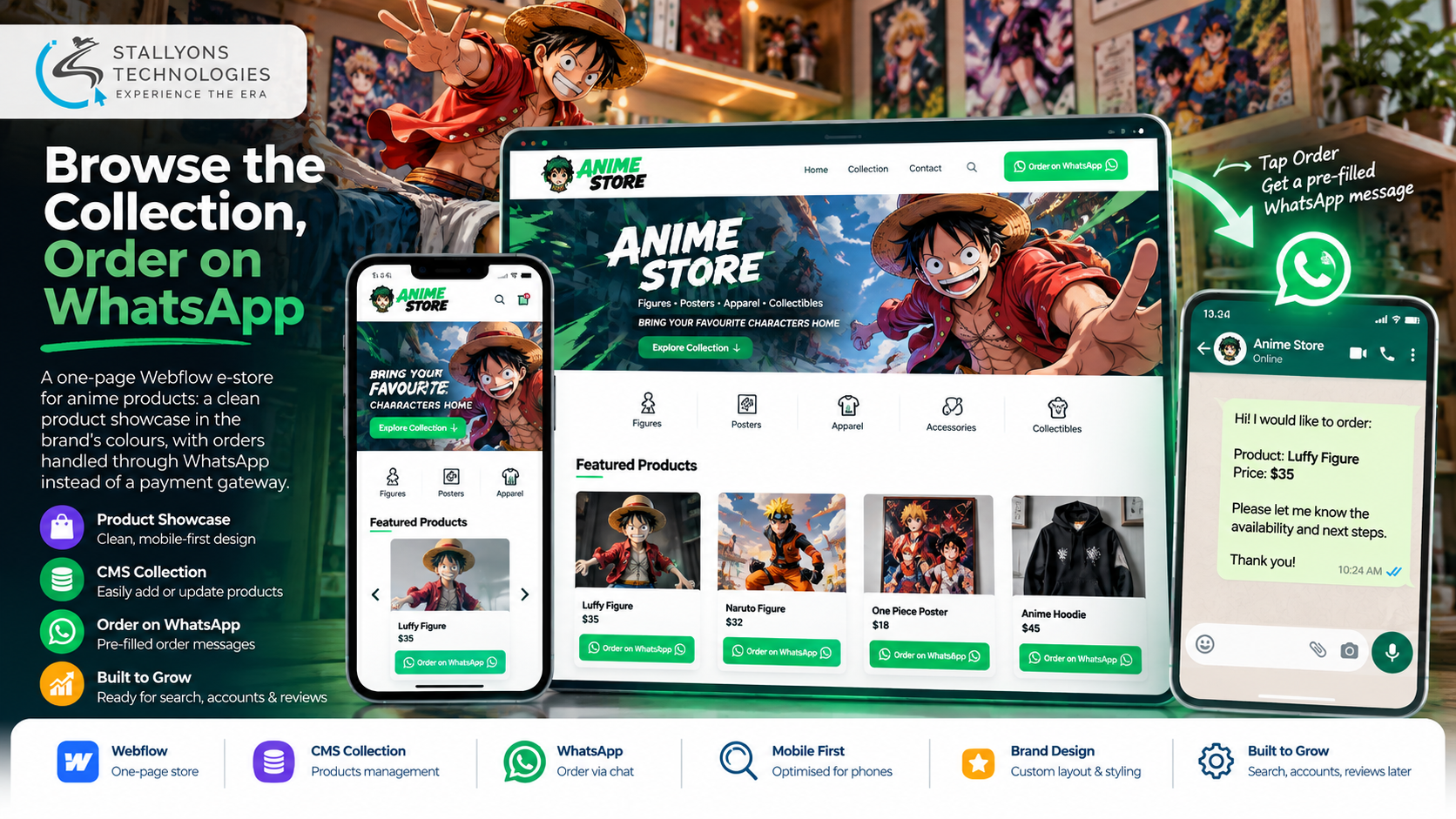
A lot of small sellers run an entire business out of a phone. The products sit in scattered social posts, the catalogue lives in the owner’s head, and every sale happens in a chat. It works, right up until someone asks “do you have a link?” and there is nothing to send. That was the position an anime products seller was in: real demand, a real audience, and no single place to point people to.
Anime Store is the one-page Webflow shop we built to be that place. Fans scroll a grid of products, each with an image, a name, and a price, and tap one button to order. Instead of a checkout, the button opens WhatsApp with the order already written out, and the owner finishes the sale in the chat, which is exactly how the business already worked. There is no payment gateway and no cart, just a clean shop window in the brand’s green colours that loads fast on a phone.
Put simply, a fan sees a product, taps Order, and a WhatsApp chat opens with the product name and price filled in, ready to send. The owner adds and reprices products in the Webflow Editor in a couple of minutes, with no code and no developer.
The Starting Point: A Shop Window Without a Checkout
The owner did not need a full e-commerce platform. Sales were already closing in chat, so a gateway would have added fees and friction without adding value. What was missing was a presentable catalogue and one link to share. That shaped a short, firm list of requirements.
- One link to share everywhere. A single page that works as the shop window behind every social post, instead of products scattered across feeds.
- Orders through WhatsApp, not a gateway. The sale had to land in the chat where the owner already talks to customers, with no card processing to pay for.
- Phone-first by default. Most fans arrive from social media on mobile, so the layout had to be built for small screens first.
- Live fast and cheap. The page was needed within days, on a budget that was simple to build, host, and run.
- Room to grow later. Search, customer accounts, and reviews were not needed yet, but the store had to be ready to add them without a rebuild.
The Build: A Product Grid That Ends in a Ready-Written Order
The store runs as one scrolling page from a branded header to a pre-filled chat. Building a page that feels like a real shop while keeping the sale in WhatsApp is the sort of focused job a Webflow development team can turn around quickly, because the whole thing rests on a tidy content model and one good card design rather than a heavy platform. A purchase moves in order.
- A fan opens the shared link from a social post and lands on the header with the owner’s logo and a short welcome.
- They scroll a grid of product cards, each showing an image, a name, and a price.
- They tap the Order button on the product they want.
- WhatsApp opens with a message that already contains the product name and price, so they only have to press send.
- The owner confirms stock and payment in the chat and arranges delivery, exactly as before.
- When new stock lands, the owner adds each product as a CMS item in the Editor and it appears in the grid with the same card design.
Every product is an item in a Webflow CMS Collection, shown through a single repeated card, so adding, removing, or repricing is a quick content edit rather than a layout change. Because the business sells physical goods, the structure was set up so proper e-commerce development can be layered on later using the same product collection, if the owner ever wants a full cart and checkout.
Technical Architecture
The store is a one-page Webflow site hosted on Webflow. The challenge was not the layout. It was making a single page feel like a real shop, getting every order into WhatsApp correctly formatted, and setting up the CMS so it could grow into a fuller store without a rebuild, all on a tight timeline. Each layer does one thing.
- Webflow platform. The visual build and hosting, with fast, secure pages and SSL by default.
- CMS Collection. Each product held as an item with a name, price, and image, editable in the Webflow Editor.
- Card template. One Collection List design repeated for every product, so the grid is consistent and the build stays small.
- Order links. A click-to-chat link per product that carries the name and price into a pre-filled WhatsApp message.
- Mobile-first layout. Breakpoints that run from a single column on phones to several across on desktop, in the brand’s green theme.
- Growth hooks. Structure ready for Webflow site search, Webflow e-commerce, and a reviews add-on on the same collection.
The piece worth getting exactly right is the WhatsApp order link. Product names can contain characters that break a chat link, so each message is encoded properly, which means it opens with the right text on Android, iPhone, and desktop every time. A broken link is a lost sale, and on a store with no checkout to fall back on, those links are the entire transaction.
Challenges Solved
A store normally ends in a cart and a payment screen. Here it ends in a chat, so the hard part was keeping the feel of a real shop while the sale lives in WhatsApp. Each product card carries its own ready-written order, which is what makes the page read as a store rather than a catalogue. Getting those messages to open correctly everywhere was the next problem, solved by encoding every link so special characters in a product name never scramble the text.
Speed was the other pressure. The owner needed the page live urgently, so a single card design and one CMS Collection kept the build quick, and changes were turned around the same day. The last decision was about the future rather than the launch: search, accounts, and reviews were left out on purpose, but the product collection was structured so Webflow search and e-commerce can be switched on later and reviews or member logins added with an add-on, without starting over.
The Result
The owner has one link to drop under every post, a page that looks like a proper shop, and a way to add products in minutes without touching code. Orders arrive in WhatsApp already written out, so there is no typing, no guesswork about what the customer wants, and no payment fees eating into small sales. Because every product is a CMS item, the catalogue updates as fast as stock changes, and the store can grow into a fuller shop whenever the business is ready. For a seller who was running everything out of scattered posts, the difference is having one place that looks the part, loads quickly, and turns a browse into a conversation with a single tap.
If you sell this way and want a page that matches it, you can hire dedicated developers who build lean, CMS-driven stores, or tell us what you sell and how you take orders and our US-registered team will map your products and chat flow to a page that fits. It suits any retail and e-commerce seller who closes sales in a conversation rather than a checkout.
Frequently Asked Questions
What is Anime Store?
It is a one-page Webflow shop for anime products. Fans browse a grid of products with images and prices, and each Order button opens WhatsApp with the order pre-filled, so the owner completes the sale in the chat. There is no checkout and no payment gateway.
How does ordering without a checkout work?
Each product card has a click-to-chat link that opens WhatsApp with the product name and price already written into the message. The customer presses send, and the owner confirms stock, payment, and delivery in the conversation, which is how the business already sold.
Why skip a payment gateway?
Sales were already closing in chat, so a gateway would have added per-transaction fees and a checkout to abandon without adding value. Keeping orders in WhatsApp means no processing fees, a direct line to every customer, and a faster, cheaper page to run.
Can the owner add and reprice products without a developer?
Yes. Every product is an item in a Webflow CMS Collection, so adding, removing, or repricing is a quick edit in the Webflow Editor. The card design is applied automatically, so the owner never touches layout or code to keep the store current.
Can the store grow into a full shop later?
It can. The product collection was set up so Webflow site search and Webflow e-commerce can be switched on later, and reviews or customer logins added with an add-on, all on the same data. The store launches simple and keeps the door open to a full cart and checkout.