


Blog
TASH: React Native
Real-Time Card Game
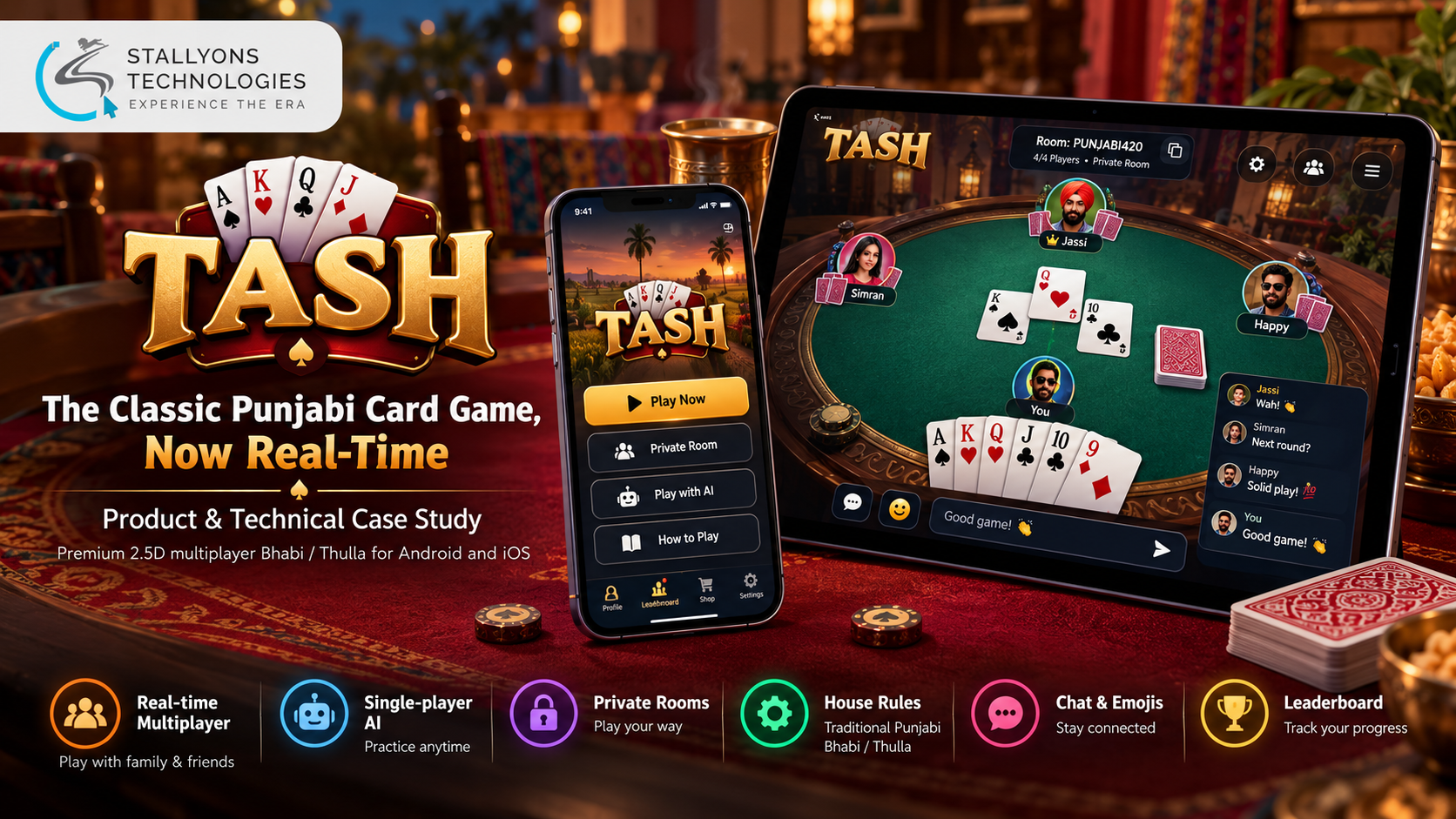
Bhabi, the Punjabi card game also called Thulla, is best played around a table with family. The trouble is that families are spread across India, Canada, the UK and the USA, and the card apps that exist feel flat, full of mid-hand ads, and locked to one fixed set of rules. TASH was built to put the real table back on the phone.
TASH is a premium 2.5D Bhabi card game for Android and iOS, published as “Tash – Bhabi, Seep, Coat & Card Games”. A player can play alone against AI, join a public table with three to six people, or open a private room and play with their own house rules, just like at home. It is built in React Native, with an angled table, realistic cards and smooth animations, and behind it sits a real-time game server that controls every shuffle, deal and move so no one can cheat.
Put simply, TASH gets you into a live game within seconds, keeps the game provably fair because the server decides everything, and lets friends and family play their own version of Bhabi in a private room. If a seat is empty, an AI player fills it, so a table is never stuck waiting.
The Starting Point: A Real Table, Not Just Another Card App
Copying the existing card apps would have repeated their mistakes. To feel like the real game, TASH had to be fair, flexible and lively from the first tap. That shaped a clear set of requirements.
- Make the game provably fair. When the phone decides the deal, players cannot trust it, so the shuffle, deal and every legal move had to be controlled by the server, not the device.
- Support real house rules. Every family plays Bhabi a little differently, so private rooms had to handle teams, removed cards, custom dealing and table signals rather than one fixed version.
- Never leave a table empty. A new game with too few players means a long wait, so AI had to fill empty seats and cover anyone who drops.
- Stop quitting as an escape. Leaving mid-game to avoid becoming the Bhabi ruins it for everyone, so a disconnect could not break the game or dodge the result.
- Feel premium without a game engine. The 2.5D table, cards and animations had to look polished in React Native and still run on weaker phones.
- Keep ads out of the way. Ads could appear at game start and on restart, but never over active play.
The Build: From Tapping Play to a Live Hand
The whole experience is built so a player is seated and dealt in almost no time. Getting an angled 2.5D table and fluid card animations to run well on everyday devices, while a server referees every move, is the substance of the React Native mobile app development behind TASH. A quick game runs in order:
- The player starts as a guest or logs in, then taps Play for single-player or a public table.
- The server matches them with three to six players and fills any empty seat with AI, clearly marked as AI.
- The server shuffles and deals, and only legal cards can be played, with the turn timer keeping pace.
- It handles Thulla, power, collecting the pile and every final-card case automatically.
- Players chat with emojis and quick messages while the hand plays out.
- A polished reveal shows who the Bhabi is, then the table can rematch or return to the lobby.
Private rooms work like a real table. The host picks a team mode or free play for up to eight players and shares a room code or invite link. They can remove cards, set the dealing sequence, pick the dealer, and use controls like Choose Color, a hidden card, showing a card to a neighbour, team collection, scoring, Undo and Restart. Every one of those controls is synced through the server so each player sees the same table.
Technical Architecture
TASH is a real-time multiplayer game, not a standard app, so the architecture is built around keeping up to eight players in sync while the server validates every card. Each layer has one job.
- Player app. React Native runs the game on iOS and Android from one codebase, which keeps a lean team iterating fast.
- 2.5D rendering. React Native Skia draws the table and cards on the GPU, and Reanimated runs the dealing, throwing and reveal animations on the native thread.
- Game server. Node.js with Socket.io gives low-latency, two-way play, and it is the single source of truth where every move is validated. Building that authoritative, rules-aware server is a custom software development job, not an off-the-shelf one.
- Data and live state. PostgreSQL holds accounts, the leaderboard, statistics and results, while Redis handles matchmaking queues and live game state.
- Integrations. Google AdMob serves game-start and restart ads, and Firebase Cloud Messaging handles push notifications.
- Admin panel. A web dashboard manages users and monitors live games and rooms.
The part worth engineering carefully was the rules engine. The full Bhabi rules, including the Ace of Spades first pile, follow-suit, Thulla, power, pile collection and every final-card case, run on the server and were tested with complete games from start to finish, because hidden cards are never sent to other players’ phones.
Challenges Solved
The hardest problems were the ones players feel immediately. Unwritten house rules were turned into code and tested end to end. Fair play on mixed networks was handled by making the server the single source of truth, so a dropped connection keeps the player’s cards in the game and the AI covers their turns until they return. A large private-room control set was kept usable by grouping it into a setup area and a small in-game menu. And a premium 2.5D look was achieved without a game engine by drawing on the GPU with Skia and animating on the native thread, with a reduced-animation mode for weaker phones.
The through-line was keeping a social game lively across distance, which is exactly what a consumer product needs to grow. Most new players arrive through invite links shared with family, the kind of product-led growth that SaaS and consumer-app startups depend on.
The Result
The outcome is a card game that feels like the real thing. Players get into a live hand quickly, the server keeps every deal fair, AI keeps tables full, and private rooms let families play their own version of Bhabi from different countries. TASH is live on both Google Play and the Apple App Store.
The build works because the server, not the phone, runs the game, which is what makes it fair and keeps families coming back. If you are planning a real-time multiplayer app, you can hire JavaScript developers who have shipped this Node and Socket.io game server, or tell us about your game and we will plan the build. As a React Native mobile app development company, we ship real-time products that stay in sync.
Frequently Asked Questions
What is TASH?
TASH is a premium 2.5D mobile card game for Bhabi, the Punjabi game also called Thulla, on Android and iOS. Players can play against AI, join a public table of three to six people, or open a private room with their own house rules, all backed by a real-time game server.
How does TASH stop cheating?
Every part of the game runs on the server: shuffling, dealing, turn order, legal moves, Thulla, power, who collects the pile and the final result. The phone only shows what the server allows, and hidden cards are never sent to other players’ devices, which makes cheating practically impossible.
Can I play my family’s own version of Bhabi?
Yes. A private room supports team modes, free play for up to eight players, removing cards, custom dealing sequences, choosing the dealer, and table controls like a hidden card, showing a card to a neighbour, team collection, scoring, Undo and Restart, so families can play exactly how they play at home.
What happens if a player leaves mid-game?
The game continues. A dropped player gets a reconnection window while the server or AI plays their turns, so a disconnect never breaks the game. Leaving can never be used to escape becoming the Bhabi.
What technology is TASH built with?
The app is built in React Native, with React Native Skia and Reanimated for the 2.5D table and animations. The authoritative game server runs on Node.js and Socket.io, with PostgreSQL for accounts and results and Redis for live state, plus Google AdMob and Firebase Cloud Messaging.