


Blog
AI Workforce: Scroll-Story
Bubble.io
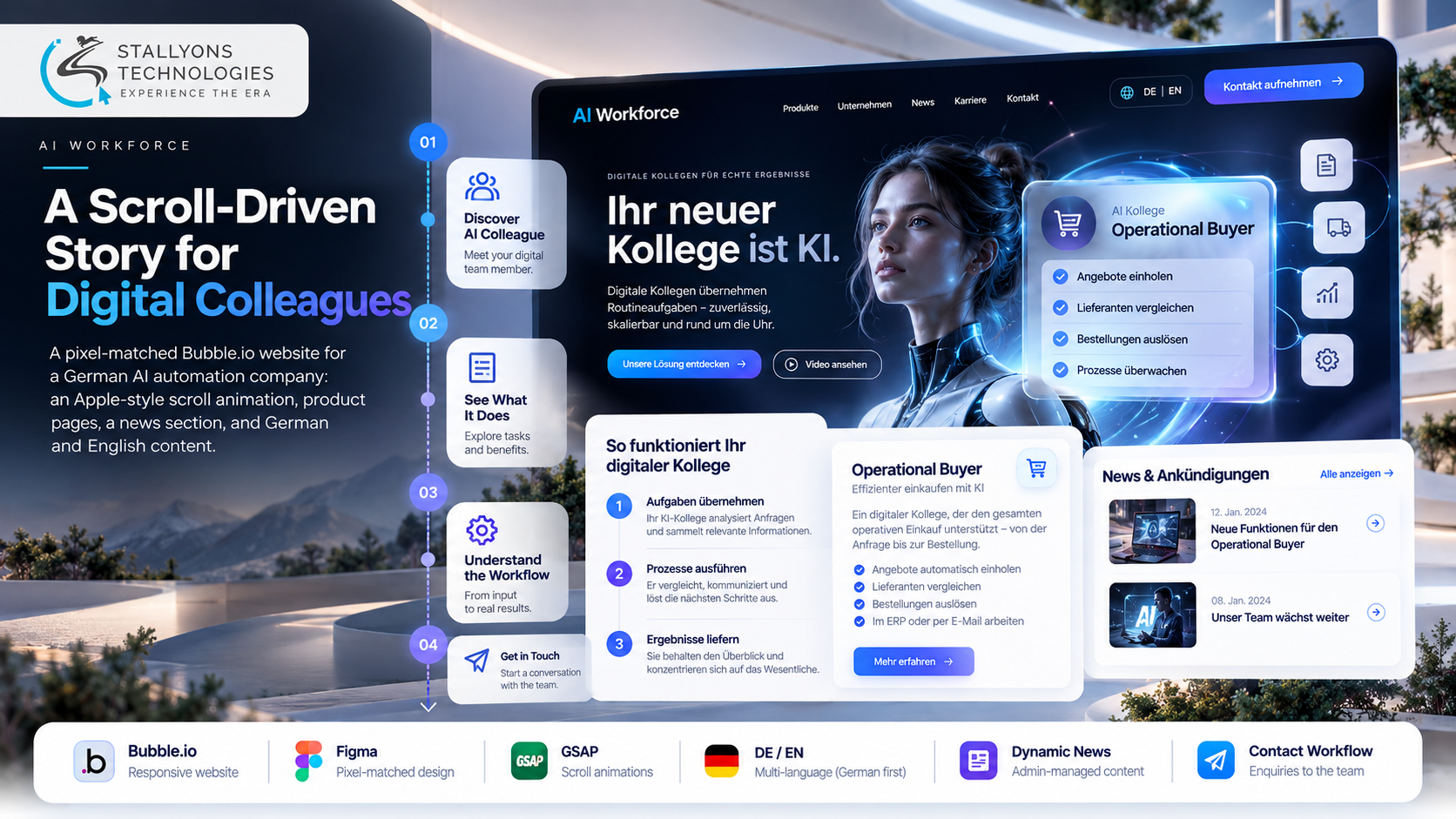
Selling AI agents means selling something a visitor cannot see. A German company offers what it calls digital colleagues, software that takes over routine roles such as an operational buyer, and its website has a few seconds to make that abstract idea land, look premium, and do it for German and English readers at once. A flat page of text would not carry it. The story needed to move.
AI Workforce is a Bubble.io website we built and evolved for that company, with a homepage that tells the product story as a sequence of slides that animate into view as the visitor scrolls, in the style of Apple’s product pages. Product pages explain each digital-colleague role, an about page introduces the company, and a news section lets the team publish announcements itself from an admin-only page. German is the main language with English alongside, and a contact form sends enquiries straight to the team. The site went live on the client’s own domain in January 2024.
Put simply, a visitor scrolls through an animated story that explains an invisible product, switches between German and English, reads the latest news, and gets in touch, while the team keeps the whole thing current without a developer.
The Starting Point: Make an Invisible Product Feel Real
The website had to make the idea concrete and keep pace with a design that changed as the business found its footing. That pulled in a set of requirements, each one shaping how the pages were built.
- Explain an abstract product fast. A visitor needed to grasp what a digital colleague does within a few seconds of landing, which ruled out a wall of text.
- Match a demanding design. The Figma files were detailed, with animation the client expected to hold closely on every screen size.
- Keep up with a moving target. The design went from an original, to a full redesign, to a simplified version within a few months.
- Run in two languages. German comes first and English second, and the client wanted to control the wording on the key pages.
- Let the team publish alone. News and announcements had to go live from inside the site without waiting on a developer.
- Stay fast and findable. A marketing site built on an app platform still had to load well and be visible in search.
The Build: A Story That Moves With the Scroll
The homepage is the centrepiece, and rebuilding a video-like animation as real, readable text that steps forward with the visitor’s own scrolling is the kind of detail-heavy work a Bubble.io app development team handles when a marketing site has to behave like a product. The site came together in a clear sequence:
- We fixed a navigation problem on the first version of the site before anything else was rebuilt.
- We turned the full Figma redesign into Bubble pages, following a shared site map and applying feedback logged on a Trello board.
- We rebuilt the homepage from a playing video into scroll-driven slides, each step animating into view with its own text, tuned for desktop, iPad, and phone so the text stays readable and the images stay aligned.
- When the client simplified the design, we rebuilt the affected homepage blocks and reworked the mobile layout to match.
- We added a news section with a list page and a reading page, posted from an admin-only page, and set German as the main language with English alongside.
- We connected the site to the client’s own domain and checked the search settings and page speed at go-live.
The two-language workflow was kept deliberately light. The client writes the static pages in both German and English, so the key wording stays under their control, while a news post written in German is sent to a translation service and stored in English too. The look itself came straight from Figma, pixel for pixel, which is where close UI and UX design work earns its place on a site meant to feel premium.
Also readour blueprint for launching a coach’s online course, from sales funnel to members-only portal
Technical Architecture
The website runs on Bubble.io, with responsive pages built from the client’s Figma designs, a scroll-animation library added through an HTML element for the homepage story, and Bubble’s app languages for German and English. The hard part was not building pages. It was recreating a video-like scroll animation with real text at every screen size, keeping up with two design overhauls, and keeping a Bubble marketing site fast and visible in search. Each layer has one job.
- Responsive pages. Bubble pages matched to each Figma version, so the live site always reflects the current brand.
- Scroll animation. A GSAP library loaded through an HTML element, tying each slide and its text to the visitor’s scroll position.
- News content. A news data type with list and reading pages, posted from an admin-only page so only the team can publish.
- Languages. Bubble app languages for the client’s own German and English static texts, with news auto-translated from German into English.
- Forms. A Bubble e-mail workflow that sends contact enquiries straight to the team.
- Review and hosting. A staging site and a Trello board where every page and every piece of feedback was tracked, then the live site on the client’s domain.
The part worth engineering with real care is the scroll story on small screens. A story that animates beautifully on desktop can lose its text or break its alignment on a phone or an iPad, so each step was adjusted per resolution, including the iPad size the client tested on, until the words stayed readable and indexable at every size.
Challenges Solved
A video that had to become an animation was the first real problem. The opening homepage used a playing video, but the client wanted the story to move with scrolling like Apple’s product pages, so it was rebuilt as scroll-driven slides with live text and adjusted for each resolution. Three design versions in a few months was the second, and a shared site map and a Trello board kept every page and every note clear as the scope shifted from original to redesign to simplified.
Two languages in one workflow could have meant writing every post twice and restructuring the site; instead the client provides the static texts in both languages and news posted in German is translated into English automatically. Ranking was the last concern, because an app platform is not built for search by default, so every page and news item was given its own title, description, and clean URL, images were compressed, and posting was locked to admins so no spam reaches the site.
The Result
The site does the job it was built for: a visitor scrolls through an animated story that makes an invisible product understandable, moves between German and English, reads the latest announcements, and reaches the team through the contact form. Three design versions were built as the brand evolved, the team publishes news on its own without developer time, and the whole thing went live on the client’s own domain. Each phase was reviewed on staging and through Trello, every milestone was paid, and the client came back for each new round of work.
It works because the homepage was treated as a product to tell a story, not a brochure to fill. If you are building something like it, you can hire front-end developers who can turn a detailed Figma design into a scroll-driven site that stays readable on every screen, or tell us about the product you need to explain and we will shape the story around it. It suits any software startup that has to make a new, abstract product feel real on its first visit.
Frequently Asked Questions
What is AI Workforce?
It is a Bubble.io website we built for a German company that sells AI digital colleagues. The homepage tells the product story through a scroll-driven animation, product pages explain each role, and a news section and contact form round it out, in German and English on the client’s own domain.
How does the scroll-driven homepage work?
Instead of a playing video, each step of the story animates into view as the visitor scrolls, using a GSAP animation library loaded through an HTML element. The visitor controls the pace, and the text stays real and readable rather than being locked inside a video.
How are German and English handled?
German is the main language with English alongside. The client writes the static pages in both languages to keep control of the wording, while news posts written in German are sent to a translation service and stored in English automatically, so publishing stays fast.
Can the team publish news without a developer?
Yes. News and announcements are added from an admin-only page in Bubble, with a list page and a reading page that follow the design. Posting is locked to admins, so the team keeps the site current on its own and no spam reaches it.
Can a Bubble marketing site still rank in search?
It can with care. Every page and news item was given its own title, description, and clean URL, images were compressed for speed, and the site was connected to its own domain with the search settings checked at go-live, so the pages are visible rather than hidden behind an app shell.