


Blog
Subscription Marketplace on
WordPress
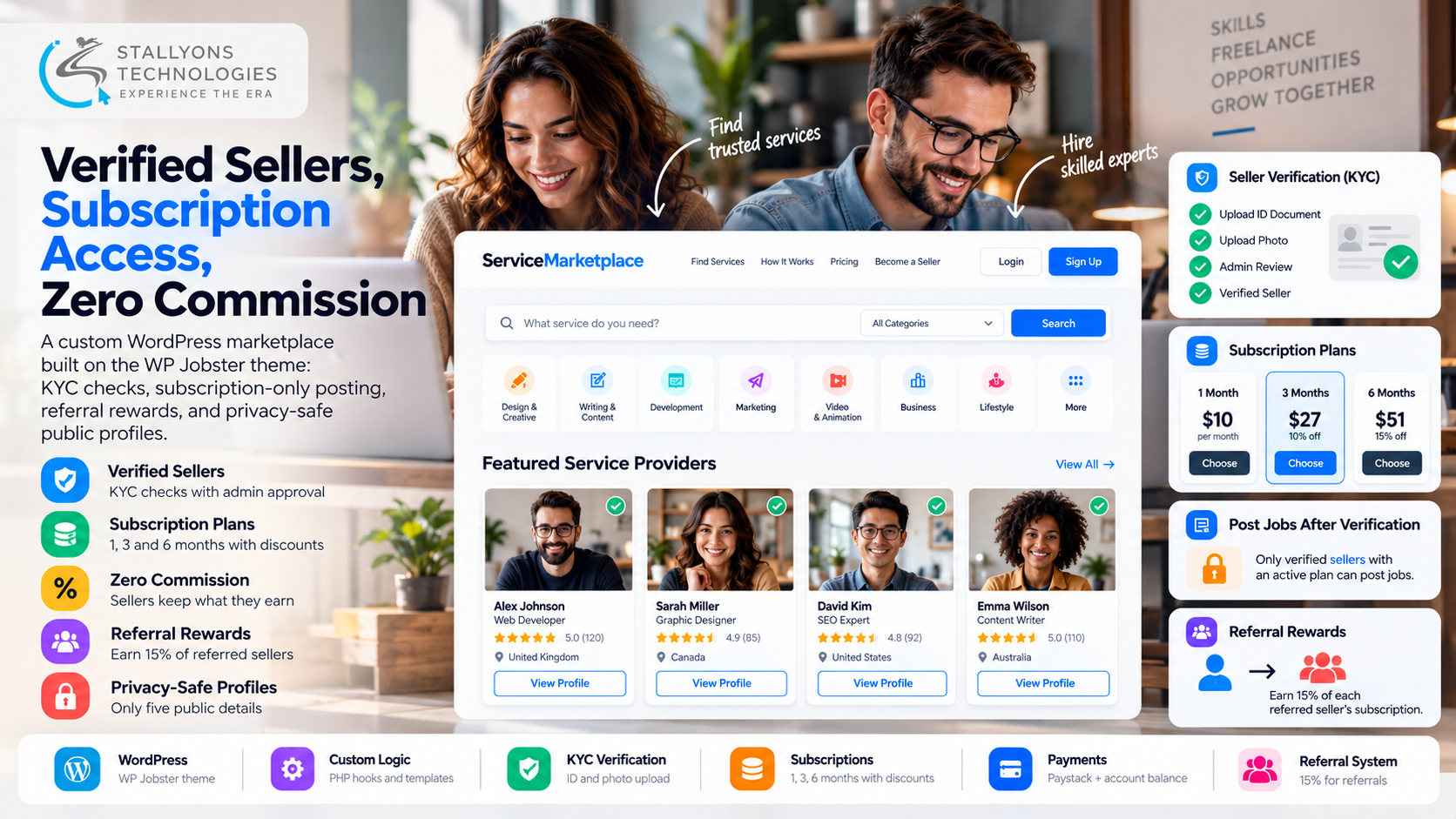
Most freelance platforms take a cut of every job. This one does not. The client runs a marketplace where service providers sell their skills to buyers and keep everything they earn, because the business makes its money from seller subscriptions instead of commission. That model only works if two things are true: every seller is a real, checked person, and nobody can post work without an active plan. The theme the site was built on assumed the opposite, open sign-ups and a commission on every job, so it had to be reshaped from the inside.
Service Marketplace is a WordPress marketplace built on the WP Jobster freelance theme and customised with our own code so it fits a zero-commission, subscription business. A new user registers, confirms their e-mail, uploads identity documents for review, and only after approval can choose a one, three, or six-month plan and start posting. A referral reward pays existing sellers for bringing new ones, card and account-balance payments both work, and public profiles show buyers only a handful of safe details while the admin keeps the full record.
Put simply, a seller has to verify who they are and hold an active subscription before they can sell, buyers see a trustworthy profile, and the platform earns steady subscription revenue with no commission on any job.
The Starting Point: Trust and Subscriptions a Stock Theme Would Not Give
Trust is the whole product on a marketplace, and the business model depended on subscriptions rather than a cut of each sale. The theme supported neither out of the box, with a public launch date already announced. That set a tight list of requirements.
- Check identity before anyone sells. Anyone could register and start selling with no proof of who they were, so a review step had to sit between sign-up and selling.
- Earn from subscriptions, not commission. The theme assumed a fee on every job, but this platform makes money only from seller plans, so job posting had to be tied to an active plan.
- Stop free posting. Sellers could post without paying, which broke the whole model, so an expired plan had to stop new posts until it was renewed.
- Protect personal data. Profiles needed to show buyers only a few safe details while admins saw the full record, including identity files.
- Hit a fixed launch. The launch had been announced publicly, so the first set of features had to be ready in under two weeks.
- Reward referrals. Sellers who brought other sellers needed a share of the newcomer’s subscription credited to them automatically.
The Build: Register, Verify, Subscribe, Then Sell
The flow a seller moves through is a genuine gate, and reshaping a commercial theme so it enforces that gate without breaking its other features is the kind of custom platform build we take on through hooks and templates rather than a rewrite. A seller moves in a set order:
- The user registers and confirms their e-mail address.
- They are taken to an identity form, also linked from the confirmation e-mail, where they upload a means of ID and a passport photograph.
- The admin reviews each submission and approves or rejects the seller.
- Once verified, the seller chooses a one, three, or six-month plan, with a discount for the longer terms, and pays by card through Paystack or from their account balance.
- With an approved identity and an active plan, the seller can post jobs; when the plan expires, posting stops until it is renewed.
- If the seller joined through another seller’s referral link, a share of their subscription is credited to the referrer’s balance.
Public profiles were cut back to five fields, a photo, username, full name, location, and gender, so buyers and sellers see enough to trust each other while identity files and contact details stay with the admin and the account owner. Keeping a live, growing marketplace stable while all of this went in is standard web development discipline: change the theme’s behaviour through its own hooks, take a full backup before any update, and keep every customisation where a theme update cannot quietly overwrite it.
Technical Architecture
The marketplace runs on WordPress with the WP Jobster theme, extended with custom PHP for the new rules. The challenge was not adding forms. It was changing how a commercial theme handles posting, payments, and profiles without breaking its other features, while the site was live and growing, and keeping those changes working when the theme and plugins were updated. Each layer has one job.
- CMS and admin. WordPress, the client’s existing platform, where the admin reviews sellers, manages plans, and tracks subscriptions and payments.
- Marketplace theme. WP Jobster, which supplies jobs, profiles, and messaging, with its posting and payment flow hooked rather than replaced.
- Custom logic. PHP hooks and templates that enforce the identity check, the posting gate, referral credits, and profile privacy.
- Identity form. A custom form with file uploads for a means of ID and a photograph, held for admin approval before a seller can subscribe.
- Plans and payments. Theme subscriptions customised to one, three, and six-month terms with discounts, paid through Paystack or from an account balance.
- Hosting. Managed WordPress hosting, with a full backup taken before every theme or plugin update.
The part that needed the most care is where custom rules meet a theme that keeps updating. More than once, an update replaced custom code and switched payment options back off. Each time the features were restored, and the durable fix was to move the custom code into a child theme or plugin so a future update cannot overwrite the rules the business depends on.
Challenges Solved
The launch date could not move, because the party was already announced, so the first set of features was built and shown by video in time, with the remaining rules added in follow-up rounds. Changing the theme’s business model was the core problem: WP Jobster is built around open posting and commission, so its posting and payment flow was hooked to require an approved identity and an active plan, and to apply referral credits, without rewriting the theme underneath.
Updates that undid the customisations were the recurring headache, solved by a backup-before-update rule and by moving custom code somewhere updates cannot reach. The last problem was human: new sellers were unsure what to do after registering, so the path was made explicit, confirm your e-mail, upload identity, then subscribe before posting, with first and last name added as required fields so the admin can identify every user.
The Result
The marketplace now runs the way the business model needs it to. Only verified sellers with an active plan can post, expired plans stop new posts until they are renewed, buyers see a consistent and safe profile, and referrals turn existing sellers into a source of new ones. The platform earns predictable subscription revenue instead of a commission on each job, which is exactly what makes it attractive to the sellers it wants to keep. The client paid every milestone, added a tip for the commitment on the project, and came back with further feature requests.
It works because the theme’s own posting and payment flow was bent to the business rather than fought. If you are reshaping a platform like this, you can hire WordPress developers who customise commercial themes without breaking their updates, or tell us how your marketplace should make money and we will map your rules onto it. It suits any subscription software business that earns from recurring plans rather than per-transaction fees.
Frequently Asked Questions
What is Service Marketplace?
It is a freelance services marketplace built on WordPress with the WP Jobster theme and customised with our own PHP. It charges no commission on jobs; sellers pay a subscription instead and must pass an identity check before they can sell, so buyers deal only with verified, paying providers.
How does the no-commission model work?
The platform earns from seller subscriptions, offered as one, three, and six-month plans with discounts for the longer terms. Sellers keep everything they earn on jobs, and job posting is tied to an active plan, so revenue comes from subscriptions rather than a cut of each sale.
How are sellers verified before they can post?
After registering and confirming their e-mail, a seller uploads a means of ID and a passport photograph through a custom form. The admin reviews and approves each submission, and only an approved seller with an active subscription can post, which keeps unverified people off the market.
What stops a theme update from breaking the custom rules?
Early on, updates replaced custom code and switched payment options off, so the team adopted a rule to back up and check before every update and moved the custom code into a child theme or plugin. That keeps the identity check, posting gate, and referral logic in place through future updates.
How is buyer and seller privacy handled?
Public profiles show only five details: photo, username, full name, location, and gender. Sensitive records, including identity files and contact details, are visible only to the admin and the account owner, so people see enough to trust each other without exposing personal data.