


Blog
Property88: WooCommerce Uganda
Location Search
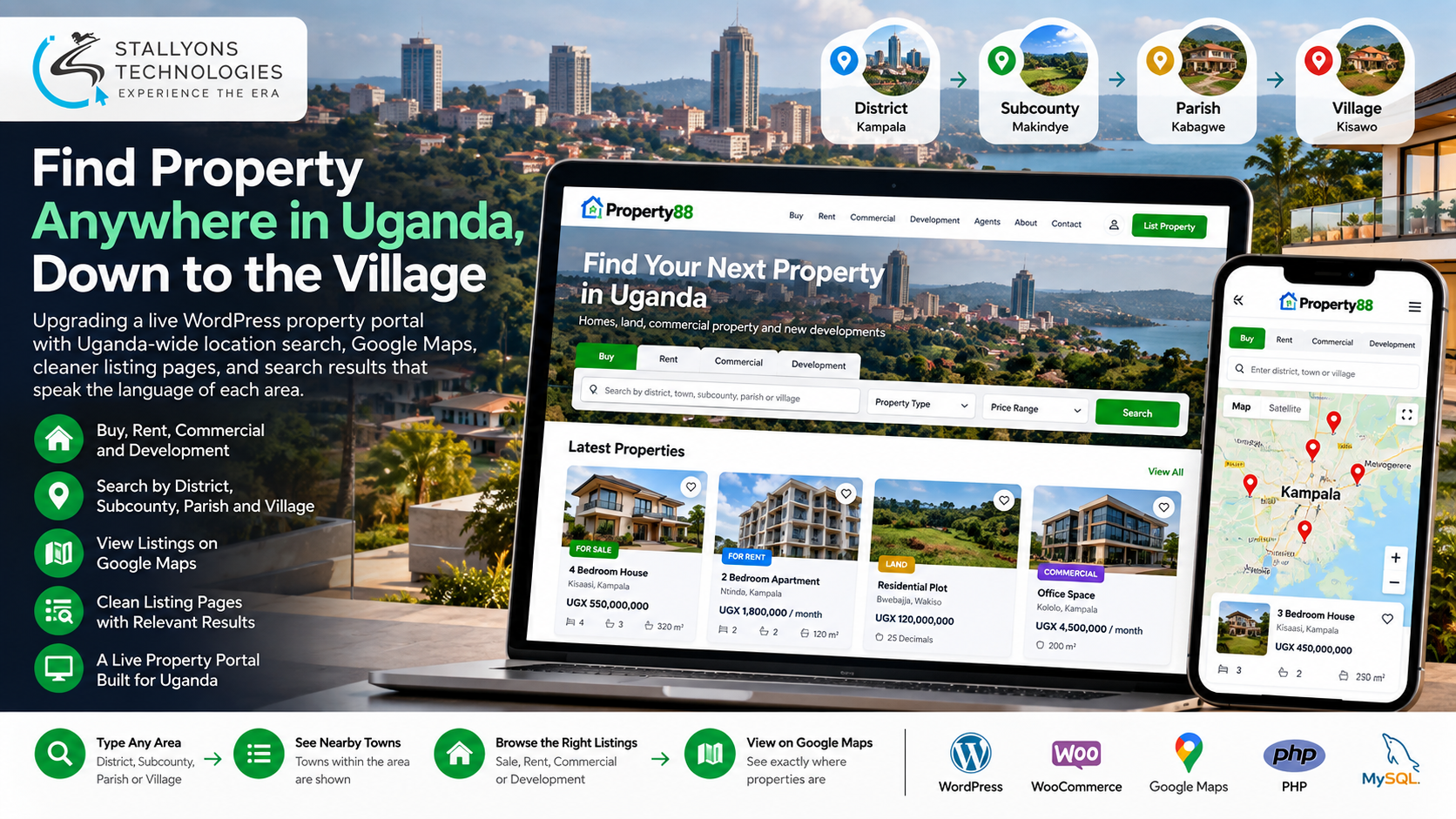
In Uganda, people do not describe where they want to live by a big city name. They name a district, a division, a parish, or a small neighbourhood. So when someone types that place into a property portal and gets nothing back, the portal has failed them, even if there are listings a street away.
That gap is what this project closed for Property88, a property portal for Uganda where buyers, renters and investors look for homes and land, commercial property and new developments, while agents and owners post listings and visitors browse them on a map. The site was already live on WordPress, but its search and maps were not built for how people actually look for property in Uganda. We upgraded the existing site around one idea: a search for an area should also return the towns and listings inside it, right down to the village.
Put simply, we taught the portal Uganda’s geography. The country’s full location structure, from districts down to subcounties, parishes and villages, was imported into the site and the map, so a search for a district also surfaces the towns within it. On top of that, listings now stay on the page for their own type, search headings name the area searched, the listing layout and sidebar were redesigned, and the separate Property page was merged into the home page. All seven requested points were built on a staging server, reviewed, and moved to the live site.
The Starting Point: Search That Did Not Know the Country
Property88 had a working site, but search and listings were holding it back. A search that only understands a few big place names misses most of what visitors are looking for, and the site was live with real traffic the whole time, so nothing could break. The main problems lined up like this:
- Search did not know Uganda’s areas. The site had no complete list of districts, subcounties, parishes and villages, so many searches returned nothing useful.
- Listings showed up in the wrong place. A commercial property could appear on the sale or rent pages, which confused visitors and made pages feel cluttered.
- Results were generic. Search results carried a generic heading instead of telling the visitor what they were looking at, such as property for sale in a named area.
- The layout felt dated. The way listings and the sidebar were displayed needed to match the cleaner, more modern portal the client had in mind.
- It was a live site with real traffic. Every change had to be made without taking the site down or breaking listings agents had already published.
The Build: A Search That Understands “Inside”
The upgraded Property88 lets visitors search the way they think. They start from the home page, which now carries the property search that used to live on a separate page, pick a listing type, and type or choose an area. Wiring the Uganda location hierarchy into custom search queries so a district also returns the towns below it is the heart of the WooCommerce development company work on this portal. A search now runs in a clear order:
- The visitor picks a listing type, Sale, Rent, Commercial or Development, and chooses an area.
- Because the site holds Uganda’s full location hierarchy, a search for a district such as Kampala, Central Division also brings up the towns inside it, for example Bukesa Industrial Area, Kagugabe and Kamwokya.
- The results page builds its heading from the type and area, so it reads as property for sale in that place rather than a generic label.
- Listings appear 20 per page in the new card layout, next to a redesigned sidebar, and the same locations show on the Google Map.
Each listing type now stays on its own page, so commercial properties appear only on the Commercial page and the same holds for Sale, Rent and Development, whether a visitor is searching or an agent is submitting. Because area-aware search and map behaviour pushes a content site toward application territory, this is closer to web application development than a simple theme edit, with real query logic behind the results.
Technical Architecture
Property88 runs on WordPress, with listings, listing types and locations stored in the site’s database and shown on Google Maps. The challenge was not adding pages. It was bringing thousands of Ugandan place names into the site as a proper hierarchy, making search understand that hierarchy, and changing how listings are filtered and shown, all on a live site.
- Uganda location taxonomy. The client’s official spreadsheet of districts, subcounties, parishes and villages was cleaned and imported as a connected parent and child structure, so every village knows which parish, subcounty and district it belongs to.
- Hierarchy-aware search. Custom WordPress queries in PHP were written so a district or division also returns listings in the towns below it, and those towns are shown to the visitor.
- Listing type rules. Search and submission were updated so Sale, Rent, Commercial and Development listings only ever appear on their own pages.
- Dynamic headings. Results pages build their heading from the listing type and the area searched, which also gives each area its own descriptive page title.
- Maps. The Google Maps JavaScript API shows listings and areas by location, using the same hierarchy as the search.
- Staging to live. Everything was built and tested on a separate staging copy, reviewed with the client, and only then moved to the live site.
The part worth engineering carefully was turning a raw spreadsheet, full of repeated and similar names, into a clean hierarchy the search could trust. Get that right and the whole country becomes searchable.
Challenges Solved
The core problem was teaching a normal search to understand “inside”. Out of the box, a search only matches the exact place typed, so the query layer was extended so a district or division includes every town below it and surfaces those towns to the visitor. That, plus a clean import of thousands of place names, is what makes a division-level search useful even when the actual listing sits in a single village.
The rest was about doing it safely. Agents were listing properties while the work was underway, so every change was built on staging, shared through a staging link and video, and moved live only once approved. Later, when the client’s live site crashed with no backup of their own, the team restored a project backup to a staging server so they could carry on. A location-aware portal like this is exactly what the real estate and property sector depends on, where a search that comes back empty is a buyer who simply leaves.
The Result
The outcome is a portal built for Uganda rather than a generic property theme. All seven requested points were delivered, reviewed on staging and moved to the live site, and the client approved the work, left a review and came back for more. A visitor can now type any area, see the towns around it, and browse the right listings for the right type on both the list and the map, with results that name the place they searched.
The upgrade worked because the location hierarchy was treated as real data, not a dropdown of a few big names. If you run a listings or portal site that needs search this precise, you can hire PHP developers who have built hierarchy-aware WordPress search, or tell us how your users search and we will map it onto a portal that finds what they mean.
Frequently Asked Questions
What does Property88’s location search do now?
It lets a visitor search by any Ugandan area and returns the towns and listings inside it. A search for a district such as Kampala, Central Division also surfaces the towns within it, and the results page names the area searched, shows 20 listings per page in a new card layout, and plots the same locations on a Google Map.
How does a district search show nearby villages?
Uganda’s official list of districts, subcounties, parishes and villages was cleaned and imported as a connected parent and child hierarchy, so every village knows which parish, subcounty and district it belongs to. Custom WordPress queries then extend a district or division search to include every town below it, and those towns are displayed to the visitor.
Are listings kept separate by type?
Yes. Sale, Rent, Commercial and Development listings each stay on their own page, both when a visitor searches and when an agent submits a listing. A commercial property no longer shows up on the sale or rent pages, which keeps each page showing only what it promises.
Was the live site affected during the work?
No. All seven requested points were built and tested on a separate staging copy, shared with the client for review by staging link and video, and only moved to the live site once approved. Agents kept listing throughout and visitors never saw half-finished features.
What technology powers the maps and search?
The site runs on WordPress, with listings and locations stored in the database and shown through the Google Maps JavaScript API. Search is handled by custom WordPress queries in PHP that understand the location hierarchy, and the work was delivered through a staging-to-live workflow.