


Blog
Delta Learning: DeepSeek
Adaptive Math App
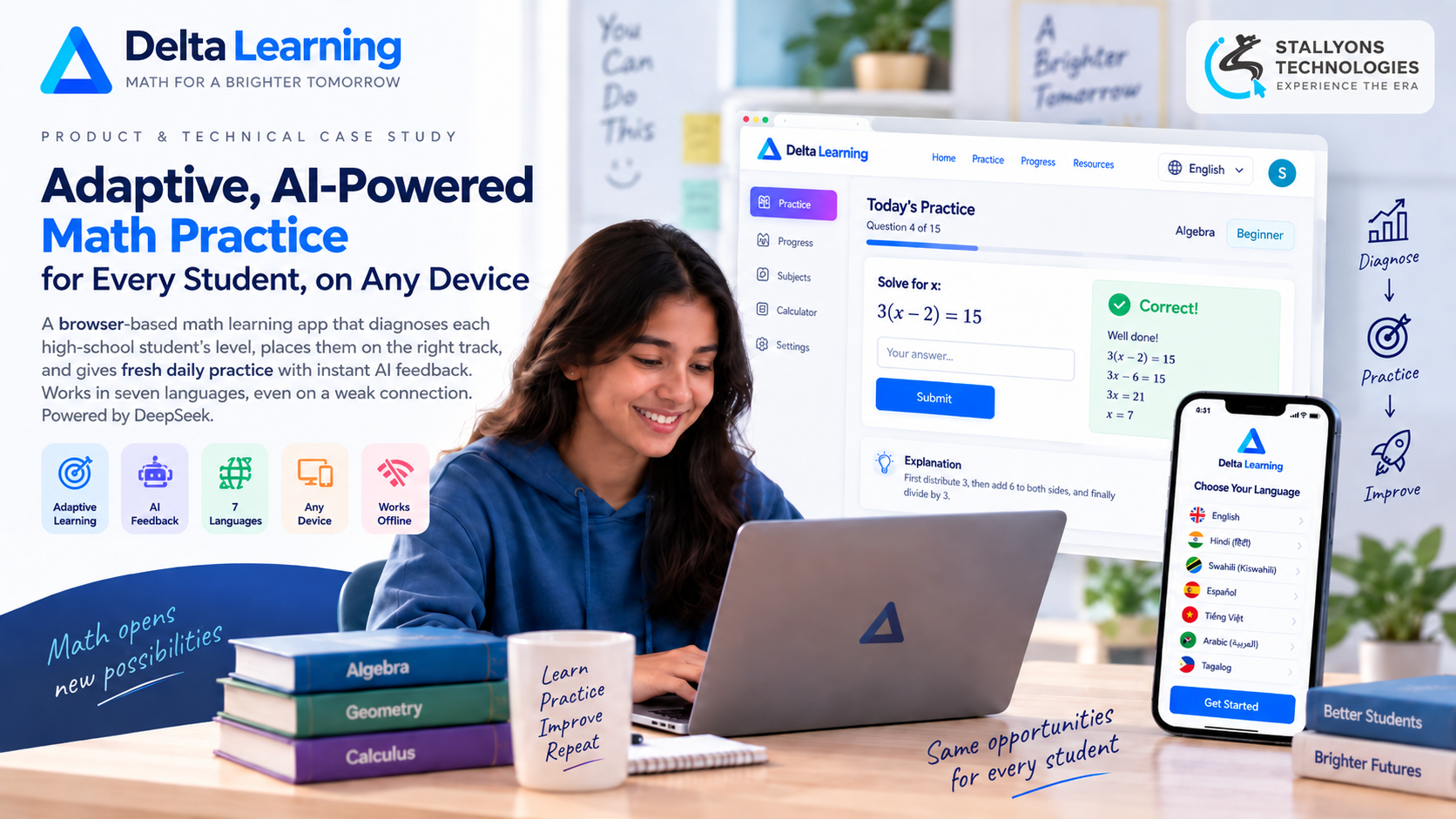
A student opens a browser on a borrowed phone, on a connection that drops every few minutes, and wants to get better at algebra. Most math tools ask for a download, a login, a fast connection, and English before they teach anything. So the student who needs practice the most is often the one who cannot reach it.
Delta Learning takes those barriers away. It is a browser-based math practice app for high-school students, built for the ones who are underserved or stuck on a weak connection. A student opens it in any browser, takes one short adaptive quiz that gets harder on correct answers and easier on wrong ones, and is placed on the right track: Algebra, Geometry, or Calculus. From then on, each day brings ten to fifteen fresh practice questions per module, each with instant feedback and a plain explanation.
Put simply, a student opens one link, answers a single placement quiz, and then gets leveled daily practice with instant AI feedback in their own language, even when the network barely works. The AI runs on the DeepSeek API: it writes the question bank, grades typed answers, explains them, and reads the quiz to diagnose each student’s level. The app is free for every student and runs in seven languages.
The Starting Point: Access First, Not Features First
For a free math app to reach students at the edge of the network, it cannot behave like an ordinary web app. That set a clear list of requirements, and almost every one of them was about access rather than about features.
- Run in any browser, with nothing to install. Plenty of students have no computer and no way to install apps, so the whole experience had to work in a browser on whatever device they already hold.
- Keep working on almost no internet. In low-connectivity areas an app that calls the network for every question is unusable, so practice had to continue when the signal drops.
- Meet each student at their real level. Students arrive knowing very different amounts, and a fixed worksheet is too hard for some and too easy for others, so the app had to find each student’s level and stay with it.
- Give feedback, not just a mark. With no teacher on hand, a wrong answer teaches nothing unless the app explains what went wrong in words a student can follow.
- Teach in the student’s own language. Math help is mostly English-only, which shuts out students who learn in Hindi, Swahili, Spanish, Vietnamese, Arabic, or Tagalog.
- Stay cheap enough to be free forever. Writing enough fresh, leveled questions by hand in many languages is slow and costly, so the content had to come from somewhere that would not price the product out of reach.
The Build: One Quiz, Then Fresh Practice Every Day
The app runs as a short first-visit quiz followed by a daily habit, not a course a student has to grind through. Generating a leveled question bank, grading typed answers, adapting difficulty, and doing all of it in seven languages on a weak connection is the substance of the DeepSeek integration services behind Delta Learning. A student’s path runs in a set order:
- The student opens the app in any browser and starts a short adaptive quiz that begins with a simple Algebra 1 question.
- The quiz climbs in difficulty on each correct answer and eases back on each miss, until DeepSeek can read the pattern of responses and diagnose the level.
- The student is placed on a track, Algebra, Geometry, or Calculus, and the matching modules are assigned. The quiz runs only once.
- Each module then serves ten to fifteen fresh questions a day, drawn at random from a stored question bank so the practice keeps changing.
- The student answers by multiple choice or by typing a short answer, and DeepSeek grades the typed ones and returns a plain explanation of why the answer was right or wrong.
- A progress bar marks each lesson complete and a daily score log records the result, so a student can watch their own improvement build up over time.
Because DeepSeek is an open-source LLM, the questions are generated once and stored, then served at random and cached in the browser, so the app stays fast and keeps working with little or no signal. Students can redo modules as often as they like, and an on-page calculator sits within reach when a problem needs one. Behind the scenes, admins create modules seeded from established banks such as CK-12 and Kuta, manage the site, and read a lightweight analytics view of users, sessions, hours learned, and countries reached.
Technical Architecture
Delta Learning is a browser app built to stay fast, cheap, and usable on a weak connection while doing real AI work behind the scenes. Each layer has one job, and together they turn a first-visit quiz into a daily practice habit that survives a dropped signal.
- React front-end. The app is a React progressive web app, so it installs nothing, runs on any device, and can keep serving practice offline.
- Laravel backend. A Laravel service handles authentication, tracks and modules, scoring, analytics, and the admin panel, with MySQL holding the question bank, students, scores, and modules.
- DeepSeek API. The DeepSeek API generates leveled questions, grades typed short answers, writes the explanations, diagnoses the level from the quiz, and helps translate the app. Tuning that written back-and-forth so grading and explanations read clearly is close natural language processing work.
- Offline cache. A service worker and IndexedDB cache questions in the browser for low-connectivity use, and scores sync back once the network returns.
- The question bank. Questions are generated once and stored, then served at random, and DeepSeek only tops the bank up when a module runs thin.
- Admin and analytics. A small admin panel manages modules and the site, and a lightweight analytics view tracks users, sessions, hours learned, and countries reached.
The part worth engineering carefully was the join between the AI engine and the stored bank, because that is where a free product either stays free or quietly stops working offline. Generating each question once and reusing it means the AI cost does not grow with every practice session, and caching the result means a student on a dead connection can still finish today’s set.
Challenges Solved
The hardest problems were the ones that usually keep a good tool away from the students who need it. Working on almost no internet was solved by generating and caching questions in the browser so practice continues offline and scores sync later. One-size-fits-all practice was solved by an adaptive quiz that finds each student’s real level and keeps daily practice leveled to them. The cost of staying free was solved by generating a reusable bank so most practice needs no live AI call. Marking free-typed answers, which is far harder than multiple choice, was solved by having DeepSeek check the answer and explain the result. And the language barrier was solved by generating and translating the app into seven languages.
The thread running through all of it is that access is the point, which is what education and edtech teams serving low-connectivity or multilingual learners need when a download, a paywall, or an English-only interface is enough to lose a student for good.
The Result
The outcome is a math app a student can open on any browser, place themselves in with a single quiz, and return to each day for fresh, leveled questions with instant feedback in their own language, whether or not the connection holds. There is no paywall and no install; the practice keeps changing; every typed answer gets an explanation; and a lean team can run and grow the platform from a small admin panel and a simple analytics view.
The build works because it was designed around access rather than around a feature list, generating a reusable question bank and caching it so a weak connection never ends a session. If you are planning something similar, you can hire generative AI developers who have built this generate-once question pipeline, or tell us what you are trying to teach and to whom and we will map it to a DeepSeek-powered app that reaches them.
Frequently Asked Questions
What is Delta Learning?
Delta Learning is a free, browser-based math practice app for high-school students, built especially for those who are underserved or on a weak connection. A student takes one adaptive quiz, is placed on an Algebra, Geometry, or Calculus track, and then gets ten to fifteen fresh practice questions per module each day with instant AI feedback, in one of seven languages.
How does DeepSeek power the app?
The DeepSeek API does the AI work: it generates the leveled question bank, grades typed short answers, writes plain-language explanations, and reads the placement quiz to diagnose each student’s level. As a DeepSeek development company we wired those jobs into a Laravel backend and a React front-end so the app stays fast and inexpensive to run.
How does it keep working with almost no internet?
Questions are generated once, stored, and cached in the browser, so a student can keep practicing on minimal or no connection. Scores are held locally and sync back to the server when the network returns, which means a dropped signal pauses nothing.
How does the app adapt to each student?
On the first visit the quiz starts simple and adjusts up or down with every answer, and DeepSeek reads that pattern to diagnose the student’s level and assign a track. The quiz runs only once; from then on the daily practice stays leveled to the student, so they are challenged without being lost.
Which languages and subjects does it cover?
It covers three math tracks, Algebra, Geometry, and Calculus, with modules seeded from established banks such as CK-12 and Kuta and expanded by AI. It runs in seven languages: English, Hindi, Swahili, Spanish, Vietnamese, Arabic, and Tagalog.