


Blog
NexaChat Case Study:
Building an HTML5 Hybrid Chat App With Real-Time Translation
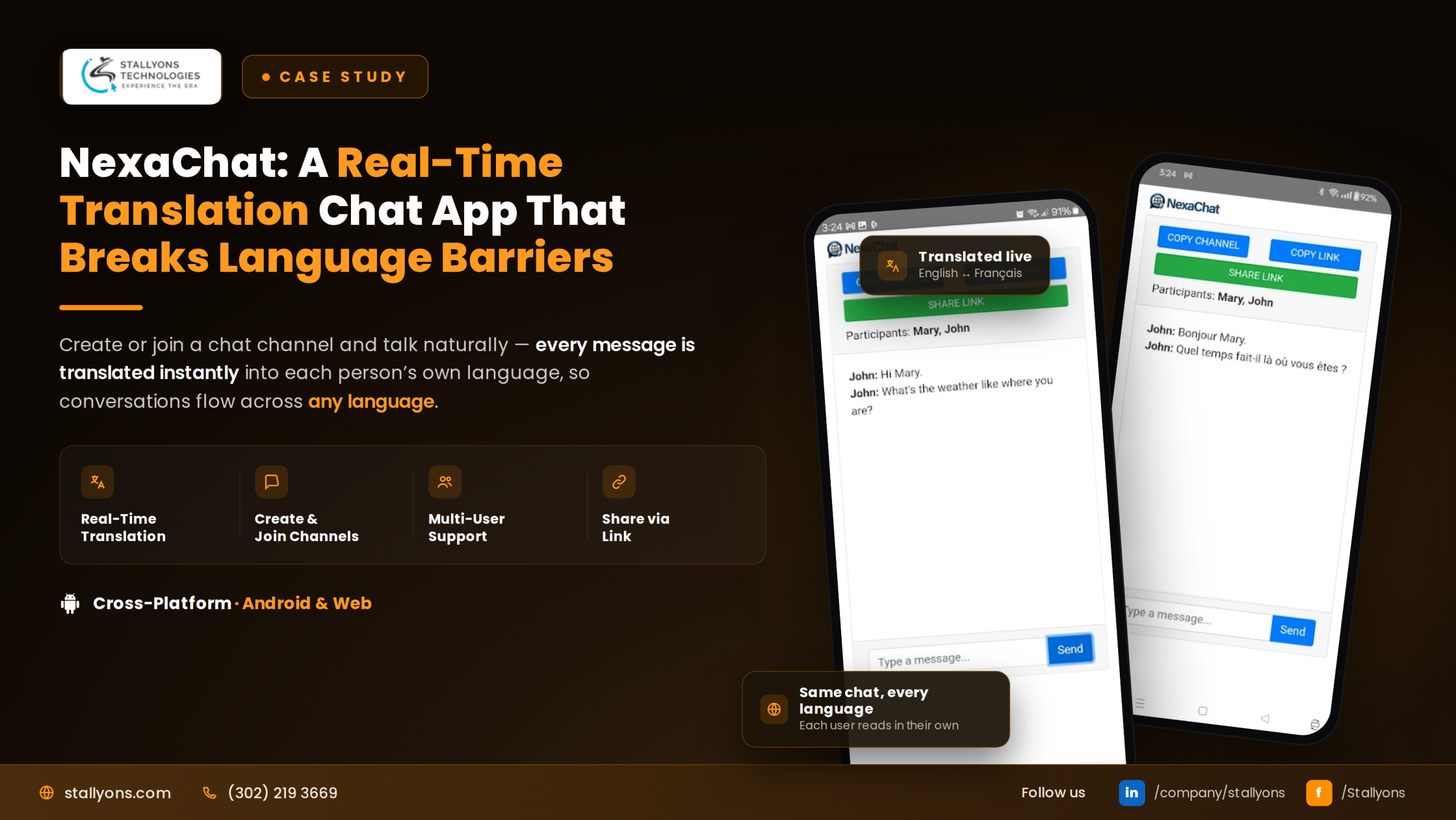
Picture a team spread across five countries, all working on the same project, yet quietly splitting into smaller groups because they do not share a language. The wider conversation slows down, ideas get missed, and people who could work brilliantly together stay silent. This is the exact problem we set out to solve when our team at Stallyons built NexaChat.
NexaChat is a real-time messaging platform that removes the language barrier completely. It looks and feels like a familiar team chat app, with channels and direct messages, but it carries one powerful difference. Every message is automatically translated into the language each person prefers. Someone can write in English, and a teammate reading in French sees the whole conversation in French, instantly. In this case study, we walk through the problem, the solution, and the HTML5 hybrid approach that made it work across both iOS and Android.
Project Snapshot
Here is the quick view for readers who like the summary first.
- Product type: A real-time messaging platform with channels and direct messages
- Platforms: iOS and Android, built as a single HTML5 hybrid app
- Standout feature: Automatic per-person translation of every message
- Backend: Real-time delivery over WebSockets, with data stored in MySQL
- Security: OAuth 2.0 login, JWT service tokens, and encrypted message transport
One shared HTML5 codebase powering two app stores, wrapped around a real-time backend, is a pattern that gives clients speed, consistency, and lower maintenance without giving up a native feel.
The Challenge: When Language Divides a Team
Teams and communities are more global than ever, but language still keeps people apart. The problems we needed to solve were clear from the start.
Language splits groups from the inside. In a community that speaks several languages, people naturally drift into smaller pockets by language, and the shared conversation suffers. Translating by hand only makes it worse, since copying messages into a separate tool and back again is slow and kills the flow of a real exchange. On top of that, most chat apps simply assume everyone reads the same language, which leaves non-speakers struggling or staying quiet. Meaning gets lost, delayed, or ignored.
There was also a trust problem to solve. People do not want messages or invites arriving from just anyone. They want to choose who reaches them before a conversation ever begins. Any solution had to respect that.
The Solution We Built
NexaChat makes language invisible. People chat exactly as they normally would, and the platform quietly translates everything so each person reads in their own language.
It begins at sign-up, where every user picks a preferred language and can change it later. From that point on, everything they read arrives in that language. When a user sends a message, it does not travel straight to the other person. First it passes through an AI translation service that detects the sender’s language, translates the text into the recipient’s language, and returns the result. The platform stores both the original and the translation, then delivers the translated version. In a channel with many members, this happens for each person, so everyone reads the same conversation in their own words.
Conversations are built on consent from the ground up. To start a direct message, the recipient must accept first. To join a channel, each invited person must approve the invite before being added. Users can be invited by username if they already have an account, or by email if they are new, in which case accepting the invite creates their account.
Translation That Just Happens
The heart of NexaChat is automatic translation that no one has to ask for. A user never leaves the app or presses a translate button. They write in their language, and everyone else reads in theirs. This invisible translation is what turns a group of different speakers into a single, flowing conversation, and it is the reason people choose the platform.
Everyone Reads in Their Own Language
In a channel where members speak several languages, NexaChat translates each message for each person. One member sees the chat in Spanish, another in French, another in English, all from the same messages. This per-user translation is far harder to build than a single shared translation, and it is what makes the platform genuinely work for mixed groups.
The HTML5 Development Approach
Here is where the engineering choices come together. NexaChat was built as an HTML5 hybrid app for both iOS and Android, sharing one web-based codebase wrapped for each app store. That single codebase handled the multi-language display, the messaging interface, and push notifications across both platforms.
We chose this route deliberately. A hybrid HTML5 build let us ship to iOS and Android from one code source, which meant faster delivery, consistent behavior on both platforms, and simpler long-term maintenance. This is the core of our HTML5 hybrid app development: a modern web-based front end that behaves like a native app while cutting the cost and time of building two separate products. It is the same philosophy behind another HTML5 project we delivered, where an HTML5 interface sat over a native sensing core.
The stack is chosen for real-time work. The single HTML5 hybrid codebase, wrapped for iOS and Android, carries the multi-language display, the messaging interface, and push notifications, while WebSocket messaging delivers every message and its translations the instant they are sent. The translation itself runs through an AI translation integration that detects each sender’s language and renders the message in the reader’s, with MySQL storing users, channels, memberships, and messages. Logins use OAuth 2.0 with JWT service tokens for Google, Apple, or custom sign-in, and every message is carried over encrypted transport with strict input validation.
Solving Real-Time Delivery and Privacy
Adding a translation step could easily have made messages feel slow, so we built the translation directly into the message pipeline and delivered everything over WebSockets. The result is a conversation that still feels instant, even though every message is translated on its way through.
Privacy needed the same care. Because messages pass through an external translation service, we encrypt them in transit, store them securely, and make sure the data sent for translation does not carry sensitive personal details. The platform also keeps a faithful two-language record, storing both the original and the translated text, so there is always a true account of exactly what each person wrote. When a message is edited, the translation is refreshed automatically.
The honest limit of leaning on an outside translation service is that a conversation is only ever as good as the translation behind it. An idiom, a name, or a piece of jargon can shift on the way through, and because the platform deliberately holds sensitive personal details back from the translator, some context is dropped by design rather than by accident. That is why NexaChat keeps both the original and the translated text: when a phrase lands oddly, the true words are still one tap away, and the reader is never left trusting a machine blindly.
Real-World Use Cases
The value shows in who NexaChat serves. Here are a few situations where it changes how people work and connect.
- A global company runs a single team channel where every member reads updates in their own language.
- A support community welcomes users from different countries without forcing a shared language.
- Two people who speak nothing in common hold a direct conversation, each reading in their own words.
- An organization keeps an accurate two-language record of important discussions for clarity and trust.
By pairing automatic translation with consent-based invites, NexaChat fits both open communities and private teams that care about who can reach them.
The Results
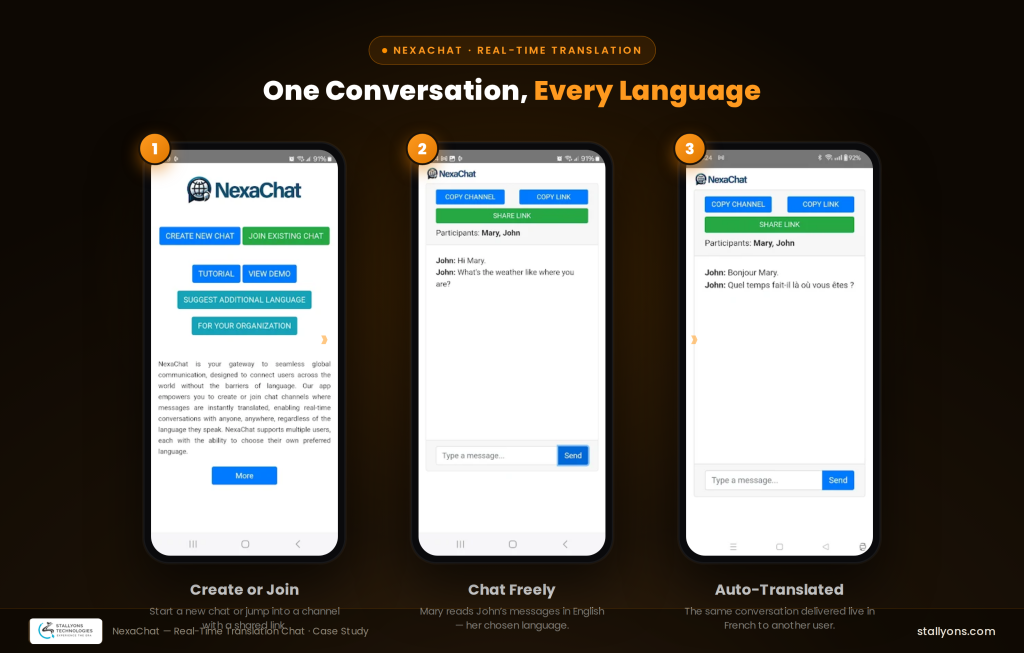
The finished product is a real-time, translation-first messaging platform delivered as an HTML5 hybrid app for iOS and Android, running on a WebSocket backend with MySQL. People chat in channels and direct messages just as they would in any team app, but every message is translated automatically into each person’s preferred language, so language is never in the way. Logins use OAuth, messages are protected in transit, and every input is validated and kept clean.
For the client, the outcome was a distinctive, secure product that solves a problem most chat apps ignore entirely. For us, it is a clear example of what a well-planned HTML5 hybrid build can achieve: one codebase, two platforms, and a genuinely hard feature delivered in real time.
NexaChat is live and available to the public today. You can see the finished product on the NexaChat listing on Google Play, where it continues to connect people across languages.
Why Work With an Experienced HTML5 App Development Team
A project like NexaChat shows what becomes possible when a hybrid app is planned properly from the first line of code. The craft is in the wiring: a front end that ships to both app stores from one codebase, then connects to real-time backends and third-party services without losing speed or reliability.
If you are planning a cross-platform app, a real-time messaging product, or any hybrid build that has to feel native on both iOS and Android, that same approach can shape your project from day one.
Ready to Build Your Own HTML5 Hybrid App?
Great products start with the right technical foundation. If you want a partner who can turn one HTML5 codebase into a polished app on both platforms, we would love to help. Explore our HTML5 hybrid app engineering, then book a discovery call and tell us what you are building.
Frequently Asked Questions
What is an HTML5 hybrid app?
An HTML5 hybrid app is built using web technologies like HTML5, CSS, and JavaScript, then wrapped so it can run as a native app on iOS and Android. It combines the speed of web development with access to native features and both app stores.
Why choose HTML5 hybrid development for a mobile app?
Hybrid development lets a team build one codebase that runs on multiple platforms. This usually means faster delivery, lower cost, and easier maintenance than building separate native apps for iOS and Android.
Can an HTML5 hybrid app handle real-time features like chat?
Yes. As NexaChat shows, an HTML5 hybrid app can deliver real-time messaging over WebSockets, along with live translation and push notifications, while still feeling instant to the user.
Is a hybrid app secure enough for private messaging?
A well-built hybrid app can be very secure. NexaChat uses OAuth 2.0 for login, JWT tokens between services, encrypted message transport, and strict input validation to protect users and their conversations.