


Blog
AppyStay Case Study:
A Native Android App That Gets Hostel Guests to Actually Meet
Picture the common room of a busy hostel on a Tuesday night. Six travelers are sitting within arm’s reach of each other. Every one of them came here, at least partly, to meet people. And every one of them is looking down at a phone, scrolling alone. Someone in that room wants to split a taxi to the beach tomorrow. Someone else has been meaning to find a dinner group. A third would join a bar crawl in a heartbeat. None of them will say a word to the others tonight.
That quiet room is the problem AppyStay was built to solve. It’s a social app for hostels and similar properties, a piece of travel and hospitality software whose whole reason for existing is to turn “people who happen to be in the same building” into “people who actually meet, plan, and explore together.” This is the story of how it came together, what made it genuinely hard, and the engineering decisions behind it, told from the inside of the build.
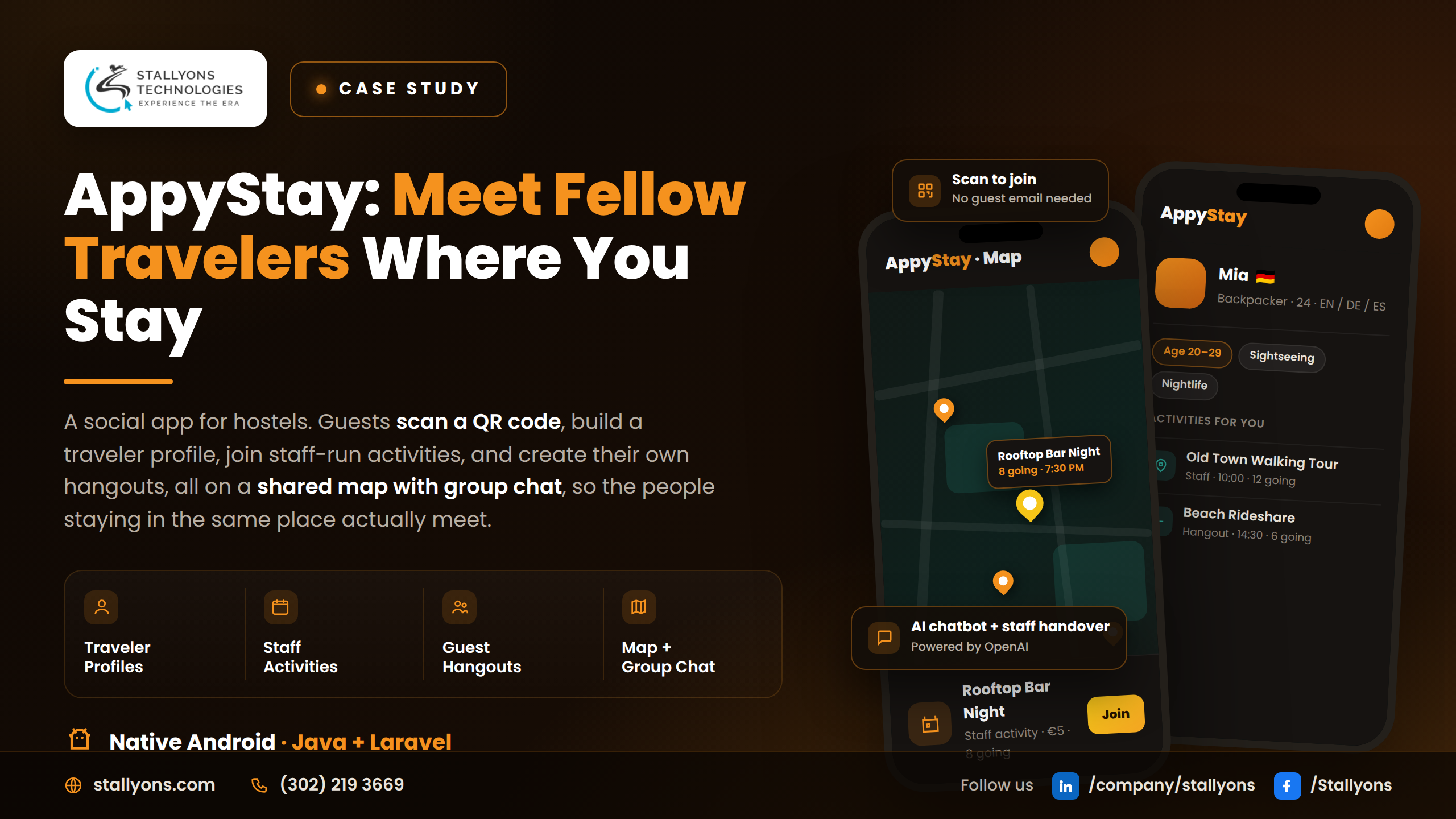
Put simply, guests at a property build a traveler profile, join staff-run activities, and create their own hangouts, all on a shared map with group chat, so the people staying in the same place finally meet.
The Problem Was Never “No App.” It Was Two Broken Connections.
It’s tempting to think hostels just need a group chat. They don’t, and here’s why. When you look closely, there are actually two separate gaps, and any real solution has to close both at once.
The first gap is between guests. People staying in the same hostel often want company, for a meal, a trip, or a night out, but there’s no natural, low-friction way to find each other. Walking up to a stranger is awkward. Swapping numbers leads to a mess of scattered WhatsApp groups that nobody can keep track of. And a random mix of strangers doesn’t always click: a group works best when the people in it roughly fit by age and interest, and there’s no easy way to arrange that by hand.
The second gap is quieter but, commercially, it’s the killer: hostels usually can’t even reach their own guests. Most bookings arrive through platforms like Booking.com, which never hand the property the guest’s email address. So the staff have people sleeping under their roof that they have no direct line to. They can pin a walking tour to a corkboard and hope somebody notices. Filling that tour, taking sign-ups, and managing spots is all manual guesswork. On top of that, just knowing who is currently checked in, and clearing them out when they leave, is fiddly to track.
So the brief wasn’t “make a chat app.” It was: give guests a natural way to meet the right people, and give the property a reliable line to every guest, from a starting point where you don’t even have their email. That constraint shaped everything that followed.
The Insight: Build the Whole App Around the One Reliable Moment of Contact
If a hostel never gets a guest’s email, when can it reliably connect with them? The answer is disarmingly simple: when the guest is physically standing at the property. That single moment, check-in, the front desk, the wall of the common room, is the one dependable point of contact. So we made it the front door of the entire product.
A guest joins AppyStay by scanning a QR code or following a link at the property, then following the hostel. That’s it. From that one scan, everything else unlocks: their profile, the activities, the map, the chat, the whole social layer. It sounds small, but it’s the hinge the whole app swings on. It converts the property’s only guaranteed moment of contact into the way every single guest onboards.
The honest flip side of hanging everything on that one scan is that it is also a single point of failure. A guest who walks past the QR code, or never follows the link at check-in, is exactly as unreachable as before: no profile, no activities, no chat, and still no email for the property to fall back on. The scan solves the reach problem completely for the guests who take it and not at all for the ones who miss it, which is why placing and prompting that code well matters as much as any feature in the app.
From there, signup is quick, with the accounts travelers already carry: email, Google, or Apple. Then they build a traveler profile, and this is where the “meet the right people” part starts working.
The Guest Experience: A Profile That Does Real Work
The traveler profile isn’t decoration. Every field earns its place by making better meetups more likely. A guest sets their name and username, their nationality (shown with a flag, so it’s easy to spot someone from home or somewhere far away), their travel style and interests, the languages they speak, a short intro, and a photo to break the ice. Their age drops them into a group, and that group quietly shapes everything they see next.
Once they’re in, the guest sees activities matched to their group and interests. They can request to join, see who else is going and how many, and comment to ask a question or just share the excitement. And all of it lives on a Google Map, with each activity showing its type, its location, and its headcount, so there’s always something to do nearby, visible at a glance.
Hangouts: The Feature That Keeps the App Alive Between Events
Here’s a trap most “events” apps fall into: staff can’t run something every hour, so the calendar has dead patches, the app feels empty, and people stop opening it. AppyStay’s answer is hangouts, the guest-created side of the app.
While staff run the official, higher-quality activities, guests fill the gaps with their own plans. A guest creates a hangout with a title, a short description, and a type, a party, a rideshare, a sightseeing trip, a bar or restaurant visit, and each type gets its own pin on the map. They drop a location, choose an age range for who can join (say, 20 to 35), and set it public (anyone can join) or private (join on request). The moment someone joins, they’re in the hangout’s group chat, so the plan comes together in one place instead of scattering across five apps.
The clever bit is the balance: staff set the quality bar with their activities, and guests keep the calendar full with hangouts. Between the two, there’s always something happening, which is exactly what keeps a community app from going quiet.
The Admin Side: Running a Property From One Panel
Everything the property needs runs from a responsive web admin panel that works on mobile, tablet, or desktop, so staff aren’t chained to a back-office computer.
From that one panel, staff add guests and send the join link or QR, review and approve join requests, and create activities with the full set of details: name, description, meeting point, date and time, price, type, guest limit, and photos, marked either open to all or on request. They link activities to groups by age and interest so the right people see them, and they moderate hangouts and comments to keep things healthy. They also manage each guest’s stay, including check-in and check-out times.
That last part hides a neat piece of logic. When a guest’s check-out time arrives, the app automatically disconnects them from the property, while keeping a history of every place they’ve stayed. The property’s “who is here right now” list stays accurate on its own, no manual clean-up, and the guest keeps a growing travel record.
The Chatbot That Knows When to Step Back
Tie it all together with chat. A guest can message the staff directly, but staff can’t answer every question at once, and travelers ask the same handful of things constantly. So an AI chatbot with human handover, powered by the OpenAI API, handles the common questions first, instantly, day or night. When it hits something it can’t answer, it doesn’t bluff; it hands the conversation to a real staff member. Staff can even tune how it behaves by editing its training prompt.
That blend is deliberate. A bot that insists on answering everything frustrates people. A pure human queue doesn’t scale. Putting the bot up front for the easy 80% and a human behind it for the rest gives guests fast answers without losing the human touch, and gives staff their time back.
The Technical Architecture
AppyStay is a native Android app built in Java, backed by a Laravel (PHP) API that also powers the web admin panel. The app carries the guest experience; the backend handles accounts, activities, hangouts, chat, and all the property logic. Going native on Android mattered here: the map interactions, the smooth activity and profile flows, and the real-time feel of group chat are exactly the places where a native build pays off in responsiveness. This kind of end-to-end product, a polished native client plus a secure backend and admin, is precisely what strong native Android app development delivers as one coherent system rather than stitched-together parts.
Here’s how the stack lines up and why each piece is there:
A few subsystems are worth calling out because they carry the product:
The QR and link onboarding is the front door, the mechanism that lets the property reach guests it has no email for. The group and matching engine places each guest in an age group and filters activities and hangouts by group and interest, so people see what fits them. The activities and hangouts system stores both staff events and guest plans with their join rules and members, and drops both onto the Google Map with type-based pins. The chat with AI handover answers first via OpenAI, then routes to staff, while hangouts and activities carry their own group chats. And the property and stay logic ties each guest to a property with check-in and check-out times, disconnecting them automatically at check-out and preserving their history.
What Makes It Defensible
Four choices lift AppyStay above “a noticeboard plus a group chat.”
It solves the reach problem first. By building onboarding around the QR-at-the-property moment, the app cracks the one thing hostels genuinely can’t do today: connect with guests whose email they never receive. Everything else is built on that foundation.
It runs on two engines, not one. Staff activities bring quality; guest hangouts bring volume. Both live on a single map, so the app stays lively even when staff are busy, and a guest always sees something to do nearby.
It groups people who actually fit. Matching by age and interest makes meetups feel natural instead of random, and a natural-feeling meetup is one people actually show up to.
It automates the boring 80% without dropping the human 20%. The chatbot saves staff time on repeat questions; the human handover keeps guests looked after when it counts.
The Challenges We Had to Solve
Reaching guests with no email was the headline problem, and QR/link onboarding at the property was the answer, turning the one reliable moment of contact into the way everyone joins.
Keeping the app lively was the second: staff can’t run events around the clock, so guest hangouts were introduced to keep something always happening between official activities.
Making meetups feel right was the third: a random crowd doesn’t always click, so grouping by age and interest, with an age filter on hangouts that can be eased in as the community grows, brings the right people together.
And balancing the bot and the staff was the fourth: the chatbot fields the common questions while a human takes over the moment it’s stuck, so speed and care coexist.
Scope: A Focused MVP With a Clear Path to Scale
This first version is deliberately an MVP: one property, two roles (admin and guest). Keeping the scope tight got a genuinely useful app into travelers’ hands quickly, on a base that’s built to grow.
The platform is architected so the obvious next steps slot in without a rebuild: one admin managing several properties, activities that can be created once and shared across chosen properties, and a dedicated staff panel alongside the admin. The MVP stays focused while leaving every one of those doors open.
The Result
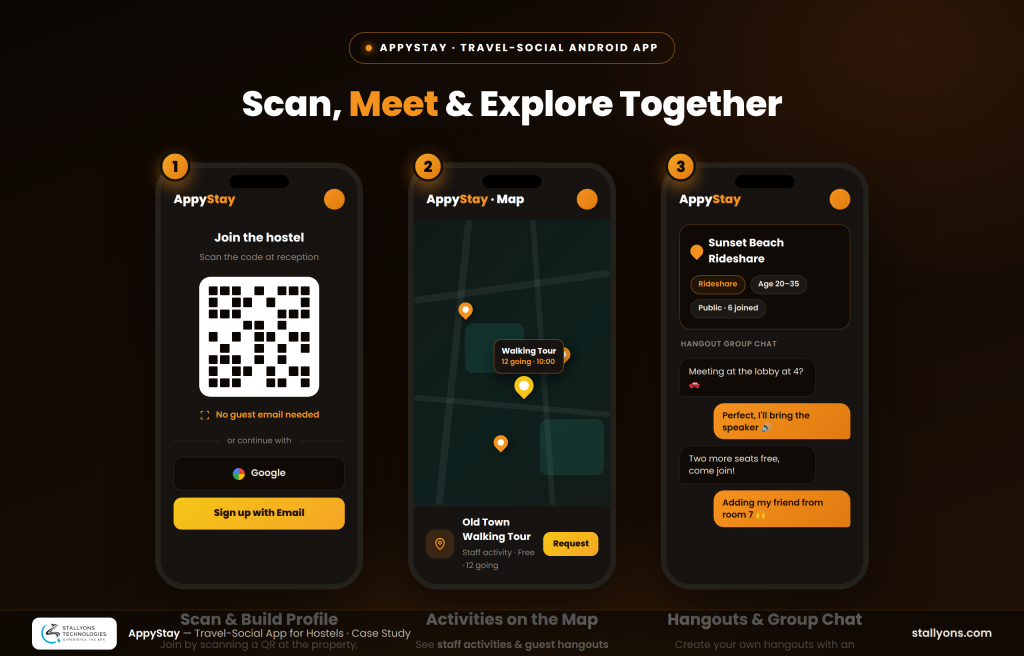
What shipped is a social platform for properties, delivered as a native Android app in Java with a responsive Laravel admin panel. Guests join by scanning a code at the property, build a traveler profile, and connect with the people staying alongside them. They join staff-run activities, create their own hangouts, see everything on a Google Map, and chat in groups and with staff. The property runs it all from one panel, adding guests, creating and moderating activities, approving requests, training the AI chatbot, and handling each stay with automatic check-out.
Put together, AppyStay closes both gaps at once: the social gap between travelers and the reach gap for the property. The people who would have passed each other in that quiet common room now meet, plan, and explore together, and the hostel finally has a direct line to every guest, starting from a scan.
Thinking About Building Something Like This?
AppyStay is a good example of what a focused native Android build can do when the product idea and the engineering are designed together: a smooth native client, a secure Laravel backend, Google Maps, third-party auth, an OpenAI-powered assistant, and a real admin panel, all shipped as one coherent system. If you have an app idea that lives or dies on that kind of end-to-end execution, our Android app development company covers the whole journey, from scoping the MVP to shipping to the Play Store and growing it afterward. You can also hire Android developers to work alongside your own team, and for a related marketplace build see our NestHappy home-services marketplace. When you want to talk it through, book a discovery call.
Frequently Asked Questions
Do you build native Android apps or cross-platform?
Both, depending on what the product needs. AppyStay was built native in Java for Android because the map, chat, and profile interactions benefit most from a native client. For other products, a cross-platform approach can be the better fit, and we’ll recommend based on your goals, not a default.
Can you handle the backend and admin panel too, not just the app?
Yes. AppyStay’s backend and responsive admin panel were built in Laravel alongside the Android app, so accounts, activities, moderation, the chatbot, and property logic all live in one coherent system rather than being pieced together from separate vendors.
Can you integrate Google Maps, social login, and AI like OpenAI?
Yes, all three ship in AppyStay: Google Maps for the activity and hangout map, email/Google/Apple sign-in, and an OpenAI-powered chatbot with a human handover. Third-party integrations like these are a routine part of a modern Android build.
How do you keep costs sensible for a first version?
By scoping a tight MVP that proves the core idea, here, one property and two roles, on an architecture that can extend to multiple properties later without a rebuild. You launch sooner, learn from real users, and invest in the next stage with evidence.
Can an app like this scale to many locations later?
Yes. AppyStay was intentionally architected so multi-property management, cross-property activities, and a dedicated staff panel can be added as later stages without re-doing the foundation.